Years ago, John Loftus shared his groundbreaking idea, the Outsider Test for Faith. The Outsider Test for Faith asks religious people to consider their own religion as if they were outsiders to it—in effect, testing it the same way they would all those others that they already think are untrue and invalid. Today, Christians still reject that potent lesson. I see why, too. Today, let me share Loftus’ idea with you, and let’s see why Christians bristle so much at the idea that their religion would fail if it were tested in the same ways they test other religions.
(This post first went live on Patreon on 8/25/2026. Please support my work—see the end of this writeup for options, and thank you for whatever you decide to do! I’m really hoping to get back to voicecasts next week. Thank you for your patience. I love doing them so this has been an extra-miserable past month.)
SITUATION REPORT: But but but where do atheists get their morality from?
The other day, I caught sight of a Christian on Threads asking atheists where they get their morality from, if not from the Bible. Her implication was exactly the same as for all those other Christians who were “just asking questions” with wide, kittenish, earnest eyes: She thinks Christianity teaches morality, so anyone who has a sense of morality must have gotten it from Christianity. Otherwise, they don’t have one.
More than that, of course, she can’t support any of her own claims with reality-based evidence. That particularly includes the existence of Yahweh, as well as his followers being the only humans on Earth to possess a sense of morality. In that way, “just asking questions” is a tactic that helps her avoid her burden of proof and shift it onto others.
(Related: Tim Keller JAQs off. I honestly don’t know why so many people think Tim Keller was a “nice” evangelical. He wasn’t.)
I wish I’d screencapped the conversation, but it flitted past and was gone in an instant. But it’s not like we can’t find numerous other Christians either asking the same “just asking questions” question or outright asserting that atheists physically can’t have a sense of morality. Here are a bunch doing exactly that on Threads, gathered earlier today:
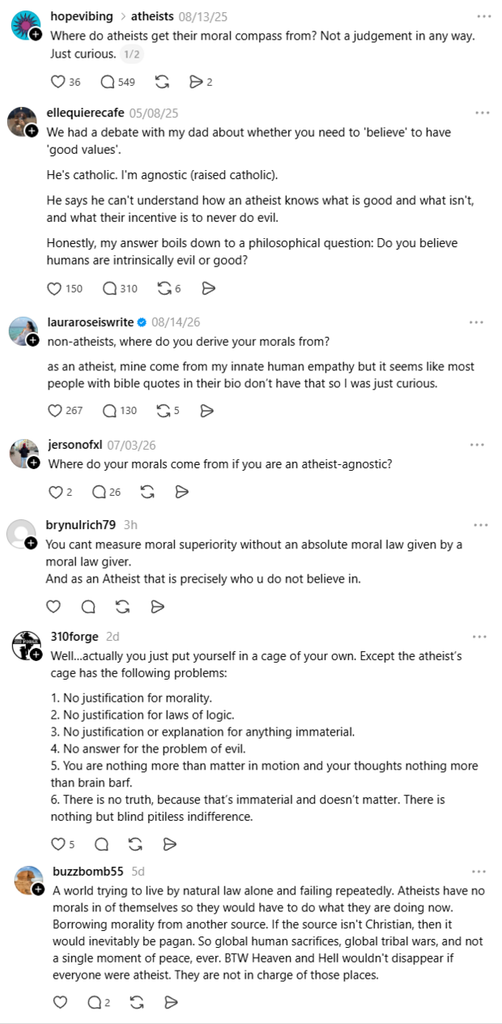
This entire situation got me thinking about John Loftus’ Outsider Test for Faith. The test is simple: Hold all religions to the same exact standards. If a religious person rejects the worship of, say, the Greek pantheon for a particular reason, then they should also apply that reason to their own religion. Christians overwhelmingly hold their religion as the default for everything, as these Christians in the screencaps do. So they consider everything only in terms of that default. They can’t move away from it.
What I’m talking about here is the context needed to maintain faith. The moment Christianity becomes just one more religion on a long shelf of countless other religions, it loses its special-pleading context. When it does, its shortcomings become glaringly obvious. And that’s one thing Christians cannot allow.
The Outsider Test for Faith is like the null position in science
In 2010, John Loftus wrote about his Outsider Test for Faith as a remedy for confirmation bias:
Speaking specifically about religious faiths, let me contrast this with The Outsider Test for Faith (OTF) which calls upon believers to test their own geographically inherited faith with the same level of skepticism they use to test the religious faiths they reject.
He doesn’t say so, but he’s basically outlining the need for the scientific method. The scientific method was devised as a way to eliminate the risk of confirmation bias from our explanations for the natural world. That’s because confirmation bias is such a powerful force in human minds that if we don’t specifically seek to eliminate it, it will taint our models and explanations—and keep us from finding out what’s really happening.
Confirmation bias is our tendency to seek out and accept only explanations that already fit into our beliefs and worldview. The more deeply we believe, the more dear our worldview is to us, the more likely we are to fall prey to confirmation bias. And everyone does it. Even the most rational people do it, unless they take great pains to prevent it from happening.
In the science world, the scientific method is the great pain taken to prevent confirmation bias. Ideally, researchers test their ideas from the null position, which means they shouldn’t have an opinion at all either way about what happens. Obviously, this ideal isn’t universally done. But when researchers lapse in their test designs, others correct these errors in time. (The scientific method also calls for reproducibility, among other safeguards against confirmation bias. This principle alone has corrected a number of interesting errors.)
Using the null position as our guide, false explanations get winnowed out like chaff, leaving the true ones behind. That’s how we moved from explanations like the various Aether theories to special relativity, and from medieval disease theories like humors and miasma to germ theory and other medical breakthroughs.
The Outsider Test for Faith functions a lot like the null position of science. It asks us to consider all religions on their own merits, without our own worldview potentially getting in the way. In that light, atheism itself is a null position for most atheists. It’s the position of no position.
And oh boy, Christians bristle at the notion of evaluating their own religion exactly as they do others! Indeed, their frequent criticisms of the Outsider Test for Faith center around treating atheism itself as a position, rather than recognizing it as the null position. Atheism is the conclusion best supported by evidence, much like the Theory of Evolution is. If Christians don’t like that, they can pony up. But good luck there: Nobody’s managed the trick yet in 2000 years. That’s why they fight so hard against tools like the Outsider Test for Faith in the first place.
In the wild: Christians judge other religions by standards that Christianity itself fails
When we look at Christians’ critiques of other religions, like Islam, we find them almost universally using their own faith as the default. A Catholic, Joe Heschmeyer, wrote a post last September that he described as “the ONLY response to Islam you’ll ever need” (emphasis in original, as always). It consisted entirely of comparing Islam to Christian interpretations of the Bible. We find this same approach echoed in a post at Christ on Campus. And in a post at Shepherds Theological Seminary.
Decades ago, I saw exactly that strategy of dismissal in Larson’s Book of Cults. That link goes to the updated 1989 version, but mine was the original red book 1982 version. Even as a firm Pentecostal way back in the early 90s, I noticed that Bob Larson’s main objection to a lot of the religions he described was simply that they weren’t Christian! Outside of that standard, he didn’t have anything bad to say about many of them. As you can likely guess, I could neither ignore or forget that fact. Once I noticed it, I couldn’t un-notice it.
So once we move outside of Christianity as the standard for judgment, we can find a few Christians making other objections. Unfortunately, all of these objections apply to their own religion.
One Christian, Jeff Barlatier, suggests that Islam’s origin story marks it as untrue because Mohammed doubted his revelation at first. Well, so did Moses at first. Barlatier claims that Moses’ doubt centered on his own inadequacies, while Mohammed’s concerned exactly who was sending the vision. Such a distinction is just splitting hairs, particularly as Barlatier goes on to claim that not one prophet in the Bible questioned the source of divine revelation. Even without such a weirdly hyper-specific claim, it’s not even true on its own merits. Samuel sure didn’t know who was talking to him at first in 1 Samuel 3.
Plenty of other Bible characters questioned their own encounters as well, like Gideon in Judges 6! So did Samson’s parents in Judges 13. And Moses himself asked Yahweh in Exodus 4:1 to give him something more tangible than just a voice instruction so he could convince his people of his vision.
Another Medium piece, this one by Dismantling Islam, criticizes the religion’s holy book. This time around, the writer claims that the Quran isn’t trustworthy because nobody can trust that the edition of the Quran that exists today is the original one. It’s a common criticism. Unfortunately for these Christians, out of about 20,000 to 25,000 early-to-medieval scraps we have of the New Testament, no two are identical. And as Bart Ehrman points out, some differ on very key points.
Additionally, Dismantling Islam takes serious objection to several contradictory passages in the Quran. I hate to be the bearer of difficult tidings, but the Bible’s got hundreds of those too. Someone even made an interactive infographic linking them. Here are the ones they’ve found just on the topic of whether or not Yahweh lies. We talked about that very question recently!
It’s always surreal to run across a Christian who spends a ton of time debunking something, but then refuses to apply the same standards to their own faith. That excellent “Ancient Aliens” debunk was made by a Christian like that!
I could go on and on, but you get the point. Christians reject Islam, and all other religions really, according to standards their own faith could never meet.
Christianity as the default is a context-dependent worldview
That’s why the Outsider Test for Faith is so important. It strips away Christianity as the default worldview. When that worldview stops being the default, Christians lose the context of their faith. And that’s the real danger in the test, for them.
Often, ex-Christians compare Christianity to the folktale of the Emperor’s New Clothes. In this Hans Christian Andersen story, the vain Emperor wants to wear the finest clothes imaginable. His tailors can’t meet his demand, so they present him with fake, nonexistent clothes. They claim that superior people can see the cloth and clothing, while inferior ones won’t be able to see it. Well, the emperor sees nothing there, but he doesn’t want to admit such a thing! So he “wears” the invisible outfit and parades around his city in his birthday suit. The people watching largely fall in with the illusion, applauding his finery. Only a small child calls out the truth: The Emperor is naked! He’s not wearing anything at all! And his voice breaks the illusion.
For ex-Christians, the comparison means we noticed that the illusion of divine action and revelation depend mightily on the buy-in of all observers. The moment someone refuses to cooperate with the illusion, it begins to fragment. The context starts dissolving.
I remember when I lost context that way: While praying with the PRAYER WARRIORS FOR JESUS campus group my Evil Ex Biff started. That little conference room ripped away the necessary context for prayer to feel divine. It was a distinctly secular space repurposed for deeply religious activity. And as such, suddenly I realized that I was just talking to myself. I wasn’t communing with a god. Similarly, my Evil Ex and James weren’t speaking in tongues and fighting demons on a metaphysical battleground, they were baby-babbling and stomping around shouting in nonsense and swinging their arms like little kids pretending to be Space Marines. They looked ridiculous. And so did I.
That situation was part of the beginning of the end of my time as a Christian. Shortly afterward, I spotted a letter to the editor of the campus newspaper whose writer complained about her student activity fees funding groups she absolutely did not support. I’ll give you three tries to guess which specific group she named as an example. The first two don’t count. Seeing that letter, I was mind-blown. It was the first time I realized that not everybody was supportive of Christianity, particularly not the end of it that I inhabited. That realization forced me to see my religion separately from my own faith in it, to see how others perceived it.
No wonder I ended up deconverting.
Just one more religion in a long line of religions, with a birth in the past and a death one day
Once Christians realize that Christianity is just like every other religion humans have dreamt up, that it has a birthday in the past and a death in its future just like every other religion ever created, the end of faith is near. Christianity only survives as long as its adherents consider it unique among all religions and judge everything else by it.
But who even knows how many religions humans have dreamt up? It must number in the many tens of thousands, if not more. From little tribal godlings to regional city-state protectors to big huge national ones to international behemoths in recent centuries, we’ve probably forgotten many times more gods than even exist today. We’ve been recognizably human for about 300k years, and recognizable signs of spirituality begin appearing in the archaeological record in the form of intentional burials about 100k years ago (if not way earlier in Neanderthal sites).
In all that time, we only have bare, outsider-written descriptions of some religions, like whatever the Druids of Ireland practiced. And we have absolutely nothing of most others.
Every religion’s adherents think their gods are real to some extent. They all claim miracles and divine revelations. They all have a creation story, and most feature some kind of afterlife. Many of them boast resurrected gods, and mystery religions abounded in talk of forgiveness of sins and the need for perfect beliefs.
More to the point, almost all of them offer lists of behavioral rules that function as “morality,” a concept that seems to predate religion and even humanity itself. One famous experiment involves monkeys being paid unfairly for tasks to test their concept of fairness, which is one of the pillars of morality. The reaction of one such unfairly-paid monkey is hilarious:
As well, religions have a distinct history as well as a lifespan. They never just pop out of the clear blue sky like Athena from Zeus’ brow. For Christianity in particular, the evolution of doctrines like Hell, an omnimax single god, and the Trinity can be traced from pre-Christian religious thought to the modern day. (We did the math on Hell.)
That lifespan means Christianity has a built-in expiration date, even if we don’t know what it is quite yet. This religion supplanted the previous popular religions of its day, and one day something more popular will supplant it. No religion lasts forever, though a few gods in the past lasted much longer than Christianity. (Examples: Anu at 3k+ years and Dagon at about 2500.) In the modern day, a couple of religions are already older than classical Judaism, like Hinduism (1500 BCE) and Zoroastrianism (1500-1000 BCE), while Jainism and Buddhism predate Christianity (around 600-500 BCE).
Uniqueness as a claim in and of itself, as part of context, as part of why Christians are threatened by the Outsider Test for Faith
I don’t think Christians like the idea of their religion being like all other religions. I can’t blame them for disliking the notion. Their claims of uniqueness are central to why they hold their faith in the first place. Those claims form part of the context of their faith. It’s why they feel so free to judge all other religions by their own.
So it’s disastrous for them to discover that other religions bear an uncanny number of similarities to their own. It’s even worse for Christians to discover that the adherents of those other religions believe likewise that their religion is the only valid one, while Christianity is wrong, and that those other believers judge Christianity by their own faith just like Christians judge every other religion by Christianity.
Indeed, those other believers often also have a very tight web of context holding their beliefs in place and reinforcing them. That’s exactly why missionaries to Asia have so much trouble converting anybody.
All these religions can’t all be right.
But they can all be wrong.
NEXT UP: A new project seeks to publicize sex abusers in Protestant ministry. We’ll check it out next time. See you soon! <3
Endnote.
(One of the sources in the previous paragraph was written by David Marshall. My goodness, he gets around. We’ve talked about him before, around here. Dude keeps trying to PROVE YES PROVE that Chinese Buddhism is actually all about Jesus. He’s clownshoes bad.)
Please support my work!
Thanks for reading, and thanks for being part of our community! Here are some ways you can support my work:



0 Comments