Recently, we talked about the downfall of G3 ministries after trying to drag Tom Ascol into a minor sermon-plagiarism scandal. These days, Tom Ascol is one of the biggest voices in the ultra-hardline Old Guard faction of the Southern Baptist Convention (SBC). So it’s extremely important for him to model exactly how to deal with heretics in the tribe. It’s even more important for onlookers to understand what he’s doing.
Today, let me show you how evangelicals deal with anonymous criticism—or rather, how they focus like lasers on the anonymous critics themselves. Then, we’ll explore why they do that. Let’s dive in!
(This post and its audio ‘cast first went live on Patreon on 9/22/2026. They’re both available there now. Please support my work—see the end of this writeup for options, and thank you for whatever you decide to do! Also, see this 2019 post about Thom Rainer, supposedly one of the “nice” evangelicals, offering very similar advice to pastors.)
SITUATION REPORT: That tempest-in-a-teapot resulted in quite a storm, plus an interesting post from Tom Ascol
In March 2026, the leaders of G3 Ministries, a Reformed pastor-education group, mailed packets to the deacons and elders of First Baptist Church of Lindale, Texas. They mailed the packets anonymously. The packets contained 30 pages of accusations against the Lindale church’s pastor, Tom Buck. The G3 leaders thought he had committed numerous instances of sermon plagiarism. In July, First Baptist still hadn’t publicly humiliated their pastor. So the G3 leaders decided to drag in other high-ranking Reformed names with more anonymous packet mailings.
Recipients of that second wave included Tom Ascol, the leader of Founders Ministries and a very high-ranking hardliner voice within the SBC’s currently-ruling Old Guard faction. He’s also Tom Buck’s informal superior in the Reformed crony network. (Buck’s also involved in Founders Ministries. And both he and Ascol have been speakers at G3 conferences in the past.) The term sermon plagiarism means not properly attributing the work of others in one’s sermons. If it sounds like a non-issue, don’t worry. We’re going to be talking about it in a minute.
Instead of taking the criticisms seriously at all, Tom Ascol savagely attacked the packet senders for their anonymity. On August 19, Ascol took to Twitter to write an extensive essay about the situation.
Eventually, what should have been a minor kerfuffle became a major storm that resulted in all four G3 leaders resigning from their elder gigs and closing G3 Ministries entirely.
This essay is incredible. It should be required reading for anyone who wants to understand just why and how evangelicals manage to be so galactically dysfunctional as a group.
Tom Ascol’s record-scratch response
Today’s topic hinges on hardliner attacks on sermon plagiarism. G3 Ministries’ leaders used this idea to attack Tom Buck.
I don’t think in my entire 24-ish years in Christianity that I ever once heard an attribution in a sermon, but hardline evangelicals use this idea as an attack vector. Back in 2021, they tried to get Ed Litton to resign as the president of the SBC using it. Otherwise, no evangelicals really care about it. They only use it to drag down evangelical leaders who haven’t done anything else wrong.
So yes, it’s like in the original SimCity and SimCity 2000 when the residents always complained about traffic if nothing else was really bothering them. (I tried so hard to clear the traffic complaints, but there was always this 12% of residents complaining! #stillfrosted)
However, there was a problem with G3’s plan: Tom Ascol didn’t care about Tom Buck’s sermon plagiarism. Tom Buck is still useful enough to merit his master’s protection. So Ascol wrote his essay to negate the criticisms aimed Buck’s way—and, of course, to demonstrate how little he cared about what those criticisms actually said.
Tom Ascol’s deep contempt needed to be expressed first
It’s interesting that Ascol barely even engages with the actual criticism—that Tom Buck had demonstrably and extensively quoted other evangelicals’ work in his sermons without citing those original authors, and had even presented others’ self-descriptions as his own without attribution. G3 Ministries’ packets included 27 pages of similarities, with about 130 total specific examples in the enclosed database.
However, Ascol focused almost entirely on the fact that the senders of these packets had done so anonymously. Here’s part of how he describes his response:
The last 3 paragraphs are a justification for sending this material anonymously. I read them aloud to my wife, and we enjoyed a good, derisive laugh. I told her that the letter was “the most cowardly, effeminate, malakoi thing” I had read in a long time. I assumed it was from a group of disgruntled women [. . .]
His deep misogyny aside, he’s telling his followers how they themselves should interpret anonymous criticism. His example sends a clear message to them. But it also sends a message to anyone else thinking of using the cloak of anonymity to express criticism of a leader: This is how their leaders will respond to them. Their tribe will punish them as much as possible for their daring.
Mocking the very real and valid fears that critics feel in deeply dysfunctional authoritarian systems
The “last 3 paragraphs” Tom Ascol mentions from the packet are the end of the senders’ preamble. They’re serious enough that I’ll reprint them in their entirety here:
Why We Are Writing Anonymously.
We are sending this correspondence anonymously. We have observed how Pastor Buck engages with those who disagree with him on social media, and we have no desire to become targets of public attack or to be drawn into personal conflict. Our concern is not personal—it is for the integrity of the pulpit at First Baptist Church and for the spiritual health of the congregation.
We have done our due diligence. We discovered the plagiarism, verified it thoroughly, documented it carefully, brought it to the attention of those whom Scripture charges with oversight of the church’s teaching ministry, and are now bringing it to the attention of those with whom Tom shares public ministry.
We pray that you will have the courage to do what is right, even though it is difficult. The health and integrity of Christ’s church depend on leaders who are willing to hold one another accountable to the standards of Scripture.
If I, as a group leader, heard someone describing one of my lieutenants like that, I’d be way more concerned about that than about the sermon plagiarism! That’s the bigger concern here, to me: Tom Buck’s a vindictive and extremely vicious, aggressive man, and he holds way more tribal power than his competence level should allow.
But Tom Ascol reads these paragraphs and immediately decides that Tom Buck’s just pissed off yet more women, who are in Ascol’s view malakoi. Malakoi is grad-level Christianese meaning “soft, morally weak, cowardly, womanly.” Evangelicals think the word, appearing in 1 Corinthians 6:9, describes sexually-perverse men. Tom Ascol loves loves loves accusing evangelical men of being malakoi. It’s all over his social media, often with confused WTAF replies from his targets. (Really, Tom Ascol reminds me of James from the PRAYER WARRIORS FOR JESUS campus group. James also had a pet insult: Pharisees. It made just as much sense as the one Ascol likes.)
Ascol ostensibly doesn’t yet know who the senders are, but they are obviously not to be taken seriously. They are to be sneered at, laughed at, held in utter contempt. Whatever they have to say, it can’t possibly be valid because they’re speaking anonymously.
How evangelicals assess criticism
So Tom Ascol has a simple way to deal with the packets. Given that their senders are just cowards anyway and probably women, nothing they say should ever be taken seriously. Haha, even his wife, a woman herself, laughs at how effeminate the senders of the packets were! HAW HAW!
As he writes, “I normally file anonymous letters in the garbage,” but this time he did happen to catch notice of some of the 130-ish examples of plagiarism. They were enough for him to determine that Tom Buck had only been “sloppy and maybe lazy in some of his sermons.” Ascol says that “much of their ‘evidence’ was simply contrived,” but doesn’t give a single concrete example of that contrivance.
“After a couple of hours,” he writes, he “decided to call Tom [Buck] and ask him directly if he had been preaching other men’s sermons.” (The packets don’t say that. They said he plagiarized books and commentaries.)
Based on what I’ve seen of him, I’m completely positive that Tom Buck has never forgotten a single word of criticism he’s ever gotten in his entire life. But at first he claimed to not know what Ascol was even talking about. Then, he apparently remembered and told Ascol that the entire thing had been dealt with internally. Of that explanation, Ascol writes: “I was satisfied. This is a local church issue.”
After that, Ascol writes that a snitch contacted Tom Buck to leak the identities of the packet senders, and from there the rest of the essay details the unraveling of the plot. Ascol concludes by accusing G3 Ministries’ leaders of having “sinned grievously.” He continues:
They have libeled Tom [Buck], disrupted the unity of FBC Lindale, and violated Scripture in the cowardly way that they have done it.
He doesn’t assess the validity of the criticism by whether or not it’s true. Instead, he assesses it primarily by who communicates it and how it’s expressed. Remember, by his own essay’s words we know that Tom Ascol immediately wrote off the entire packet as the handiwork of malakoi.
They don’t care if the criticism is valid or not, only how the critic ranks against them (ft. A DIAGRAM!)
Assessing criticism in evangelicalism follows a set pattern:
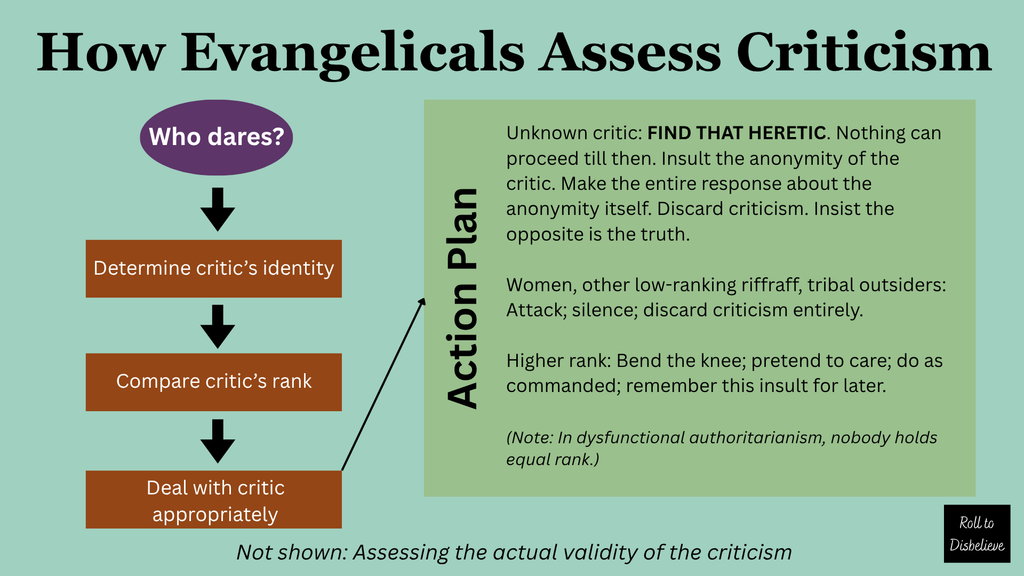
Evangelicals are dysfunctional authoritarians. That means that they are completely focused on power. Their entire system is built around giving leaders more and more unilateral power over more and more people.
So they interpret criticism in only two ways: Is it from someone higher ranking or lower ranking? If from someone higher ranking, obviously they must bend the knee. They obey without public grumbling and thank the critic for loving them enough to be truthful. But if from someone lower ranking, that person is overstepping their bounds and must be brought into line.
(You will not often hear about evangelicals giving their pastor criticism in the form of “a word from the Lord.” But oh my, what a spicy thought! The results would keep their church gossiping for months.)
The order of operations does not include actual analysis of the criticism itself
That’s why Tom Ascol expressed contempt for the senders without even bothering to find out what the criticism was about or what evidence pointed to its validity. He didn’t care if it was valid or not. He only cared about mocking the anonymity of the senders. So he mocked the very paragraphs the senders wrote about why they felt they needed anonymity in the first place.
It was only much later that he says he even glanced at what he describes as “a couple of pages” of the 27 pages of plagiarism examples included in the packet. Those examples functioned, at most, as an afterthought. He barely devotes any of his Twitter post to negating their validity.
It doesn’t matter, either, that in 2021 Mark Tuso at Founders Ministries wrote that Ed Litton needed to resign his presidency over far less than this. Ed Litton’s not a hardliner, so sermon plagiarism constitutes a valid reason to demand his resignation. But Tom Buck’s in the tribe and he’s still useful, so the double standards turn in his favor this time.
Anonymity is necessary
I get it. Anonymous criticism can be tough to receive. People feel much freer to express themselves when they know they can’t be attacked and punished for their opinions. Those opinions don’t get as gently couched or as sensitively expressed. I know that sucks for the group leader hearing them.
Sometimes, people who criticize anonymously might only fear retaliation. Maybe the target of their criticism has never once given them any reason to feel like that could happen. Their fear might be misplaced. But that’s not often the case when someone’s criticizing their own group, and either way it’s not something to be mocked or derided.
Worse, the group leaders themselves might take criticism very poorly. They might consider it a statement about themselves and the quality of their leadership. Or they might think the criticism is a reflection of the group’s ruling philosophy or creed. So their response is very personal and defensive, which doesn’t fix the problem. And extremely authoritarian leaders, like these hardline Reformed evangelicals, will almost certainly not only mete out retaliation and take criticism personally, but also use the criticism to gather more power and destroy the dissenters.
These leaders get completely discombobulated by anonymous criticism. They can’t do their normal action plan then. Without knowing just who made the criticism, they can’t respond as they normally would. The critic might outrank them, for all they know.
I’m sure evangelical leaders have fired lieutenants over far less than what this woman says in that “Undercover Pastor” video.
What should matter more than who or how
The actual issue, sermon plagiarism, doesn’t really matter one way or the other. But the way Tom Ascol dismisses it matters very, very much.
I’ve actually been in a similar situation as the woman in that YouTube sketch—criticizing work stuff to the actual boss and not realizing it. One morning, this well-dressed lady walked into my office like she owned the place. I was in shock. And she chatted me up. So I told her.
Thankfully, the boss in my case—actually my workplace’s regional manager at the time, so my grandboss—knew exactly how to respond.
Oh, I needed more power outlets? Where exactly? Okay, thanks. And I was expected to make coffee because the coffeemaker was in my area, even though I didn’t drink coffee then and got criticized for making it wrong? Hm, interesting, maybe we should check into relocating it. Thankfully, I began to think something was up right around then, and I’d presented my concerns in a professional and friendly way.
My grandboss never retaliated against me. In fact, electricians soon installed those extra outlets, so that was good. Unfortunately, the coffee machine couldn’t be relocated. Hey, she’d tried.
In the end, what got said mattered more to my grandboss than who said it or how it was expressed.
But the leaders in these dysfunctional authoritarian systems can’t respond that way, ever. Leaders will never admit that something in their group is wrong because that is a reflection on their qualities as a leader. They will never allow anonymous complaints because they can’t respond on a power basis until they know for sure who that person is. And they will never admit the legitimacy of anything said by someone of lower rank than themselves.
There’s no fixing that kind of group. For evangelicals in particular, their system’s rot goes all the way to the bone. You can’t fix that. Only their leaders can, and they don’t want to do so.
NEXT UP: Evangelicals can’t stand any competition at all, so obviously real therapy is a problem for their leaders. We’ll check out their latest attack on reality. See you soon! <3
Endnotes
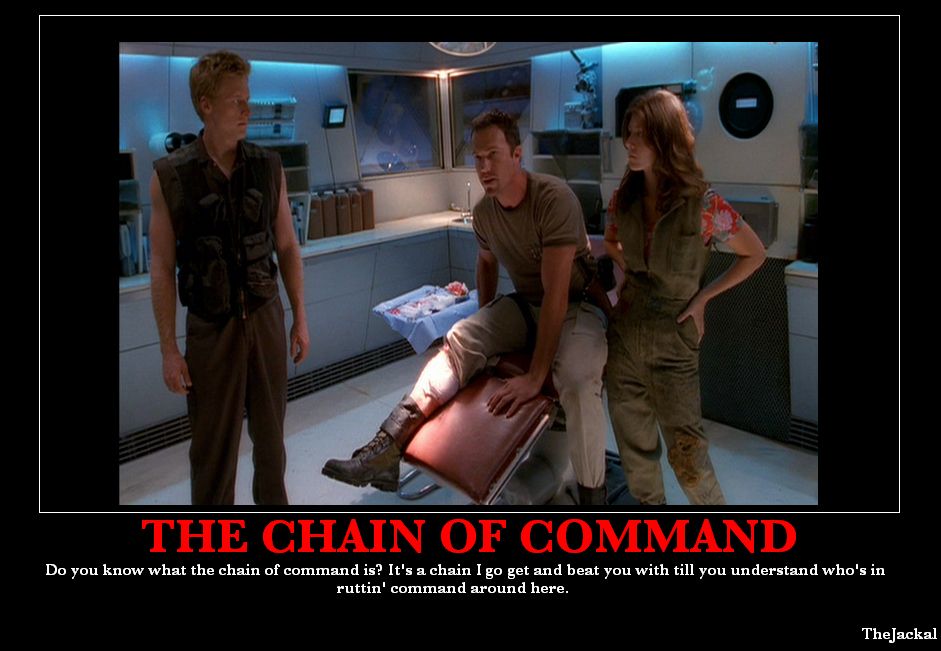
The way evangelicals respond to criticism always reminds me of that quote from Firefly:
Please support my work!
Thanks for reading, and thanks for being part of our community! Here are some ways you can support my work:




0 Comments