File this under Fork Found in Drawer: An evangelical with no psychology training or experience publishes an almost-certainly 100% AI-written essay on an evangelical news site about how awful psychology is at really, truly fixing people’s emotional and mental health problems.
There’s just something magical about someone in the most regressive, reality-allergic flavor of Christianity using the peak of human tech to help a Bronze Age god crawl into smaller and smaller gaps in human knowledge. And we’re going to explore that magic today.
(This post and its audio ‘cast first went live on Patreon on 9/25/2026. They’re both available there now. Please support my work—see the end of this writeup for options, and thank you for whatever you decide to do!)
SITUATION REPORT: The AI essay about Jesusing one’s way to complete mental health
Christian Post published a post from Dale Moreau on September 16, titling it: “You’re not broken. You’re occupied territory.” In it, Moreau concedes a lot of ground to modern therapy and medication, but he doesn’t think those are the complete answers to mental health. He wishes that therapists were “allowed” to suggest Jesusing to round out a complete solution package.
The first time I read today’s OP (original post/original poster), I immediately pegged it as AI. Indeed, five different AI tools I ran on it found it to be 100% AI-written. But the post’s AI nature wasn’t originally the focus of today’s exploration. At first, it was just a hilarious side note. But as I considered the post, the fact of its AI influence became more and more ironic—and yes, even relevant.
For the most part, our OP is a bog-standard evangelical attack on real therapy. As is usual in this genre of exhortation, it comes from an evangelical with absolutely no stated formal psychology training or education. He disingenuously presents his attack as a helpful suggestion for achieving true mental health and peace. See, real therapy can’t actually completely fix a person. No, for that you need to devote yourself to this guy’s religion!
Yes, the guy whose entire career consists of selling his flavor of Christianity says psychology can only get you so far. To go the full distance, you need his product.
What initially made this post interesting to me is how it fits into the concept of the god of the gaps. Normally, as I’ll show you in a moment, we see this approach used in Creationism. There, Christians try to assert divine action in the smaller-and-smaller questions humans still have about evolution and natural selection. But Moreau uses it to pre-empt criticism of the idea of Jesusing one’s way to mental health. See, sure, trauma and brain chemistry are real! He admits it!
But he declares without evidence that real therapists are “not allowed to say” that Jesusing should be part of mental health too. (In my writing, all emphases in quotes are from original sources unless otherwise stated.) That’s quite an assertion, as is his follow-up assertion that Jesusing is a deep magic that modern psychologists are just too materialist to consider.
However, I’m also interested in our OP because of its sheer, shameless lack of self-awareness. This guy draws upon the peak of human technology to complain that modern therapy isn’t drawing enough from his favorite ancient book of poorly-interpreted myths or his favorite flavor of reality-denying, regressive religion. There’s something incredibly magical about that level of cognitive dissonance. We’ll be touching on that magic today, too.
Everyone, meet Dale Moreau. Sort of.
We can’t really say anything definitive about Dale Moreau because he’s carefully hidden his power level for many years.
Here’s his bio blurb on Christian Post:
Dale Moreau (BA, Biblical Studies; MDiv; PhD, biblical theology and languages) pastored for thirty years, has taught at the college and seminary level, and has written for more than 55 years with work cited in scholarly literature. He hosts Theological Voice on Substack, recovering the Bible’s supernatural worldview for pastors, scholars, and students: dalemoreau.substack.com.
That is the most specific bio you will ever see about him, too.
He never, ever names the exact schools that granted him his degrees. We know of one of his “mentors,” William Hendricks, who indeed taught at three different seminaries run by the Southern Baptist Convention (SBC). However, Moreau never lists them or any other schools. In evangelicals, I associate this vagueness with their awareness that specifics would destroy their perceived authority.
In addition, I could find no doctoral dissertations or masters theses written by Dale Moreau. Nor could I find a single example or citation of his work in any actual research journals. That said, he has written and published a surprising number of articles on academia.edu—which is not a research journal. I myself could likely do the same exact thing with my BA in social sciences and my School of Hard Knocks associate’s degree. (Note: Actually, make that way more than “likely.” The site doesn’t vet authors at all. It looks like literally anybody could create an account there and upload whatever they want.)
Notably, I found not one reference anywhere in his biographies to any formal training in clinical psychology or therapy.
Instead of actual qualifications, Moreau leans extremely hard on borrowed authority. He has advanced degrees, even if we don’t know who granted them or exactly what they involved. He has had highly-esteemed mentors in the past, even if we have no idea how he uses the term mentoring. He’s written all these essays which he posts on academic-sounding sites, even if they’re really just Bible studies that got lost on their way to WordPress.
And oh boy, this guy loves AI. Here’s a screenshot of his Substack that I took today:

On his Substack, Moreau titled his March 15 post “How to Study the Bible with AI (Without Letting AI Interpret Scripture).” Interesting!
Armed with what sparse knowledge we can muster, let’s look at Dale Moreau’s recent essay at Christian Post.
A non-scientist tries (and fails) to explain why real science doesn’t draw upon his specific religious beliefs as a cause or treatment for anything
In his Christian Post piece (relink), Moreau begins:
Modern psychology can describe your anxiety down to the neurotransmitter. It can trace your patterns to your childhood, your brain chemistry, your attachment wounds. All of that is real. And all of it together still leaves out an entire dimension of what you are.
He argues that modern psychology and real therapy deliberately omit his religious notions of a person’s “entire dimension.” Without the specific package of beliefs he sells, people can at best only be half-healed:
Spiritual causes aren’t ruled out because they were investigated and found wanting. They’re ruled out by definition, before the investigation begins.
So, the map psychology hands you is drawn with half the territory missing — not because the other half was explored and found empty, but because the map-makers agreed ahead of time that it couldn’t exist.
The Bible draws the whole map.
It’s quite a self-own. Lacking any background in real science, Moreau really has no idea what he’s talking about. He offers only a gross (but typically-evangelical) mischaracterization of both real therapy and the scientific method. The result is a stunning example of the Law of Conservation of Worship, wherein he mistakenly thinks that everything works like his religion does.
Yes, the reality-based science world did indeed rule out spiritual causes for things. They did that because reality-based models explain mental health challenges far better than any religious ones do. These reality-based models not only describe things better, but also allow us to make better predictions for treatment development.
Nobody serious uses the Bible as a clinical manual to treat, say, PTSD (post-traumatic stress disorder). Nobody who wrote the Bible knew about PTSD—any more than they could knew the real bacterial cause of leprosy! And nobody uses the Bible to prescribe mental health treatment, either—any more than they could use it to treat cancer and toothaches.
Reducing the Bible down to a diagnostic and treatment manual does a sore disservice to it, but evangelicals do this and worse with their holy book all the time.
But what’s interesting is that Moreau concedes and abandons so much of the mental-health battlefield.
The god of the gaps strikes again
Dale Moreau is part of a very interesting split of evangelicals regarding mental health treatment. What began as evangelicals’ solid rejection of all things psychological now stands as multiple strands of approaches to the topic.
That’s not surprising, but it is interesting! In evangelicalism, once something becomes part of its ecosystem, it never leaves. Trends never really die out. They just compete with more and more trends as new ones pop up. It’s the opposite of real science, in which numerous explanations may exist at first for a question. But as we study that question more and more, we winnow out models that don’t explain it as well until we’re really left with just one main model. Research can dethrone it easily enough by developing a better model.
By contrast, religious people start with a small number of explanations, then add more to the list as time goes on. These newcomers generally start by admitting that science explains a lot of things, but scientists simply can’t explain everything. The stuff we still don’t understand becomes the new crevice their god inhabits. He is their god of the gaps. They shove him into smaller and smaller holes to explain what remains unsolved.
So in the 1st-2nd centuries, the New Testament’s writers presented many mental and physical illness alike as caused by demons. Curing these illnesses meant banishing the demons. But most evangelicals are a lot further along than that now, despite the many Christians who refuse to see any kind of illness as anything but a spiritual battlefield.
If you’re wondering, a spiritual battlefield operates exactly like the classic South Park scene, except with more Christian jargon:
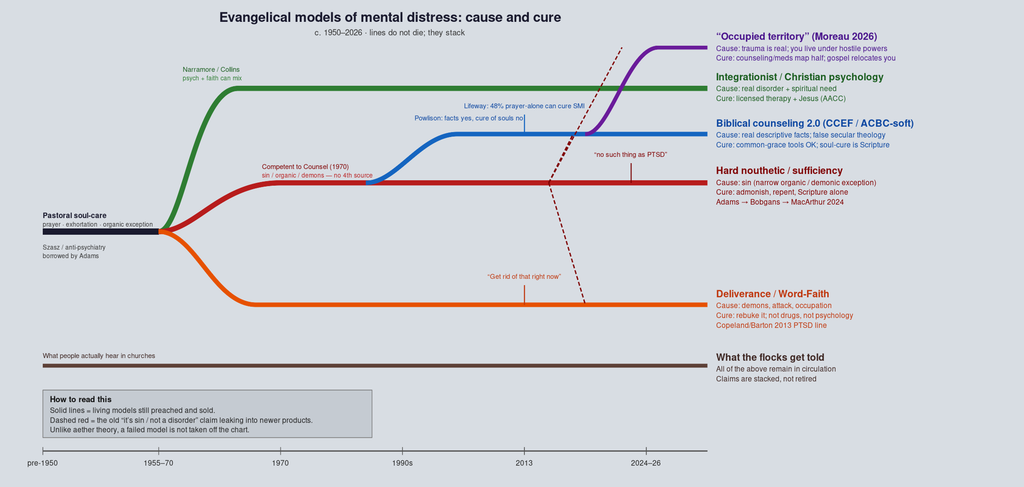
A timeline of evangelicals’ battle against real therapy
In 1970, Jay Adams wrote Competent to Counsel. This book explained mental health as an outgrowth of spiritual health. Practically speaking, spiritual health just means fervor, obedience to their group leader’s rules, and adequate performance of devotions. In this model, mental illness usually results from sin—meaning lack of fervor, disobedience to rules, and inadequate devotions. (They sometimes allowed other causes, but sin was their main focus). Once a client uncovered and corrected their sin, their mental illness dissolved.
This approach to mental health dominates many evangelical groups today. Its name changed from nouthetic counseling to biblical counseling, but it remains much the same. Its proponents can be identified easily by their use of the distinctive term “sufficiency,” since they believe the Bible is “sufficient” for curing mental illness. You can see one example in a 2007 writeup about the SBC embracing biblical counseling. Another example is PsychoHeresy by Martin and Deidre Bobgan, first published in 1987.
John MacArthur’s site Grace to You echoes this opinion. This powerful evangelical leader been talking like that since at least 1991, according to a 2015 blog post on his site. He completely rejects the mere idea of using real psychology to help with mental health. In 2024, he publicly and explicitly denied that PTSD, ADHD, OCD, and similar illnesses even exist.
By 2013, David Barton and Kenneth Copeland were saying out loud that they didn’t think PTSD should exist—because soldiers just needed to remember that the Bible said soldiers were “guiltless.” (PTSD isn’t about guilt. But whatever.) That same year, Lifeway ran a survey that found that almost half of respondents thought they could treat serious mental illnesses like bipolar disorder and schizophrenia through “Bible study and prayer ALONE.” Notably, though, that meant that slightly more than half of respondents felt those weren’t “sufficient!”
Eventually, evangelicals modified some of these talking points. They created new strains of fake counseling to account for very obvious real-world causes of mental illnesses. For example, the Association of Certified Biblical Counselors (ACBC) accepts that trauma causes PTSD—and that their god specifically allows that trauma. As one of the group’s members noted in 2022, they just don’t accept that real therapy helps manage it.
And now we arrive at 2026. Moreau pushes a further-refined talking point: Trauma does cause stuff like PTSD and real therapy can help with a lot of it, but his favorite Christian devotions should also be part of the treatment package. However, nouthetic and ACBC schools of thought still compete with Moreau’s idea for evangelicals’ attention—alongside the other major Christian schools of thought about what causes mental illness.
In its way, the situation with real therapy looks a lot like my favorite timeline of Christian denominations:
The burden of proof: Why real therapy doesn’t look at what these Christians think are important
The basic problem that Moreau’s having is that nobody’s ever produced support for the existence of souls—or really, for anything supernatural. And if he can’t show it, as Aron-Ra says, he doesn’t know it. Stuff we don’t know doesn’t make it into scientific models.
Scientists are materialists because nothing but material has ever been demonstrated to exist. Either supernatural stuff exists but it’s irrelevant, or it just doesn’t exist. None of our models or explanations need to draw upon anything unproven because none of that unproven stuff has ever been shown to be a factor in anything. That’s why supernatural stuff cannot be incorporated into real-world solutions: it was, in fact, “investigated and found wanting.” That exclusion isn’t an order from higher-ups!
But here’s the funny thing: Moreau thinks he’s selling a god who meddles in the mental health of his followers. What he’s actually selling is a package of devotional practices. The actual imaginary underpinning of those devotions hardly matters. What matters is the real-world practice of them: Prayer, church attendance, Bible study, etc.
Those practices can be studied. In some ways, devotional practice can help some people simply by virtue of being meditative or giving them a community or a personal narrative they can use. But for some reason, evangelicals don’t like rigorous study of their ideas.
If religious people like Dale Moreau think that therapy needs to incorporate his religious devotions into its models, then they would do far better to demonstrate that those devotions enhance the models. That would matter far more than scolding Christian Post readers for their therapy choices. But weirdly, that’s not what they do.
(Maybe they’re learning from the example of Creationists. According to Lenny Flank’s excellent 2005 essay on the topic, Creationists had to stop doing field research because their results kept deconverting their own scientists.)
Nor do I expect evangelicals to change now. They have never accepted their burden of proof in anything else. I certainly don’t expect them to start here, and especially not with an enemy they’ve hated and fought for decades.
The sheer magic of using AI to complain about real therapy in mental health practice
It’s amazing to see an evangelical publish an AI-written essay on this topic. Dale Moreau could not possibly illustrate modern evangelicalism better than this.
First off and most obviously, AI is cutting-edge technology that could not exist without the scientific method. Whatever AI he’s using, materialist hands made it. He literally could not get an AI made by, say, Creationists. The best they’re ever going to do is corrupting a real AI into a guardrail-bound yes-man for their religion. So it’s funny that he’s using it to try to disqualify reality as the sole arbiter of diagnosis and treatment.
Second, he’s complaining about mental health practices when he doesn’t really know anything about them or how they’re developed. Nobody in real science is scared of whispering the word “Jesus” in their research. They just don’t reach for evangelical tools because they’re not a reliable enhancement to or replacement for current treatment models. But he assumes—just like Creationists do—that real science operates exactly like evangelicalism in general, with authoritarian power driving the psychology car and only approved findings allowed. His misunderstandings there are downright comical.
Incidentally, real science is why we now have useful therapy for BPD (Borderline Personality Disorder). The condition was considered more or less untreatable when I was young, but it’s no longer the unstoppable force it used to be. But Jesusing doesn’t really help it or any other disorders.
Third, it’s painfully obvious that he’s trying hard not to offend evangelicals who have actually benefited from real-world therapy. I’d go so far as to suggest that he worded his AI prompt to avoid such offense.
Mental health vs Jesusing: The referendum came in years ago
The sheer number of evangelicals suffering from mental health challenges speaks to how grievously inadequate Jesusing is as a therapy method. I myself developed PTSD as a Christian, though I had no idea what it was at the time. It only worsened as I proceeded through flavors of the religion to ever-more-high-control groups. By the time I deconverted, I was an anxious, neurotic wreck.
And of course I tried to Jesus my way out of the worst symptoms of the illness. Of course I prayed my heart out. I studied the Bible. I did my level best to “hand all that anger/worry over to Jesus,” as evangelical leaders teach. But it persisted until a real therapist got his hands on my case file and instantly figured out what the problem was.
Finally, everything made sense. I wasn’t suffering because Jesus was letting it happen for some weird reason. Nor did I suffer because I’d offended a god somehow. Or because some demon had cursed me, even. No, I just had some neurological miswiring to deal with. Evolutionary changes to my brain had determined that miswiring. Natural experience did the rest. And real therapy alongside medication dealt with it just fine.
The day I got diagnosed and given a treatment plan, I sailed out of that guy’s office like a bird taking wing from a great height.
Most evangelicals wouldn’t dare to suggest Jesusing to replace a cancer-treatment package. With scary illnesses, they tend to back down on the idea of Jesusing for all of it. They know that Jesusing can only be a bit of decoration at the top of the package—if even that.
Maybe evangelicals like Dale Moreau are starting to see mental health challenges in similar ways. But it’s far too little too late. Worse, it’s obvious that he’s retreating into the smallest gaps the human eye can detect. I reckon it pays his bills to do this, though, so I don’t expect him to change.
NEXT UP: Evangelicals keep talking up this supposedly-massive revival from Gen Z men. But we’ll check out how reality keeps pissing on their dreams from a great height. See you soon! <3
Please support my work!
Thanks for reading, and thanks for being part of our community! Here are some ways you can support my work: