For years now, our annual Spooky Season series has focused on mostly evangelical women’s increasingly-futile efforts to find husbands within the tribe. But this year, we have a different horror story to tell. This year, let’s wander the suddenly-empty hunting grounds of the Great Evangelical Husband Hunt.
(This post and its audio ‘cast first went live on Patreon on 11/3/2026. They’re both available there now. Please support my work—see the end of this writeup for options, and thank you for whatever you decide to do! From introduction: That tradwives post I was talking about.)
SITUATION REPORT: Wow, the Husband Hunt sure looked different this year
Around this time of year, I dive into reports on the state of marriage within evangelicalism. For years now, those reports told of women seeking but not often finding suitable husbands. The hunt looked especially dire for the women hitting middle age and beyond—and at the time, churches were indeed top-heavy with such women. Evangelical pastors routinely lamented the “feminization” of churches that catered too much, they felt, to women’s interests at the expense of men’s. Someone even ran a TV show, It Takes a Church, based around a church selecting suitable husbands for female members.
That was the status quo for years.
But things look different now. Evangelical leaders are increasingly doing a surprised Pikachu face over young women’s increasing reluctance to marry evangelical men. And now that evangelical Zoomer men are visibly outnumbering Zoomer women, those leaders are getting more serious about a response to the trend.
Of course, their response is unsurprising: Shaming young women into putting up with substandard men and extremely unfair divisions of labor within the home.
Today, I’ll show you the landscape of the new hunting ground—and we’ll explore the demographic shift going on in evangelical churches.
In the wild: Evangelicals grapple with marriage, husband and wife roles, and the importance of parenthood
In March 2025, Al Mohler fretted about what he described as “a marriage crisis.” The crisis, it seems, is simply that more young women were opting out of marriage. Sheila Wray Gregoire correctly noted in response that women increasingly recognize that the manchildren populating churches just don’t make good husbands—and the evangelical rules for marriage do not lead to happy, functional marriages.
In May 2025, The Dispatch told us that “tradwives are in short supply.” A tradwife is just a married stay-at-home mother. Their writer suggested evangelical men be more open to working wives. Matt Walsh, a very conservative commentator, bit back that conservative men don’t want “career-driven women.” (A month earlier, Media Matters had elaborated more on his opinion.)
In June 2025, Relevant ran a story titled “The rise of Christian women who don’t want marriage or kids.” Their writer, Ellen Hayes, asserts that their “quiet but steady refusal is reshaping the future of the church.”
In September 2026, a Christian site, The Washington Stand, fretted hard about the rise in numbers of single young men. Someone they asked about it said “They’re [. . .] kind of like drifters.” Sean McDowell, Josh’s son and quite a terrible apologist, said he thought they suffered from “a lack of a larger vision, a lack of a deeper purpose, and the goodness and beauty of marriage.”
On October 16th, a pair of “stay-at-home daughters” apologized publicly in Slate for teaching young women things that they now acknowledge were deeply damaging. Other tradwife influencers (an oxymoron if I ever heard one) have reversed their former positions about how awesome tradwifery is. The piece’s writer, Sarah Stankorb, notes:
They [these reversals in opinion] are a sign that gender-based authoritarianism is unsustainable, even among the biggest advocates for women’s submission.
She’s not wrong. I’ve been talking about it for a decade and more now.
A startling reversal in strategy
Tim Challies insisted in February 2025 that “men who love Jesus will always be in high demand.” But reality doesn’t match his words. For a couple of years now, young Zoomer men have outnumbered young Zoomer women. The New York Times even wrote about it in 2024—and the picture heading their story shows almost nothing but young men sitting in the pews. I counted maybe four young women in that picture. I also spotted a couple of older women sitting with their husbands and children. That’s it.
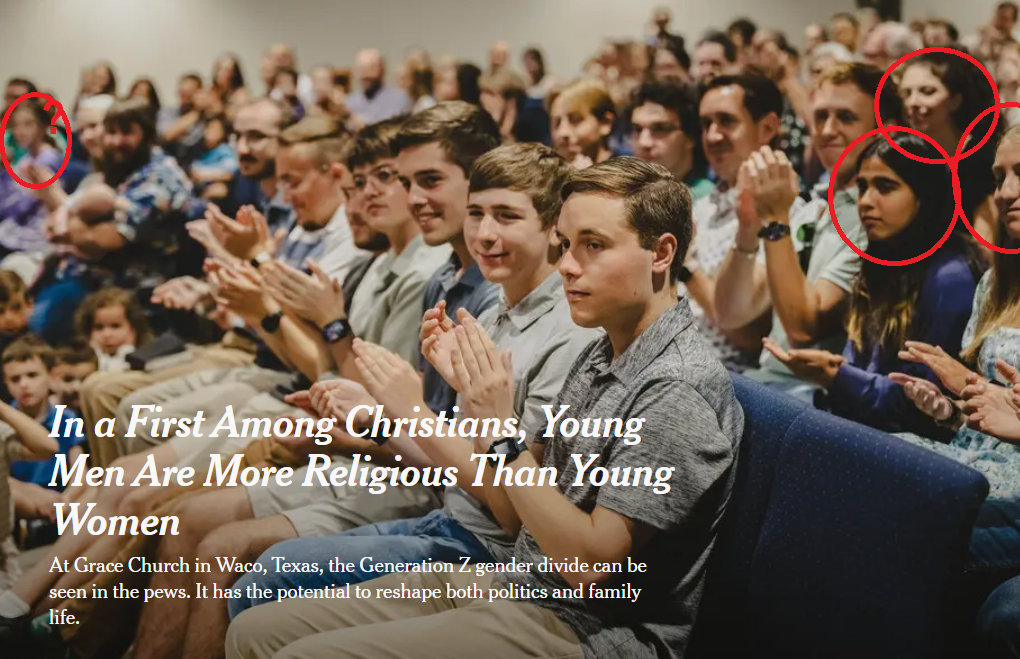
Though this shift in demographics doesn’t amount to any kind of reversal of Christianity’s decline, it is noteworthy in itself. Church leaders are well used to seeing more middle-aged single women than anything else in their pews. Now they’re seeing attendance skewing more toward young single men.
That perception has led to a sea change in how they lecture their sheep about marriage. Possibly the funniest reversal I saw was on a site called Apply God’s Word (AGW). In January 2018, their headline was “Why Don’t Christian Guys Ask Me Out?” Then, in July 2026, the exact same writer offered a post called “5 Ways Some Churches Keep Christian Men Single.”
Al Mohler, a big name in the Southern Baptist Convention (SBC), made the same reversal. A minute ago, I showed you that March 2025 post he wrote lecturing women about not marrying. But for years, he was trying to shame men into marrying. All the way back in June 2004, he was accusing evangelical men of dragging their feet. In August 2009, he wrote a popular post called “The Case for (Early) Marriage,” which focused mainly on men’s reluctance to get hitched. Its title riffs on an equally popular post by Mark Regnerus (“The Case for Early Marriage”) that appeared in the July 2009 issue of Christianity Today.
But now, women are opting out of marriage. That’s a “five-alarm fire” to Al Mohler. And I can see why.
How The Firm made sense of evangelical leaders’ insistence on marriage
In the 1991 John Grisham novel The Firm, protagonist Mitch McDeere joins a prestigious law firm in the Deep South. Soon after, he begins noticing how weird his new workplace is. When the FBI demands he help them investigate his bosses, he hesitates. The Firm will murder him if they suspect he’s turned on them, but the FBI won’t treat him kindly if he refuses them.
One of the details about this book that really stuck with me was a scene wherein one of Mitch’s bosses affirms that they really wanted to see Mitch get married and start having kids right away. They saw marriage and family as ways to further ensnare their employees. These important family connections only make it harder for employees to consider leaving (or snitching). When Mitch continues to act out, they arrange a very compromising situation for him—and get photos of it that they know would cause big problems for Mitch if his wife sees them.
I was Pentecostal when I read that book for the first time. In fact, I’d gotten married myself not too long beforehand. And even I could see the parallels in that book with how evangelical leaders treated married and unmarried ministers. It was vanishingly rare for a single man to become a pastor or big-name leader in my denomination. I knew of precisely one, a pastor and traveling evangelist from upstate New York. (Years later, I still can’t believe none of us women realized he was gaygaygaygaygaygay.) I didn’t even know of any married ministers who didn’t have kids as well.
Marriage to a proper evangelical lass, kids tightly involved in the church youth group, these are connections that make it much harder for evangelical men to break free of religion. Usually, those obligations will keep men busy enough that they probably won’t even have time to think about their faith.
The 4-14 window explains the rest of the necessity of the husband hunt
There’s another, even more serious reason for evangelical leaders to shake their fingers at young men and shame women back into line:
Evangelicals do not convert many outsiders.
Most of their growth occurs within the church—and specifically, from members having children and raising them to be evangelical in turn. No marriages means no kids, which means no indoctrinated next generation, which means way fewer people in the future to replace those dying.
Sure, their retention rate for kids blows chunks. Churches can count themselves lucky if they can keep about 60-70% of the kids born into their sheepfold. Seriously, that’s how few can be expected even to identify as Christian at all in adulthood. But it sure beats the number of people entering evangelicalism from outside it. (Surveys vary, but according to PRRI, somewhere around 18-20% of evangelicals converted in from something else.)
Children need to be indoctrinated enough to accept Christianity’s essential underpinnings before they turn 14. (Hence, the name for this vulnerable age: the 4-14 window. It’s already closed on Millennials and Zoomers, and is starting to close on Alpha.) But nowadays, the children of unaffiliated heathens don’t often encounter indoctrination in the wild. So if church leaders see children anywhere, it’ll be in their own churches.
If their adult flocks aren’t having as many kids, then the church has way fewer kids to indoctrinate. They’re already looking down the double barrel of that demographic disaster: aging members die, but nowhere near enough younger ones can pick up their slack.
So church leaders need to figure out a way to get more of their younger members married and making babies.
Sir! Shaming doesn’t work! Commencing more shaming!
It’s almost comical that evangelical leaders really have nothing whatsoever in their toolbox but shame to change this situation. Al Mohler, in his “five-alarm fire” post, grumbles that unmarried women perceive married women as less happy than they are. To him, the issue is simple:
The crisis is the mismatch between the expectations and perceived status of a lot of young women in our societies compared to young men.
He also notes that way more women identify as liberal than men do (39% vs 25%), leading to even more “divergence” between men and women’s expectations of a mate.
But his solution set is so limited. He launches into a lecture about “Marriage, Creation Order, and the Goods of Marriage.” Despite evangelical marriage rules actually being strikingly recent (as Beth Allison Barr has demonstrated so well in her 2021 book The Making of Biblical Womanhood), Mohler insists that this is the way Yahweh intended marriage to work. Anyone saying otherwise, he tells us, is literally sinning against Yahweh.
When he piously claims to feel “heartbroken for the young women in this article who seem to have abandoned marriage on their horizon,” it comes off more as him being frustrated that he has literally no way whatsoever to persuade them to take a dive for Team Jesus and marry one of the many lonely evangelical manchild pew-warmers.
His heartbreak doesn’t matter to the young women who’ve decided not to marry one of those pew-warmers—any more than his denunciations mattered to evangelical men in the 2000s. When it comes to their futures, very few people are willing to obey evangelical leaders at the expense of their own consciences.
The forest teems with game, but the husband-huntresses are few this year
Now that we have all this info under our belts, we can journey into the marriage forest of evangelicalism.
Before us, we see more game in these woods than there has ever been. Young men, bright-eyed, Jesusing as hard as they possibly can, and wanting young, pretty tradwives. They need tradwives to build them huge families (and take care of them, natch, with no help from the menfolk). Without tradwives, they can’t get that process started.
But tradwives are as hard to find as the entwives of Tolkien’s writing. The trees may echo with the calls of hopeful tradhusbands-in-waiting, yet few huntresses answer them.
I honestly don’t think evangelical leaders have any idea how to handle this reversal of fortune. They’ve been snarling about too many women in churches for decades. Now they’ve got more young men than they know what to do with, and way fewer young women for pairing them.
The even more hilarious byproduct of fewer women and more men in churches
In 2012, Jim Henderson published The Resignation of Eve. It was quite an interesting book, I thought, with a prescient premise: What if women abandoned churches?
At the time, it was crazy talk. Women way outnumbered men in evangelical churches. But Henderson basically said, Hear me out, evangelical men. What would happen? And he drew a powerful picture of how churches would collapse without women’s labor and money.
Women, after all, are a church’s main volunteer force. Women handle children’s ministry, often the music ministry, and generally any other thankless task around the building. They comprise most of the choir, the planning committees, and numerous other departments. If even a few aren’t in their prearranged places on Sunday morning, a church soon devolves into chaos.
Henderson was largely talking to men in this book, and it shows. When he focuses on the women church culture has wronged, ignored, and minimized, it’s generally to chide men for not doing enough to make them feel appreciated. He really thought that if men just did this one thing, then women would happily keep being the workhorses of churches everywhere.
We’ll never know if he was right, because evangelical men didn’t do that one thing. They never have. They never will. The very structure of evangelicalism prevents it.
And now, evangelical men face the very real prospect of the horror story Henderson describes in his book: A church with no women.
Does anyone actually think misogynistic evangelical men will man all the volunteer stations? Teach the children? Vacuum the sanctuary after services? Cook the potluck dishes? Do the church accounting, type the pastor’s letters, collate the Vacation Bible School signups?
Who’s going to do all that stuff if a church has next to no women?
I’m at as much of a loss as evangelical leaders likely are right around now. But I’m laughing about it, and they definitely aren’t.
NEXT UP: A pastor wonders why so many Christians act like demons aren’t real. I’m feeling helpful, so I thought I’d answer him. <3
Please support my work!
Thanks for reading, and thanks for being part of our community! Here are some ways you can support my work: