Not long ago, the Discord’s AV club watched A Distant Thunder (1978), the sequel to A Thief in the Night. This movie hit a vast number of tropes in evangelical Rapture/Endtimes movies, centering on one of my very favorites: Taking the Mark of the Beast may occur under duress, but it may never be completely involuntary. The person taking it must always have some say in the decision to take it.
In fact, this trope not only illustrates how completely daft the entire Endtimes fantasy package is, but it also contradicts a number of long-beloved evangelical beliefs about the nature of their god and the afterlife. Today, let’s trace the concept of the Mark of the Beast, see where it comes from and how it’s used today, and then explore why evangelicals will never let it go.
(This post and its audio ‘cast first went live on Patreon on 10/27/2026. They’re both available there now. Please support my work—see the end of this writeup for options, and thank you for whatever you decide to do!)
SITUATION REPORT: A Distant Thunder centers entirely around the taking of the Mark of the Beast
A Distant Thunder continues the story begun in A Thief in the Night.
The Rapture from the first movie is now a distant memory; we’re now in solid Tribulation territory. Patty, our heroine, languishes in a strangely hygienic prison surrounded by very churchy-looking staff and guards. All of the staff and guards are trying to get the prisoners to decide to accept the Mark of the Beast, which is a tattoo identifying its bearer as a minion of the Antichrist. The prison allows prisoners to stay for a while in cells, but they’re eventually herded into a very churchlike meeting hall to make a final decision.
In the churchlike meeting hall, Patty doesn’t know yet if she will take the Mark or not. Her fellow prisoners are all TRUE CHRISTIANS™. They can’t understand her indecision. After all, she’s not a TRUE CHRISTIAN™ herself, and refusal means her eventual execution. (She’s one of those ickie liberal Christians who think their god is all about love and forgiveness, though this movie acts like she’s not Christian at all.)
Patty tells the story of how she got captured to her friends in flashbacks, ending with the present time. By the movie’s end, she’s marched to a guillotine out back. It terrifies her. But she still hasn’t quite decided. Even the reappearance of her friends Diane and Sideburns (Jerry) doesn’t sway her either way. Sideburns forces Patty to watch her dear friend Wenda get beheaded.
The movie ends with Patty screaming in terror as she watches Wenda’s execution. Then, astonishingly, we get a hard cut to an end card reciting John 3:16.
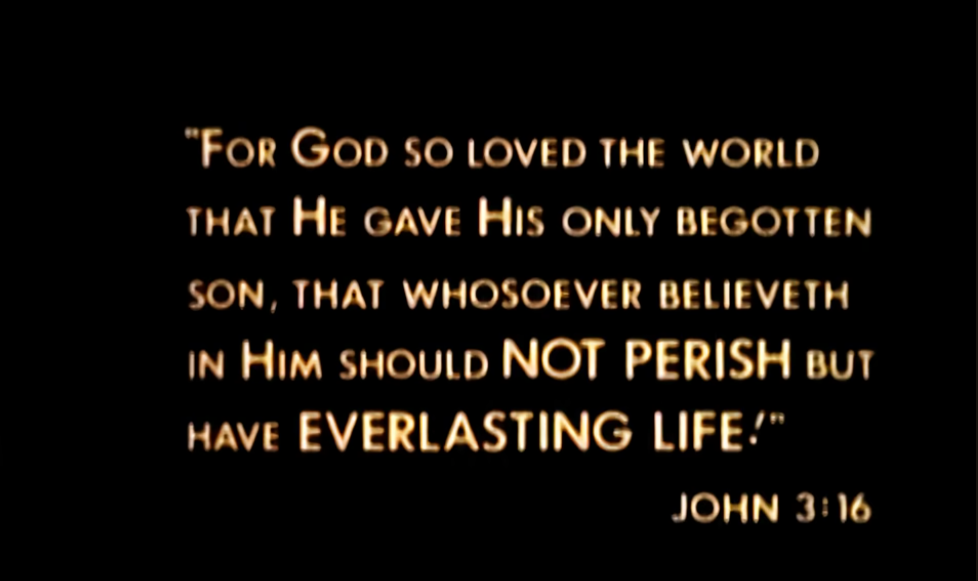
It’s tonal whiplash, to be sure.
Since this movie centers entirely around whether or not Patty will take the Mark of the Beast, let me show you what it is, where the idea comes from, and why it’s so important to Endtimes believers.
Christianese: The Mark of the Beast
In Christianese, the Mark of the Beast is a very special part of the Endtimes conspiracy theory. In the big lead-up to the end of the world, the Antichrist takes power. He demands that everyone get branded with his special mark on their foreheads or hands. Without this mark, they can’t buy from shops or do any kind of business.
Christians get the notion of the Mark of the Beast from Revelation 13:16-18:
And the second beast required all people, small and great, rich and poor, free and slave, to receive a mark on their right hand or on their forehead, so that no one could buy or sell unless he had the mark—the name of the beast or the number of its name. Here is a call for wisdom: Let the one who has insight calculate the number of the beast, for it is the number of a man, and that number is 666.
In the next chapter, an angel calls out:
If anyone worships the beast and its image and receives its mark on his forehead or on his hand, he too will drink the wine of God’s anger, poured undiluted into the cup of His wrath. And he will be tormented in fire and sulfur in the presence of the holy angels and of the Lamb. And the smoke of their torment rises forever and ever. Day and night there is no rest for those who worship the beast and its image, or for anyone who receives the mark of its name.
Yes. There’s no forgiveness, ever, for anyone who takes the Mark.
The penalties for taking the Mark of the Beast
Chapter 16 of Revelation tells us that those who took the Mark will break out in “loathsome, malignant sores.” Finally, in chapter 20, we learn that the Christians who resist taking the Mark will be resurrected at the very end of the Endtimes. These special Christians will rule the perfected Earth with Jesus for a thousand years. In fact, they’ll be the only humans around because all the other Christians won’t be resurrected till the end of those thousand years.
(See also: The jobs Christians imagine they’ll be doing in Heaven.)
Also, if you’re wondering, here’s how most of these Endtimes stories go: At the end of the thousand years, the forces of Satan and Yahweh will briefly fight. Yahweh will obviously totally win. Afterward, Yahweh will hold Judgment Day for all humans, destroy the universe, and make “the new Jerusalem” as a heavenly city. His favorites will live there forever.
So it is hugely, hugely important for all Christians to avoid taking the Mark of the Beast. They might not have any idea what Jesus meant when he described the “unforgivable sin,” but they can sure understand this one!
The problem A Distant Thunder faces about the Mark of the Beast
Possibly the highest hurdle A Distant Thunder faces is that nobody has any idea what the Mark of the Beast even looks like or how it’s supposed to work. The Bible seems to think it’s just a physical mark of ownership. However, the inability to buy and sell without it suggests other options to Endtimes believers.
When I was Pentecostal, I often heard and read about concern about credit cards and bar codes. Yes, the bar codes that stores use.
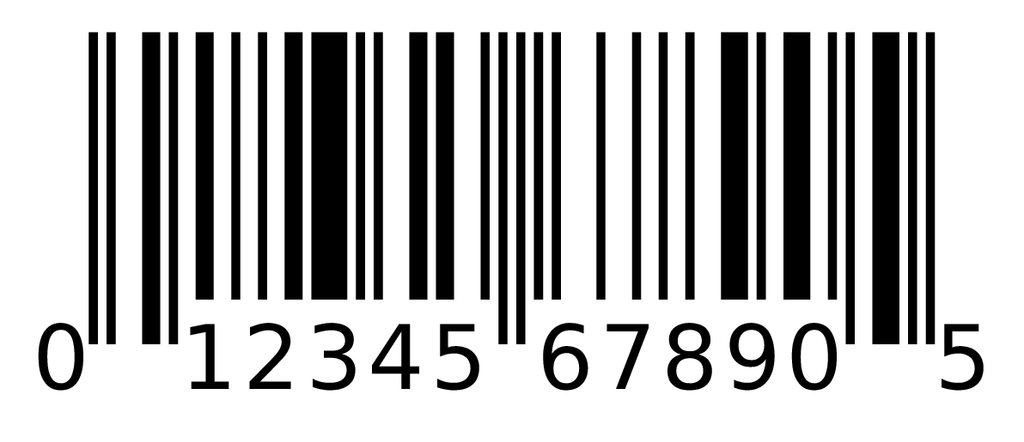
In the early-to-mid 1980s, at the height of the Satanic Panic, bar codes were still coming into use in retail. (Here’s a link to the Smithsonian Museum’s history of them!) Pentecostals and other Endtimes believers panicked about them. They were just positive that very soon, people would also be tattooed with bar codes.
People then were also moving to credit/debit cards, which only made their nervousness more intense. Indeed, Endtimes fantasists have seen the Mark of the Beast lurking behind a number of bushes: RFID (radio frequency identification) chips, Social Security numbers, even school identification cards (with or without chips). Even in 2019, we find essays online exploring whether or not pet identification chips might be an Endtimes concern for Christians.
The Thief in the Night series takes place in its current time, when all of these technological advancements were either in the far future or very new. So in these movies, the Mark of the Beast is just a tattoo. Its only function is signaling affiliation with the Antichrist. It’s changed since the last movie, but here it is in the sequel:
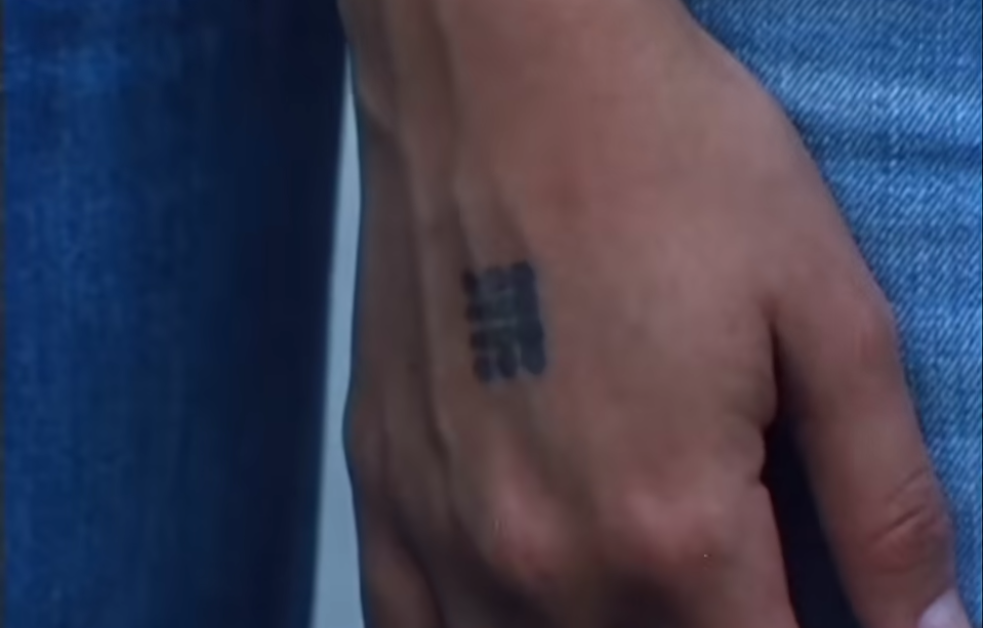
But in that affiliation, the people taking the Mark cut themselves off from Heaven forever.
The bedrock assumptions A Distant Thunder makes about the Mark of the Beast
Every source I’ve ever found about the Mark of the Beast insists on the same concepts:
- The Mark is always knowingly taken, never accidentally.
- Nobody will hold Christians down and force the Mark upon them.
- Taking the Mark means renouncing one’s faith forever and going to Hell.
In A Distant Thunder, we get all three concepts. The entire movie revolves around Patty’s indecision about whether or not she should take the Mark. She’s motivated way more by escaping pain and death than she is by love for Jesus, but she still can’t quite get past her terror of Hell—which she knows is her fate if she takes that Mark.
Above all, taking the Mark of the Beast is always voluntary. Accepting it under duress is fine—even under loads of duress, as in this movie. But ultimately it must be accepted.
One prophecy site tells us directly: “No true believer will stumble into it.” Got Questions, an evangelical site, says something similar: “[A]ccording to the Bible, unknowing acceptance of the mark is impossible.” Rapture Ready, that venerable Endtimes site, offers more assurances: “[W]hen one takes his [the Antichrist’s] mark, he will knowingly and willingly be accepting Satan as his lord.”
Moreover, it will never be something done without knowing what it is. It must be consciously done. It can’t be accidentally acquired. As one redditor noted in 2022, “if you have to ask, you don’t have it.”
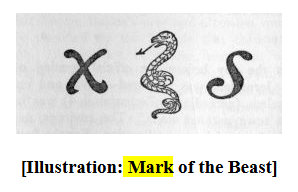
Even older Christian Endtimes fiction notes that the Mark is voluntary. A 1918 Sydney Watson book, The Mark of the Beast, tells that the Mark is, “of course, entirely voluntary.” Of course! Here’s Watson’s take on the Mark, too:
The people who care least about human rights suddenly think their human right of self-sovereignty will matter to the Antichrist in A Distant Thunder
As I’ve shown you, every Endtimes fantasy assumes that nobody ever gets forced to take the Mark. Nobody ever holds down Christians and tattoos/microchips them against their will.
And that is just astounding, considering how little Endtimes fantasists think of human rights in general. Their anti-abortion culture war alone demonstrates that fact. They’ve made a movie (The Life Zone, 2011) where their self-insert authorities imprison pregnant young women, force them to gestate and give birth against their wills, and they present themselves as the good guys in that story. They want to strip women of their right to vote, turn America into a hardline Christian theocracy, and think that The Handmaid’s Tale depicts a society that would work just fine if only everyone Jesused correctly.
If not even COVID and a resurgence of measles could get a Democratic government the power to hold Christians down and jab them with vaccines, then I don’t think anyone has to worry about a godless government tattooing people against their consent.
It’s just amazing that Endtimes fantasists think the Endtimes will feature a government that would absolutely execute dissenters, but never hold them down and tattoo them. They really do not think this scenario through at all.
But they really need the Mark to be voluntary. Otherwise, it wouldn’t really be fair for Yahweh to damn the takers to Hell, would it? If someone forces the Mark on a person, then there’s no need for the recipient to renounce any beliefs first, nor to make a formal statement of allegiance or worship of the Antichrist. The very concept of a forced Mark brings Endtimes believers into some very alarming and nuanced territory that they are really not prepared to travel.
A Distant Thunder also shows us a god who suddenly cares enormously about free will and voluntary choices
The most striking thing about Endtimes beliefs is the sudden pivot on Yahweh’s part to caring enormously about his human pets’ free will. If I could say one thing about Yahweh, it’s that he very obviously doesn’t care about that. That’s always the least of his concerns.
In the Bible, we routinely see him violating people’s free will in all kinds of ways. He hardens hearts, freely lies to his pets and tries to keep them in an animal-like state of pre-human innocence, holds future humans responsible for something ancestral humans did, and will (according to Hell-believers) hold humans responsible for offending him even though zero solid, credible, compelling evidence exists for any of the claims about him.
So it’s truly remarkable that he’s now suddenly such a stickler for people consenting to the Mark of the Beast. It’s not real consent, of course, any more than “the gospel” involves any. “Do this or I’ll hurt you so bad your grandkids will feel it” isn’t exactly a mark of consensual relationships.
He won’t save his people from the Tribulation’s persecution, no. Nor will he suddenly offer any signs of his existence or of miracles being real or anything like that. (Why start now, right?) But he will damn humans if they decide to survive rather than martyr themselves.
But A Distant Thunder, like the entire suite of Rapture/Endtimes beliefs, isn’t about sense
This movie explores an impossible dilemma: Stay true to Christianity, or die. Its creators want the sheep to think very hard about just how dedicated they are to their religion. That’s what Rapture fearmongering is all about.
By watching this movie’s modeling of a martyr response, hopefully the sheep will hold to their commitments in lesser situations. Thankfully, that turned out not to be the case. Christianity entered a steep decline early in the 2000s that has only temporarily paused now.
The solution to that decline won’t involve even bigger threats, either. Threats only work if the person being threatened thinks they’re based in reality. Empty threats of Hell and damnation, in absence of any evidence that even an afterlife exists, mean as much to most people as being told Santa won’t bring them presents at Christmas. Most people know that a threat’s only as scary as its basis.
But to a certain kind of person, someone trained to fear even empty threats if they’re over-the-top enough, someone lacking the mental tools needed to assess claims and discard untrue ones, these threats can be extremely effective. Mostly, these will be children, but adults can certainly suffer from the same lack. (Often, adults have these critical thinking skills, but they just don’t apply them to religious claims. That’s how you end up with an evangelical guy who could make an hours-long documentary debunking the old TV show Ancient Aliens—and yet still totally believe in Christianity.)
This entire movie series targets Christians who won’t ask too many questions about the threats on offer. That’s why these threats are so humongous, so completely out of proportion, and so terrifying to so many religious people. It keeps them from asking questions—and finding out there’s nothing underneath all that thunder.
NEXT UP: A new twist in the Great Evangelical Husband Hunt: Where are the huntresses?!? We’ll be exploring that question next. See you soon! <3
Please support my work!
Thanks for reading, and thanks for being part of our community! Here are some ways you can support my work:



0 Comments