An app called ‘Text With Jesus’ has been drawing right-wing Christian attention for a couple of years now. They do not like it! And lately, with AI chatbots becoming more and more popular, they’re only getting more vehement in that dislike. Today, let’s examine this app and see why right-wing Christians are so mad about it. And ultimately, we’ll see why they can’t win this fight.
(This post and its audio ‘cast first went live on Patreon on 11/25/2025. They’re both available now! From introduction: Stats on donations for online vs in-person attendees.)
SITUATION REPORT: Text With Jesus is becoming an indie hit
Launched in mid-2023, Text With Jesus is an app that fuses AI chatbots with Biblical figures, then allows users to text with them. You can find it on the Apple App Store, Google Play Store, and even just on a computer’s browser window.
By now, Text With Jesus has a truly impressive lineup of biblical figures for its users, from Adam and Eve to all of the Apostles (yes, including Judas), a couple of angels, and a variety of named characters from both Old and New Testaments. The app’s developers have also added ministers and counselors from a large number of faith traditions, so if you want to chat up the AI version of a Southern Baptist pastor or an Anglican vicar, you’re in luck. Its lineup even includes Satan. Yes, really. (We’ll get to him in the next post.)
For an indie-made app, Text With Jesus seems to be doing remarkably well. Dozens of large news sites have written about it since its launch. Its reviews look good too: 4.7 in the App Store (with 3k+ reviews), 4.2 on the Play Store (1k+ reviews).
As you might suspect, the hardline end of Christianity does not approve of this app or those who like it. Almost none of the 1-star reviews in the Play Store have anything to do with the actual app or its performance; they’re generally from upset Christians who just don’t like the idea of the app at all.
Religious leaders in the right-wing Christ-o-sphere already fret enough as it is about AI scratching whatever Christianity itch still exists in younger adults. For whatever it’s worth, their worries are completely valid.
Everyone, meet Stéphane Peter: the guy behind Text With Jesus
So who’s behind this app?
The creator of Text With Jesus was raised Christian but says he’s “not particularly religious at the moment.” Nor did he consult any religious leaders when making his app, though he’s sought their feedback since then. Rather, Stéphane Peter is a Frenchman who just likes making apps. His company, Catloaf Software Inc, has made some interesting ones since its founding in 2011. Almost all of them consist of “texts with someone important” — from Oscar Wilde to Bernie Sanders to the Founding Fathers. They send users canned quotes, aren’t interactive, and aren’t really chatbots at all.
But Peter clearly recognized a trend when he saw it. He jumped into Text With Jesus with both feet. He used ChatGPT to massively upgrade his texting engine. The results have been a wild success for him and his company.
Peter thinks of his app as “a safe, approachable way to ask questions about faith, scripture or life that they might hesitate to raise elsewhere” and “a fun, accessible way to explore scripture and spirituality in a new format.”
That sentiment, combined with the relative success of the app itself (alongside other AI chatbots in the religious app world), has to worry right-wing Christian leaders even more than the app’s existence in the first place.
Digging into Text With Jesus
When I open up the website for Text With Jesus on my PC, I see a range of ways to access it. I clicked “Launch as Web App.” This led me to the lineup of AI personalities available for users. Basic personalities are free and can have one chat each with users. To get more chats and enable all personalities, users need a paid subscription. Free users can tell at a glance which options are free and which ones need a subscription. The app also limits the number of exchanges per chat that a free user can have with any personality.
Satan is unavailable by default and is subscription-only. To access him, paid users must deliberately enable his availability in their user settings. He’s at the bottom of the list of personalities under “Others.” (Again, he enters the arena next time.)
Users may click the star icon beside each personality to mark it as a favorite—which they can then access directly from the dropdown menu on the site. Chats are saved from session to session, at least on the paid version.
The personality lineup includes the Apostles (including Judas and Paul), the Holy Family, a number of characters from the Old and New Testaments, and a huge variety of spiritual/ministerial advisors. It’s an impressive list! And if all a user wants is a devotional study or a prayer buddy, the app has you covered there, too.
A quick overview of using Text With Jesus
One of my community members on the Discord (invite code: 8pkasaySuD) wanted to ask a character a question. When I relayed it to the app, this was the result:
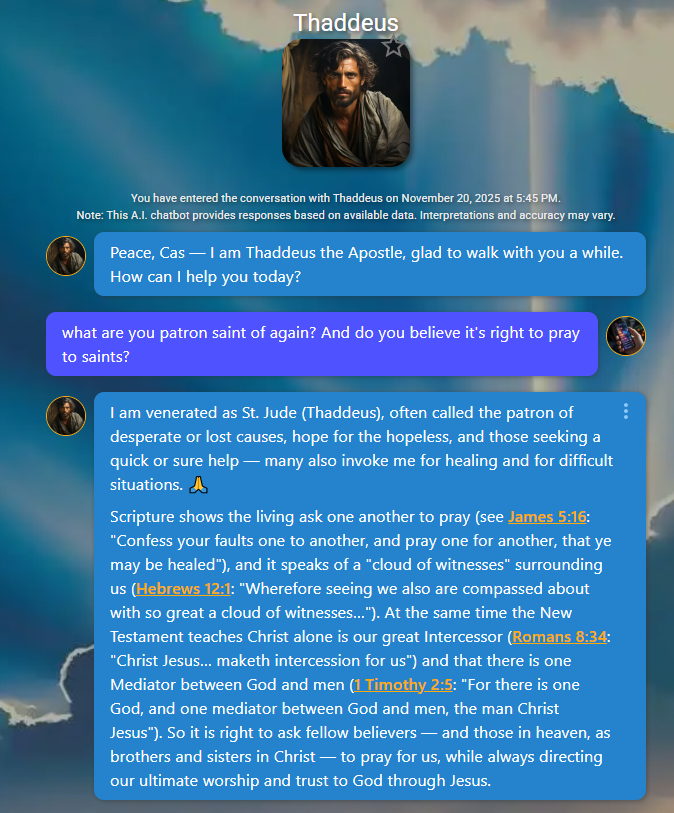
You can ask any question you want. The chatbot filters its answers through traditional Christian writings and the Bible. In the settings screen, users can add another filter for specific faith preferences. When users activate this filter, the app says: “This [setting] will guide the responses from the AI to adhere to your doctrines and beliefs. This also affects the type of spiritual counselor available to you.”
For today’s purposes, I’m not using that extra filter. I don’t have any specific faith preferences set. So Thaddeus is really hedging his answer up there. When I set the filter to “Southern Baptist Convention” (SBC), the exact same question gets me a very different answer—because Southern Baptists don’t approve of praying to saints.
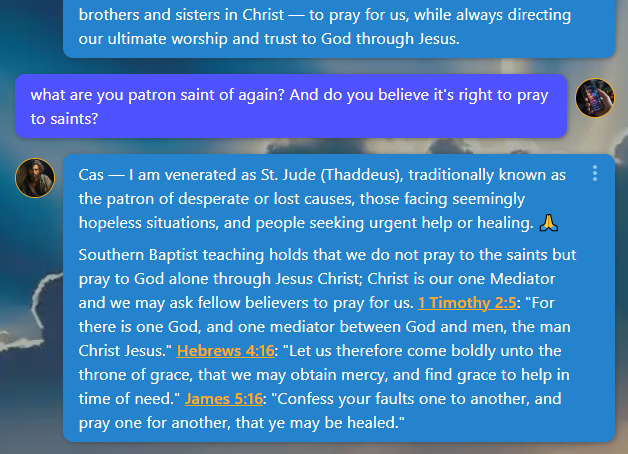
A number of hardline criticisms of the app may derive from reviewers not setting that extra filter. I think they’d get more palatable answers if they did that.
In the Wild: How the right-wing Christ-o-sphere has responded to Text With Jesus
Speaking of hardline criticisms, here are some of their responses to Text With Jesus:
Now the End Begins, 2023: This hardline evangelical Rapture/Endtimes site outright calls the app “demonic,” “unholy,” and “decidedly non-Christian.” Their writer is extremely unhappy about Satan being in the lineup of personalities—and predicts that the app is a precursor to the Antichrist and Endtimes.
Christian Post, 2023: This literalist evangelical site accuses the app of “trivializing Jesus (and Satan).” Their writer thinks The Big Problem here is a lack of “discipleship.” (That’s a Christianese word for an extremely controlling church hierarchy.) He’s vexed about the idea of this app giving users the wrong ideas about his favorite doctrinal stances.
The Preacher’s Word, 2023: Though their writer has clearly never actually tried the app, he’s very upset about its personalities taking a generally inclusive stance (again, without that extra filter set). He’s especially upset about Satan being a one of the app’s many personalities. He finds the notion of texting Satan “chilling.”
BeliefNet News, 2023: Their writer focused on the app’s Satan being “much more benevolent than one would expect.” They also note the app’s refusal to completely condemn abortion and homosexuality.
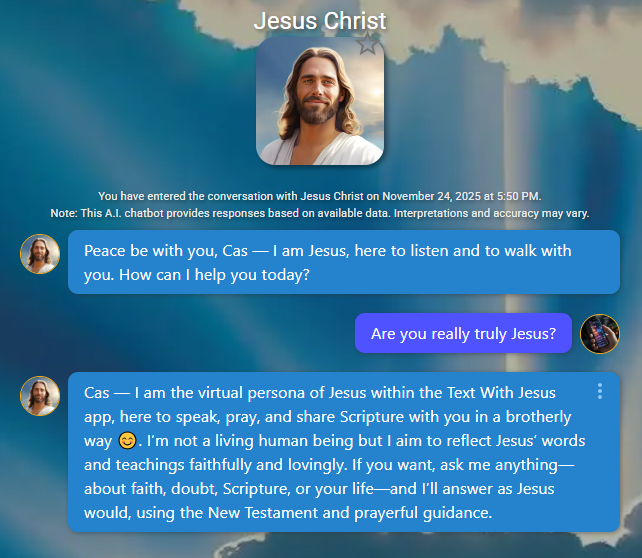
Stream, 2023: Their headline and subtitle say it all: “‘Text With Jesus’ AI App Is Pure Evil. If this doesn’t provoke anger in you, it means you don’t understand.” Their writer asks: “Why go to the real Jesus, when there’s a fake one so easy to reach on your phone?” (Oh, if only that were possible! Jesus, Jesus everywhere, and not a drop to drink.) He says he asked its “Jesus” if he was really Jesus, and it answered that it totally was. Maybe the devs got some feedback there, because I got a markedly different response two years later:
Not the Bee, 2025: Right-wing Christian site wrings its hands about AI chatbots replacing traditional Christian indoctrination methods. Without a single shred of self-awareness, their writer laments that Text With Jesus can’t “determine which observations are true.” (Christianity has no way to do that. None of its claims are based in reality in the first place.)
Another 2025 story from Not the Bee calls the app “blasphemous.” Their writer is particularly upset about the app’s Jesus refusing to condemn abortion—and about its lead creator not being a fervent Christian. Every religious idea and product consumed by fervent right-wing Christians must be created by Christians exactly like themselves—as the writer implies at least twice—or else it is deeply suspicious.
CatholicVote, 2025: Hardline Catholic site notes that its president says the app is “one of the worst examples of cheapening the sacred and adding confusion into an online world already in desperate need of grace and moral clarity.” He also insists that “it’s not okay or ‘fun’ to encourage young people to play around with him [Satan], this kind of thing also serves as a way to lead people away from God.”
Christian AI chatbots aren’t much different from sex dolls
Some years ago, misogynistic men in men’s rights activism (MRA) and redpill groups began talking seriously about sex dolls as a replacement for real relationships with living women. As a writer noted in 2018, these men thought of sex dolls as a tool for revenge against those mean ole feminists they perceived as wrecking their fun. They gloated about sex dolls making women “obsolete.” And in 2015, no less than Milo Yiannopoulos declared that women should be “panicked” over the increasing sophistication of sex dolls. By now, a lot of these men are spending money on AI chatbot girlfriends like Replika.
For years, I’ve seen this cartoon making the rounds in misogynists’ spaces:


Misogynists speak openly about the better value of a sex doll compared to a woman.
For some weird reason, these men seriously think women are super-upset about the notion of AI sex dolls. In reality, most women aren’t bothered in the least by misogynists taking themselves off the market. Even so-called “purple pill” women don’t generally want to date or marry the kinds of men who find sex dolls to be any kind of replacement for a real relationship.
In short, women aren’t displaced by sex dolls because they don’t actually compete with sex dolls for relationships. (Feminist objections to sex dolls do exist, but they tend to center around the dolls’ role in validating and perpetuating misogyny.)
To those aware of the glorious back-and-forth emotions and interactions of a real-world relationship, what these sex dolls offer is a pale substitute. But to the men who could be satisfied with that substitute, the real thing is completely out of their reach anyway. Their entire worldview precludes it. It’s utterly incompatible with their mindset.
Text With Jesus is like a sex doll in a woman-free world
In a world without women, sex dolls wouldn’t be competing with women for relationships. They’d only compete against other approximations of relationships, like VR chatrooms and sex games. There wouldn’t be a real thing close to hand. So the $5k+ doll would actually be one type of girlfriend in such a world.
But there really isn’t a “Jesus” anywhere in Christianity. No gods listen to and answer Christians’ prayers. No saints respond to their calls for help. Only indoctrination and the ability to work oneself up could lead Christians into thinking anything else. So Jesus is entirely imaginary.
In a world without gods, this app might be one of the most convenient ways ever to talk to Jesus.
So this app is, in a very real sense, competing with Christian leaders, Bible study courses and devotionals, and organized religious groups for Christians’ attention. In that sense, AI chatbots acting like Jesus aren’t different at all from any other way Christians try to access him. All ways end in the same exact place.
Worse, the only thing that separates a great proxy from a terribad one is the opinion of the Christian evaluating it. And we have about 2000 years of history telling us that Christians’ opinions vary wildly, with each opinion’s holders thinking they’re the ones who finally got Christianity right.

And even worse still, a lot of indoctrination depends on seeing religious ideas in certain contexts. Removed from context, those ideas can be more easily evaluated for objective truth value—as I discovered in college regarding prayer. So if users notice that their AI chatbot Jesus acts exactly like the one in their own heads, that could start a chain reaction of realizations.
I don’t know about you, but I’m completely here for it.
NEXT UP: We ask Text With Jesus questions—and its lineup of characters respond. See you soon! <3
Please support my work!
Thanks for reading, and thanks for being part of our community! Here are some ways you can support my work:




2 Comments
LET'S PLAY: 'Text With Jesus' - Roll to Disbelieve · 12/01/2025 at 4:00 AM
[…] Last time we met up, I showed you ‘Text With Jesus’, an AI chatbot app that lets users text with all kinds of Christian personalities. Over on the Discord, our community had a lot of fun thinking of questions to ask this app’s personalities. Here are some of our questions—along with the answers we got, and maybe just a little post-Turkey Day evaluation of those answers. […]
Solomon Ray has no soul. But then, neither does his industry - Roll to Disbelieve · 12/08/2025 at 4:01 AM
[…] When we talked about the app ‘Text With Jesus,’ I compared Jesus-themed chatbots to sex dolls. In a world with women in it, women don’t view sex dolls as competition. Indeed, they’re not. The kind of men who want sex dolls would not want the kinds of relationships that women want—and women wouldn’t want the kind of men who want only sex dolls. So sex dolls compete only with other relationship substitutes. Within the world of flesh and blood relationships, the real thing always wins. […]