In recent years, we’ve talked a lot about evangelicals’ utter inability to appeal to Gen Z. But the latest approach I saw at Christian Post (archive) might take the cake for potential hilarity. Opinion post writer Tanita Tualla Maddox has made a few suggestions that sound like they will backfire catastrophically for almost every evangelical who tries them. Today, let’s see how she thinks evangelicals can reach Gen Z (oh, and Gen Alpha) at last.
(This post went live on Patreon on 12/7/2023. Its audio ‘cast should be there too!)
Everyone, meet Tanita Maddox: Our ‘Gen Z expert’
Tanita Tualla Maddox’ post covers both Gen Z and Gen Alpha. But mostly, she’s talking about Gen Z.
Gen Z people range from roughly 11-26 years old now, so a lot of them are either approaching their college years, smack-dab in the middle of them, or entering the workforce. Gen Alpha was born starting in 2010ish, so their oldest members are only about 13 years old.
In her bio, we learn that Maddox works as an Associate Regional Director for Young Life. After some sleuthing, I realized that this isn’t just a title. It’s a title plus a workplace. “Young Life” is some kind of youth evangelism association (archive). And she’s worked for them in some capacity for 20 years—so since she was just a wee lil fundagelical college student!
Her bio at Christian Post also informs us that she is some sort of “doctor,” but we don’t know what her doctorate is in. On her LinkedIn account (archive), we learn it’s a D.Min, so nothing related to young-adult psychology at all. Her other schooling relates to English language arts and “Christian leadership.”
That Christian Post bio also tells us that she is a real live “Gen Z expert.” A Gen Z expert, everyone! That’s how bad evangelicals are at recruiting and retaining Gen Z: Someone can hang out a shingle advertising her expertise in a generation.
She has a bunch of videos and articles relating to Gen Z (archive) at her personal site. I must say, it sounds like she markets herself well, or else she’s hired the right marketing people. I’ve never heard of her before, but she is all about that Gen Z.
What’s funny is that her Christian Post opinion post covers Gen Z and Gen Alpha. I guess she’s realizing that Gen Z is now leaving that all-important 4-14 Window for good. Evangelicals will be panicking about Gen Alpha in short order. So it’s time for the Gen Z experts to pivot around to the new generation instead. It’ll be interesting to see if she begins marketing herself as a Gen Alpha expert soon. But for now, she is a Gen Z expert who simply includes Gen Alpha into her opinion post—for what are all too obvious reasons, and as if they’re largely the same.
At her age of 40something (I’m guessing here from her LinkedIn; she got her BA in 2001), she herself qualifies as either an older Millennial or very young Gen X.
Possibly the funniest post about reaching Gen Z (oh, and Alpha) that I have ever seen
Maddox begins by asking her readers if they’ve ever made friends with someone online. She even drops the cool trendy slang “IRL” to describe “in real life.” Then, she asserts the following:
Friendship was once limited to who was in our direct geography or proximity, and then by whose phone number or mailing address we had, but now the physical boundaries of friendship have been transcended by technology. This experience is well-understood by the next generations: Gen Z and Gen Alpha. The primary purpose of using social media is for relational and communal purposes: for connection, not information.
However, the experience of developing friendships online has varying familiarity to Millennials, Gen Xers, and Baby Boomers.
And I’ve got ask: She’s kidding, right? Or was she so busy recruiting for her religion that she missed the entire first wave of internet life? I’m an early adopter, myself. I posted on Usenet and can easily remember what life was like online before browsers and search engines. That’s back before users could even see inline pictures!
I knew someone in the mid-90s who liked to download packages of internet porn on Usenet. However, he couldn’t see what a package contained until it was on his hard drive and decoded. All he had to go by was its uploader’s description. And yes, he lived in fear that one day someone might slip some child sex abuse materials (CSAM) or gore into the package just to mess with downloaders like him. When the first major browser, Netscape, gained the ability to see package contents before downloading (by auto-decoding them on the fly), he leaped on it like white on rice.
As for search engines, you can still find old-school sites that include a “web ring” of links to other sites at their bottom. These were what we used instead of search engines, because there weren’t any good search engines yet. Website creators joined web rings and added that code to their pages so users could find related sites more easily. Even when search engines became more common, they were slow to gain complete listings. When Google’s search engine debuted, users could actually send them links to index. I did that a few times. For that matter, website creators had to write their HTML and JavaScript on the fly. We didn’t have website builders!
Older Millennials were more in line with Gen X in terms of internet adoption: Some went for the new technology early, while others waited till it was more common. Younger ones, though, adopted it quickly in childhood.
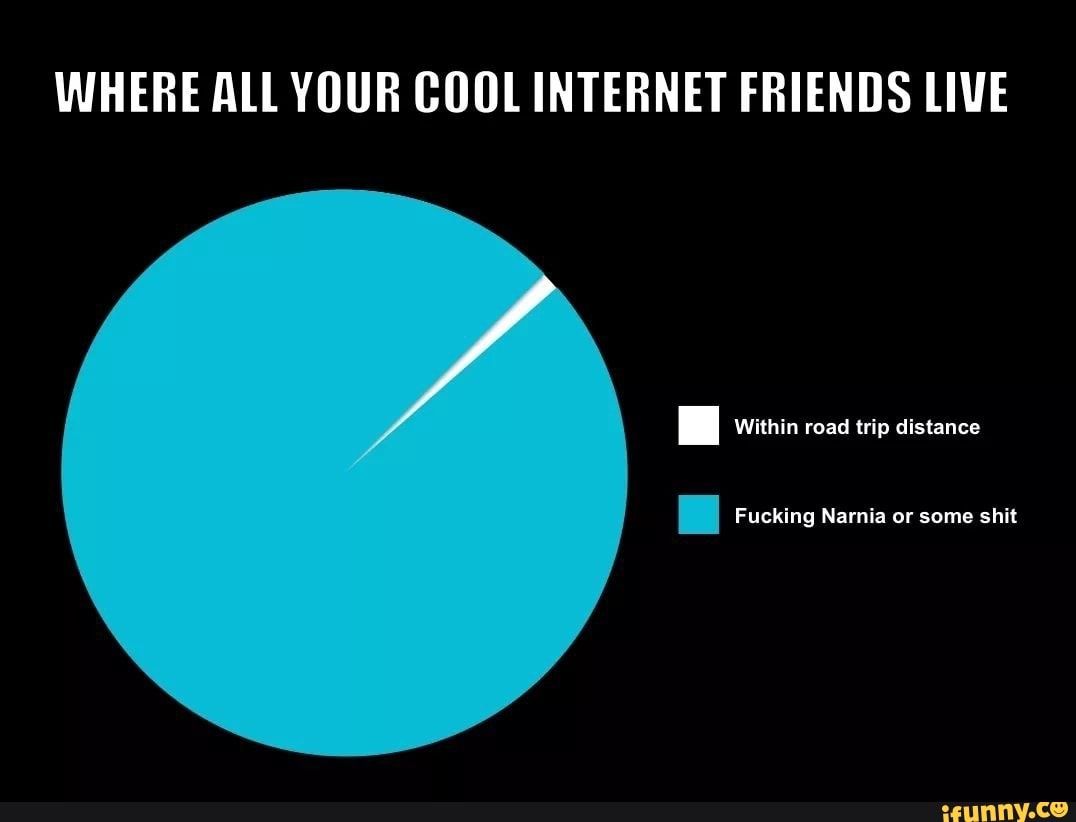
I’m telling you all this to say that the situation Maddox describes hasn’t been the case since I was a wee babby internet user myself. Most Millennials know exactly what it feels like to have all their friends living so far away that they can only hang out online. The classic meme about it was likely made 20 years ago by now—and probably by a Millennial:
FEELS.
Social media has been around since the late 1990s as well. (One might even consider America Online, which began around 1989, as social media.) It’s not at all a Gen Z or Alpha thing. By the early 2000s, MySpace, LiveJournal, Facebook, and other such sites were taking the young adult world by storm. By the late 2000s, smartphones made their debut—but Millennial kids had already been using Sidekick phones for the same exact purposes since 2002. Sidekick marketing almost exclusively targeted tween and teen Millennials. (Alas, the Sidekick became a casualty of the smartphone wars in 2010.)
I don’t think I’ve ever encountered anyone who adopted and used the Sidekick in their late 20s or 30s. Instead, older people used the far more professional Blackberry line of phones. Debuting in 1999 and lasting till 2016, this line of phones featured top-notch security and many of the functions of early smartphones, including proprietary messaging with other Blackberries. Even top-ranking government officials (like President Barack Obama; archive) used Blackberries for official purposes.
What I’m saying here is that Gen Z has obviously gone more all-in on social media, but it was not in the least unusual for Gen Xers and Millennials to meet people online without ever seeing them even once in person. The world Maddox describes hasn’t been a thing since the early-to-mid 1990s. She’s describing her own early life as a very young Gen X or older Millennial. Midrange and younger Millennials won’t recognize themselves much in her description.
Mentoring is The Big Problem Here with Gen Z, apparently
After establishing that Gen Z’s world is far more digital than that of previous generations, Maddox then laments that older evangelicals aren’t properly “mentoring” younger ones in the use of the internet:
Though older generations are charged with stewarding the next ones, there is a lack of mentoring in the area of digital community and relationship-building. There is a barrier to an increasingly important need for discipleship in the digital space.
And what is that barrier? “Technology,” she asserts. Older people just don’t understand the social media that younger adults are using nowadays. And that may well be true, especially in the case of TikTok. Most older people have no clue about how to use it, much less understand what a huge impact it’s had on Gen Z (mostly for the worse, unfortunately).
Also, scope the word “discipleship” there. That’s evangelical Christianese for intensely controlling someone else to make them so Jesusy they will never even think about leaving the religion.
Because Maddox’ operating premise is that Gen Z (oh, and along with Gen Alpha) is uniquely afflicted by social media in a way that previous generations simply weren’t, she’s free to assert that social media is to blame for these generations’ reported problems:
Due to lack of understanding, or awareness, surrounding digital and social media, older generations have pulled back, leaving Gen Z to fend for themselves in the digital world — throwing their hands in the air with a collective, “You’re on your own, kids!” The result is right before our eyes: increased anxiety, loneliness, depression and suicide.
Did you catch that? Kids are dying, in more ways than one, because they have been left to their own devices (pun intended).
This is not an option.
And that’s a strange cause-and-effect claim to make. I’ve never seen Gen Z (or Alpha) attribute their problems to social media. Mostly they refer to the absolute clusterfuck trash fire that is America’s economy and government nowadays. And that economy didn’t tank only in the past 20 years. Consider these memes, all made by Millennials:



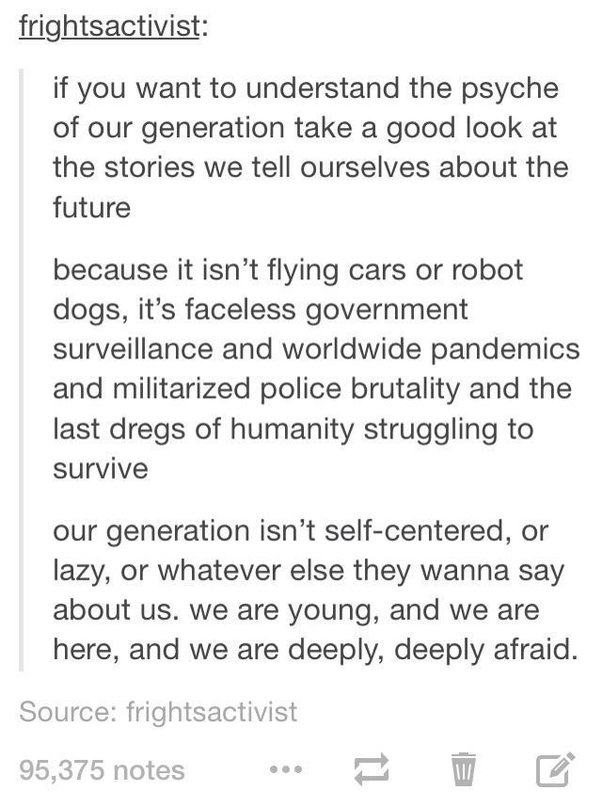
Meanwhile, here’s a Gen Z meme about why Gen Z is so anxious and depressed:
Here it is.
Weirdly, social media doesn’t come up at all in this actual Gen Z’s list of problems. Instead, the world that older generations have created weighs them down. Social media is where they go to escape those fears, or perhaps to express them in safer environments than IRL. (<– see what I did there? I am so HIP to the SLANG.)
The solution to The Big Problem Here
Having laid out her assertion that social media itself is responsible for the problems afflicting Gen Z (oh, and Alpha), Maddox now offers the solution to this pressing issue:
If social media is where the next generation is, it is time for adults to enter into that space to better understand, communicate with, and care for them. To do so effectively, it must be done relationally, and this means learning to speak the language of the next generations. Starting a conversation doesn’t mean knocking on the door, but liking, following, or commenting on social media. It is opening a digital door to real-life friendship and mentoring.
And that means that Gen X and Millennial evangelists need to learn to use…
…Instagram.
Ben Boelter, a Young Life staff associate at Fresno State, refers to Instagram as a new version of the football game: it is where people connect, gather, see others and are seen.
What in the world is this!
She doesn’t even mention SnapChat or TikTok, which draw far more Gen Z people than Instagram does. (Meanwhile, I’m struggling even to remember the last time I saw a teenager on Instagram. It’s all Millennials and older for me at least.) Gen Z women even prefer using TikTok’s search function (archive) to find information, rather than an actual search engine site’s engine. To be fair, Instagram has rolled out some new functions that are very similar to the ones TikTok offers, which has drawn some Gen Z users (archive) to use the platform more often (archive).
But forget it, she’s rollin’.
Oh, and did you notice the trendy evangelical term “relationally?” That means pretending to be friends for the sake of making a Jesus sale.
And what this solution looks like for Gen Z (oh, and Alpha)
Maddox uses this assertion about Instagram to suggest that if Christian evangelists will only start approaching Gen Z (oh, and Alpha) on Instagram, then it’ll pay off bigly in the form of successful recruitment. Here’s what that looks like:
So, when Destyni was a scared freshman, moving away from home to a college in a different city, and lost in how to find friendship and community, she was found on Instagram. The Instagram account for Young Life at Fresno State gave her a follow. Behind the screen was Ben, who made sure to enter the venue of social media to proactively invite college students to events and community.
She received a short message in her direct messages, “Hi Destyni! Thanks for following us. My name is Ben, and we’d love to invite you to our next event.” This individualized invitation in the digital space resulted in a meaningful in-person interaction.
Destyni showed up. She felt embraced by the community and upon reflection, she recognized she would not have the community or faith she has today without the social media invitations she received. But it took a caring adult to enter into the digital space and knock on her digital door.
Gotta love that cr8ive name spelling of “Destyni,” don’t you? If she began college at 18 years old like most Americans do, she was a midrange Gen Z. But that’s only if this interaction occurred recently. We don’t know when it occurred. Knowing evangelicals, it could have occurred any time between 2010, when Instagram began, and 2023. So we don’t even know for sure that Destyni is even Gen Z. If she was 18 in 2010, she’d be Millennial!
When evangelicals don’t provide necessary information, always assume that info destroys their entire story.
But let’s assume that this occurred recently, and that Destyni was an 18-year-old Gen Z when a strange man sent her multiple messages on Instagram inviting her to an evangelical Christian group’s activities. (No, I sure didn’t miss the plural noted in the penultimate sentence up there.)
Instead of being completely weirded out by these messages, like most young adult women would, she was receptive to them. Instead of being completely alienated and disgusted by evangelicals’ culture wars, as most Gen Z folks are, she was totes on board with the idea of joining an evangelical group on Instagram and IRL. (<— I AM SO HIP!) Destyni not only was fine with evangelicals and fine with a strange man inviting her out of the blue to attend an evangelical group’s functions, but she even stuck around! And she credited that man with keeping her in a Christian community with his multiple “social media invitations!”
Can you see now why I read this opinion post with my expression constantly shifting from amusement to appalled horror and back again? I can only imagine how many times this invitation was not well-received.
Misusing research that was already biased and flawed to support a thesis that never works
After suggesting that adults should message young people on social media platforms to recruit them to evangelical groups, we get some misused research:
Almost three-quarters of Gen Zers want to consult older generations when making big or difficult decisions, according to a 2022 Barna study. Mentorship is consistently listed [archive] as a top criterion for emerging adults when looking for job opportunities. Gen Z wants to learn from us, and if we can learn to enter into their world and understand their language, we can begin to serve as translators.
Maddox implies here that Gen Z is just dying for older evangelicals to evangelize them on social media. But her supporting facts doesn’t relate at all to this situation. The “consultation” Gen Z wants out of “older generations” is not a private message on social media asking them to hang out with an evangelical group, nor exhortations to become evangelical at all. Getting a job is nothing like joining a religion, so the “mentorship” in each case looks completely different. What Gen Z wants to learn from older generations does not look at all like religious sales pitches.
Of note, I couldn’t find the exact 2022 Barna study she cites (and which she cited without linking it, as she did the mentorship article). It might be this one (archive) that discusses Gen Z and their opinions about leadership. Or it might be this one (archive), which mentions mentoring briefly as one method (out of many) that Gen Z respondents use to learn new skills. But if it’s that second one, mentoring shows up as the fifth most-favored route to learning:

From Barna Group, 2022. (Archive).
Unless Maddox is adding categories together, only 28% of Gen Z respondents answered that a “coach or mentor” was their most-favored way to grow and develop. But the question is incredibly misleading. It’s not just about “growing” and “developing.” It’s also about “investing in your giftings, abilities, or skills.” And since this is an evangelical-run and evangelical-created survey, the answers could relate to both of these completely different situations, or only one of them.
This is why nobody sensible trusts evangelical research. Barna Group and their like always couch questions in ways that can be answered to sell tons of their merchandise. Their customers must believe that there is totally a way to reverse whatever sky-is-falling predictions they’re drawing from these shit-tastic surveys.
Outside the Christ-o-sphere, we learn that Gen Z people often feel really put off by older generations. If evangelical strangers are pitching religious groups at them on social media, I can see why. Exhorting would-be evangelists to do more of that sounds like a great way to really upset Gen Z.
And if they try that with Gen Alpha any time soon, they’ll be upsetting Alpha parents.
Jumping the gun early on Gen Alpha though, aren’t we?
As I mentioned earlier, Gen Alpha’s oldest members are only just now turning about 13. Most of them will be considerably younger, perhaps even just babies right now. They might even just be gestating right now or not even twinkle in their parents’ eyes yet, since 2024 appears to be the generally-accepted cutoff for that generation.
So it’s funny to see Maddox lumping Gen Alpha in with Gen Z. Gen Alpha is completely incomprehensible (archive) to older generations. They’re watching toilets hop around, sprout heads, and sing hip-hop in wildly chaotic animations. One video compilation of these dancing toilets has amassed 2.4M views since June 2023:
The comments on that video are fascinating. Many come from obviously older people who have no idea what in the world they’re watching. Not even Gen Z can make sense out of it. One of Gen Alpha’s favorite YouTube channels, Ryan’s World, boasts 36M subscribers, with most videos breaking 100k views. This channel is similarly unknown to older people.
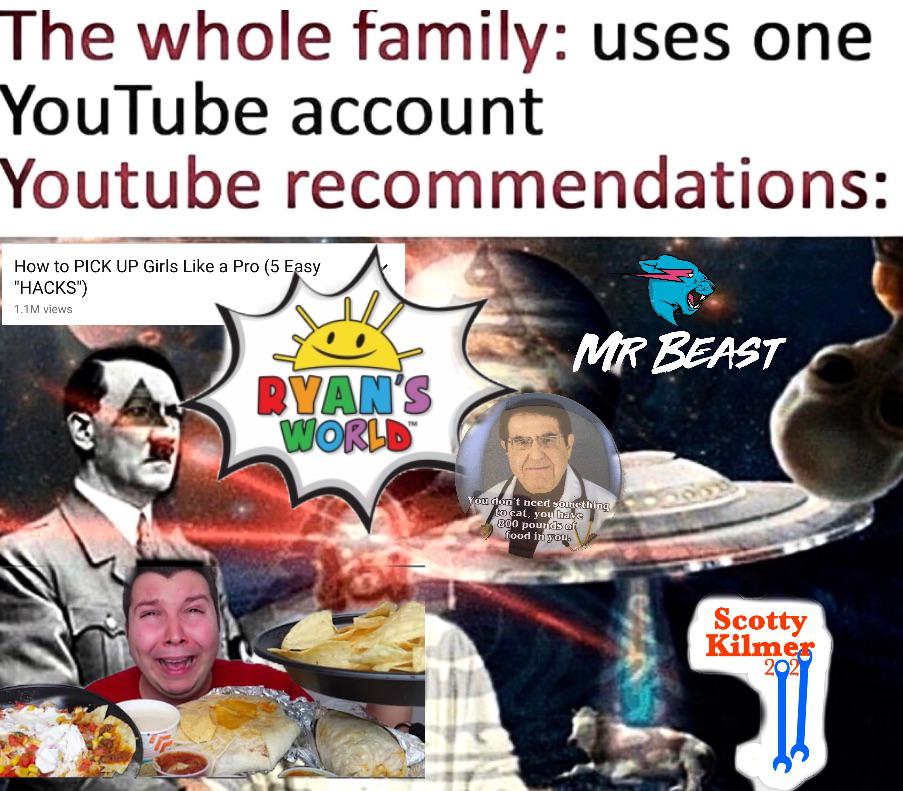
From left to right: Hitler with an Illuminati symbol over his eye; a video titled “How to PICK UP Girls Like a Pro (5 Easy “HACKS”)” with 1.1M views; drama YouTuber Nikocado Avocado crying with a huge array of takeout food in front of him; Jesus with laser eyebeams; a sunshine-shaped logo for the channel “Ryan’s World,” a pin of Dr. Now from My 600-Pound Life saying “You don’t need something to eat, you’ve got 800 pounds of food in you”; a UFO; the planet Jupiter; the logo for YouTuber Mr. Beast; a cow being abducted by raybeam; a political logo for “Scotty Kilmer 2020”; a Gray alien peeking in from the upper right corner. I’m not sure what to think about myself knowing that I know what all of these things are except for the Scotty Kilmer thing.

Evangelicals aren’t really good at adjusting to new things, so I haven’t seen a whole lot of Gen Alpha evangelism posts out of the Christ-o-sphere yet. Maddox might be one of the first to go there. But even then, she drops the Alpha pretense eventually; her last paragraphs mention only Gen Z, and it’s obvious her post only really talks about Gen Z. Someone who is probably Maddox herself jammed a few mentions of Alpha in there to make her post look more relevant, especially considering that Gen Z has almost entirely slipped out of the 4-14 Window—and thus are largely beyond the reach of evangelism. Since Alpha folks are between 0-13 now, evangelists have a shot at them still.
It’s going to be interesting to see what happens when these evangelists try to apply Gen Z thinking to Gen Alpha. I don’t think there’ll be a lot of overlap. I strongly suspect, more to the point, that Gen Alpha will be even less interested in what these evangelists are trying to sell them than Gen Z is, and that is saying a lot.
What evangelicals think they’re selling vs what they’re really selling Gen Z
Don’t think ‘cos I understand, I care,
Don’t think ‘cos I’m talking, we’re friends— Sneaker Pimps, “6 Underground,” 1996
The essential problem evangelists are having right now is that Gen Z fundamentally doesn’t align with evangelicalism. A few years ago, The Atlantic ran an article (archive) about the social views of Millennials and Gen Z. Unsurprisingly, Gen Z leans leftward on almost every issue:
In the United States, economic insecurity has pushed Millennials (born from 1981 to 1996) and Gen Zers (born after 1996) to the left on nearly every policy issue, economic and cultural alike. Young Americans want their country to become more “European,” favoring tuition-free education, single-payer health care, and an increased role for the state in the economy. Older Americans are the ones who tend to be attracted to Donald Trump’s populist cocktail of immigration restriction, protectionism, and easy money.
And Gen Z clearly voted in good numbers in 2020, with half of 18-29-year-olds showing up at polls, compared to 39% of the 18-29 crowd in 2016. In fact, the more liberal the state, generally the more 18-29-year-old voters turned out! According to repeated surveys cited by La Wiki, Gen Z really doesn’t tend to like Donald Trump either. Nor do they tend to like much of anything that evangelicals want to change about American society.
Surveys (like this huge one from American Survey Center; archive) also usually reveal that they’re pro-choice, favor LGBT rights and inclusion, and accept non-marital cohabitation as a given. But evangelicals are only drilling down harder on their culture wars (archive) as their numbers continue to decline.
So evangelists like Maddox may think they’re selling a super-Jesusy religion to their targets—or even, as one writer for American Enterprise Institute thinks (archive), a worldview that stabilizes society itself. Their targets clearly see something else entirely in evangelicalism.
Not for nothing does Barna Group wring its hands (archive) over only 4% of Gen Z holding what they call “a biblical worldview,” which is Christianese for the kind of Christianity Barna Group likes: extremist, culture-warring evangelicalism. Gen Alpha will likely have even fewer subscribing to that worldview.
Unless Maddox can master the whats and whys of Skibidi Toilet, she doesn’t have a ghost of a chance of understanding the generation to come. But then, she doesn’t seem to understand the generation before them, either.
Endnote
I asked Mr. Captain if he’d ever heard of Skibidi Toilet. He said he had not. I briefly explained what it was and began pulling it up on YouTube.
He loudly refused to watch a video about dancing toilets singing hip-hop. No way, no how was he going to put himself through Skibidi Toilet. He’d a million times rather make new color combinations of his Big Stompy Robots.
Of course, I can’t really blame him. It’s weird, to say the least. Not as weird as The Color of Pomegranates, which I loved, but weird all the same. I reckon every generation has its Skibidi Toilet. Pomegranates was the Boomer version of that in 1969.
How you can support Roll to Disbelieve
Thanks for reading, and thanks for being part of our community!
And now, here are some ways you can support my work:
- Patreon, of course, for as little as $2 a month! I now write Patreon posts twice a week, on Tuesdays and Thursdays, with patrons getting early access 3 days ahead of time.
- Paypal, for direct one-time gifts. To do this, go to paypal.com, then go to the personal tab and say you want to send money, then enter captain_cassidy@yahoo.com (that’s an underscore between the words) as the recipient. It won’t show me your personal information, only whatever email you input.
- My Amazon affiliate link, for folks who shop at Amazon. Just follow the link, then do your shopping as normal within that same browser window. This link adds nothing to your Amazon bill, but it does send me a little commission for whatever you spend there.
- And as always, sharing the links to my work and talking about it!
Thank you so much for being a part of Roll to Disbelieve!




1 Comment
Evangelicals offer wrong answers only to Gen Z concerns - Roll to Disbelieve · 12/16/2023 at 1:37 AM
[…] week, I introduced you to a real live ‘Gen Z expert,’ Tanita Maddox. As I noted at the time, Maddox has been very busy writing articles and recording videos about her […]