For years now, Southern Baptist Convention (SBC) members have watched their denomination decline in both cultural dominance and memberships. Recently, the branch of the denomination devoted to information gathering and analysis, Lifeway Research, released some new information about that decline.
In short, that decline’s nowhere near over yet.
How Southern Baptists use the Annual Church Profile—and how they don’t
The Annual Church Profile (ACP) is a yearly survey of Southern Baptist churches. It asks them a variety of questions about:
- Baptisms
- Total membership
- Attendance in-person (and online, since the pandemic)
- Sunday School and small group enrollment and attendance (a small group is something like a Sunday School class for adults; members pray together, study the Bible, and have Jesusy discussions)
- How much money the church has given to SBC projects
The SBC operates as a kind of mother ship to dozens of state-level conventions. Most American states have one. Some states have so few Southern Baptists that they must combine with other states, while others are so large they have more than one. But generally, each state has its own state convention. Churches operate more or less independently, as do the state conventions representing them. Each state-level convention runs its own ACP.
Note two major facts about the ACP.
First, some state-level conventions sometimes ask questions in a different way than others. Or they may leave out some questions entirely.
Second, it’s completely voluntary. Southern Baptist leaders do not require participation in it. So a church may elect to answer all questions, or just some, or only one, or none at all. Participation has no effect on membership in the denomination.
For the ACP discussed here today, 69% of Southern Baptist churches participated by answering at least one question on the survey.
Sidebar: Now consider why a Southern Baptist church might not participate
Given what we know of the SBC as a whole and about Southern Baptists in particular, we can make some educated guesses about churches that refused to participate in the ACP.
I’m betting that the 31% of churches that didn’t participate weren’t exactly doing great, metrics-wise. If they’d been baptizing people left and right, running stunningly effective evangelism programs, and growing so fast their pastors’ sermons were standing-room-only, no way no how would they forget to tell the mother ship about it, or simply refuse to participate.
It’d be extremely interesting to see what Southern Baptist stats would look like if the denomination’s leaders required ACP participation. But I don’t think it’ll ever happen. When such two-edged proposals come up, Southern Baptist leaders begin sweating greasy droplets of muh autonomous local church.
(That’s also why Southern Baptist leaders in the Old Guard faction don’t want to do anything about the denomination’s sex abuse crisis. They’re just so incredibly concerned, you see, about muh autonomous local church. But of course, when those autonomous local churches decide to be inclusive toward gay people or hire women to be pastors, suddenly even the Old Guard faction finds its teeth; archive.)
What Southern Baptist analysts found in the 2022 ACP
You can find a summary of the 2022 ACP here. It looks like the state-level conventions are still gathering the information together from 2023 to send to the mother ship for last year. On the site for the California Southern Baptist Convention (archive), I found a due date for the 2023 ACP: March 1, 2024. So we’re a ways off from knowing how the denomination did last year.
Usually, though, Southern Baptist leaders release a little tickle in the early spring. They like to do that in the run-up to their big Annual Meeting every summer. So keep an eye out for it around April. For now, we’ve got 2022 to keep us company.
And oh, what company it is!
Overall, this new analysis paints a picture of deep decline that is nowhere near even bottoming-out yet. In almost every single way imaginable, Southern Baptist congregations are in trouble. The pandemic only accelerated their decline.
This is probably one of the most dire graphs I have ever seen out of the SBC:
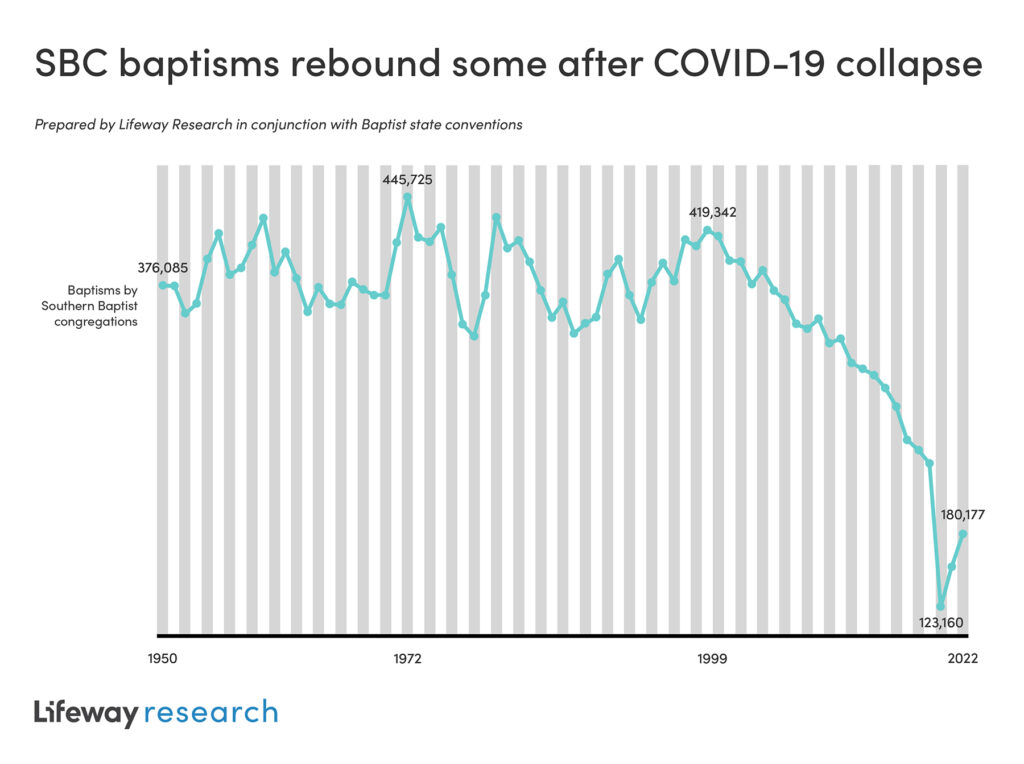
That can’t have been easy for some poor Southern Baptist graphic artist to make. But it’s truthful. After their disastrous pandemic drop in 2020, Southern Baptist churches rebounded all the way to 180,177 baptisms. And even that’s awful. They haven’t seen that small of a number since around 1920, when churches dunked 173,595 people.
(Info about specific years’ performance comes from Annual Reports on the official SBC site. The reports contain info about the previous year. So the 2023 Annual Report contains info about 2022, and so on and so forth. If I give a date like 2018 for a figure, it can be found in the next year’s report, so in this case 2019.)
This is Southern Baptist info we don’t normally get
Years ago, I ran across a report released around 2014 by the Pastors’ Task Force on SBC Evangelistic Impact & Declining Baptisms. It’s an analysis of the 2012 ACP. It is an absolutely eye-opening document, too. I highly recommend it to anyone interested in evangelical-watching.
And I recommend it for one important reason:
It reveals that Southern Baptist leaders have access to a wealth of information about baptisms that they don’t generally make available to the public. One of the most important metrics they reveal is the age of the people getting baptized. I’ve never seen this exact information provided anywhere else.
In the 2012 ACP report, as the Task Force revealed, 25% of Southern Baptist churches had zero baptisms. 60% of respondents didn’t baptize anyone between 12-17, while 80% reported “0-1 young adult baptisms (age 18-29 bracket).” Worse, the Task Force revealed this damning bit of trivia: “The only consistently growing age group in baptisms is age five and under.”
This new analysis of the 2022 ACP makes a good chaser for it, because it, too, reveals a lot of information that doesn’t usually appear anywhere else. For instance, it mentions that about 43% of Southern Baptist churches had no baptisms at all in 2022, while 34% had 1-5. That’s a lot more coming up empty than did in 2012.
Of note, in 2012, churches baptized about 315k people and counted 15.8M members. In 2022, they recorded 180,177 baptisms and 13.2M members.
I’m extremely interested in knowing how the ages broke out in those 2022 stats. If the mother ship had that info in 2012-2014, then it does now.
And they’re not talkin’, which makes me strongly suspect that most of the reported baptisms are the under-18 children of existing adult members and returning members who want to make a public demonstration of their re-affiliation.
(Related: You must be born again and again and again; Gaming a broken system with baptisms.)
And stuff most people could probably guess about Southern Baptist churches generally
As one might guess, Southern churches saw more baptisms, as did urban churches and new churches (less than 20 years old). Rural areas have a lot fewer potential new recruits living nearby, and well, Southern Baptist churches always did do well in the American South. It’s in the name!
New churches, as well, saw a lot more baptisms than old ones did. A church established more than a century ago is probably pretty stuck in its ways and traditional. It’s had time to attract and then alienate all the people in the area. But a lot of evangelicals’ ears perk up when they notice a brand-new church in their vicinity. They think it’ll be different than the ones they’ve tried. They’re willing to visit and check it out.
Churchless believers, those Christians who believe but have left church culture and membership behind, seem particularly open to trying brand-new churches. Often, they’ve been burned hard by other churches, but many say they want to find a good church to join.
Alas, new Southern Baptist churches often have trouble surviving past about five years. The people they attract might leave, taking their wallets with them, or the church’s leaders might turn out not to know how to lead volunteer groups very well.
As a May 2023 article hints (article), the mother ship’s general strategy for about 15 years now has been to scattershot new churches everywhere imaginable in the frantic hopes that they outweigh the number of churches closing each year. Every one of those struggling churches needs a pastor, even if that pastor will also need a day job.
“I’m glad I’m retired,” said one former Southern Baptist pastor in 2022 (archive) of the entire situation with pastors’ overall short tenure.
Selling Southern Baptist church membership on the basis of real-world social benefits
I’ve noticed lately that Southern Baptists have been talking up the real-world social benefits of joining their churches. That’s a wise strategy, far better than the one they’ve been using:
- Convince marks that the Bible is literally true and Jesus is literally a real god who does real stuff in the real world (and will send the disobedient to Hell)
- Then, sell marks active, engaged SBC church membership as the only way to Jesus correctly
Pushing harder on real-world benefits will generate a lot more interest, as long as they can deliver on their promises.
And so we see in the 2022 ACP analysis that churches with very active, engaged members also tend to bag the most baptisms. The more people participate in small groups, in particular, the generally higher their baptism rate—but churches that claimed 100% participation tended to have way fewer baptisms on average (5.9) than those claiming 75-99% participation (7.2).
What’s really interesting about that figure is that churches claiming 25-49% participation got 6.4, and those claiming 0-24% participation got 5.5. So that 100% participation figure of 5.9 baptisms is definitely a strange one.
Also, very large churches with 500+ attending weekly worship services tended to be the only ones that increased their number of baptisms between 2017 (5.2) and 2022 (5.6). Most regions were doing well just to maintain their 2017 numbers.
The Southern Baptist baptism ratio still blows chunks
The number that Southern Baptist leaders consider their very most important is what they call their baptism ratio. That’s the ratio of baptized people per existing Southern Baptist members. It asks: How many Southern Baptists’ resources did it take to get one person baptized?
And it’s why Southern Baptist leaders have known about their decline for about 50 years. That number speaks to the effectiveness of Southern Baptist recruiting and retention. Until about 1974, their ratio hovered in the 1:20-1:29 range. They liked it there. But after 1974, it never dipped that low again.
(Note: The SBC’s Conservative Resurgence began in earnest in the 1970s. This takeover by ultraconservative schemers and hypocrites finally ended in the late 1990s with solid victory.)
In 1985, the baptism ratio hit 1:41 at last. Despite Southern Baptist churches doing everything they could think of to fight it back down into the 1:30s again, it hit 1:50 in 2012. I saw a lot of Southern Baptist panicking around that time. It didn’t do any good then, either, because in 2018, it reached 1:60. I heard nothing about it that time, though.
Then, the pandemic blasted that already-struggling baptism ratio to smithereens:
- 2019: 1:62
- 2020: 1:114
- 2021: 1:88
As of 2022, they’d clawed their way back up to 1:73.
Which leads to the most hilarious bit of Southern Baptist goalpost-shifting I’ve ever seen
That is just shockingly bad, by Southern Baptist standards. That gets evangelicals to wondering if maybe Jesus just doesn’t like the denomination or something.
So the analysts behind the 2022 ACP report have figured out a way to move the goalposts!
Now they’re going to give a ratio between baptisms per every 100 people attending worship services. And doing it that way, they get a baptism ratio of 1:20 for 2022!
However, that’s still a decline, as they tell us themselves:
Another way to examine baptisms and rates for churches is by considering the number per worship attendees. Unfortunately for Southern Baptists, that number is also in decline. With worship attendance also falling, that means baptisms are falling at a faster rate than attendance. [. . .]
Among Southern Baptist churches that reported attendance in 2022, for every 100 people attending a worship service in a Southern Baptist church, five people were baptized on average. In other words, it took 20 Southern Baptists to reach one person. While that is the best number in the past four years, it’s still a decline from 2017 (5.9 per 100) and part of an overall negative trend.
2022 ACP Analysis, Lifeway Research
Man alive, I really and truly don’t know how Southern Baptist leaders are going to deal with this in the next few years. Sooner or later, someone’s going to remember that the Conservative Resurgence was supposed to fix the decline. That’s how its architects and leaders sold it to the flocks. But it seems to have done the exact opposite.
Worse, pushing hard on the supposed real-world social benefits of joining Southern Baptist churches won’t work unless the people in those churches live up to the hype. And most of them just don’t, which we know because they’re falling apart across the board.
That simple truth may explain the relative success of the largest churches in the denomination: Plenty of stuff to do, plus a much higher chance of finding someone nice to make friends with. But if there’s another group that offers those same benefits for less hassle, watch out!
To grow, Baptists need to up their affability game in ways they have never had to do for their entire existence as a denomination. I just don’t think they’re up for the challenge. And I strongly suspect their leaders would agree with me there.
Please support my work!
Thanks for reading, and thanks for being part of our community! Here are some ways you can support my work:




36 Comments
FiveAcres · 02/01/2024 at 9:38 AM
I wonder what the first graph in the article would look like if it were redrawn to reflect SBC baptisms by per capita people in the United States.
Captain Cassidy · 02/01/2024 at 8:42 PM
It’d be an absolute disaster. In 2012, the SBC wasn’t anywhere close to the decline they’re in now. It wasn’t great, but it was still something they could rationalize away. And their task force report notes that they were falling further and further behind basic population growth in the US. Yeah, that kind of graph would be fun to see.
Chris Peterson · 02/01/2024 at 10:42 AM
Why worry about metrics? I’ve been 32 for the last 30 years. Can’t explain that wrinkle, but what the hell…
Rick O'Sheikh · 02/02/2024 at 10:22 AM
Sure, metrics are important – when they are in your favor.
WCB · 02/01/2024 at 11:27 AM
As CC pointed out, the hard line conservatives have not managed to demonstrate great success in the market place of ideas. Sooner or later there must be a reckoning. More progressive churches will abandon the SBC. Younger adults find it a turn off. latest Pew Research shows more women than men joining ranks of Nones. Misogyny doesn’t sell well. The next 25 years for the SBC is going to be interesting.
OldManShadow · 02/01/2024 at 3:38 PM
It will probably turn into a new incarnation of the KKK at the rate they’re going.
Brian Shanahan · 02/08/2024 at 2:49 AM
So it’ll simply return to its roots then.
Carstonio · 02/01/2024 at 12:10 PM
On the surface, the SBC resembles a for-profit business attempting to grow its customer base. But the successful ones recognize that doing so means changing to meet their customers’ expectations. SBC does the exact opposite – it expects its customers to change and then blames them when they leave or when desired customers aren’t interested. The answer is not that the organization is a religion. Instead, it’s that SBC was founded to defend the power of wealthy slaveowners, splitting with the Northern Baptists over the slavery issue, and its mission remains the creation and preservation of a white male oligarchy. I would say theocracy except that evangelicals generally think of “white” and “Christian” as being the same thing.
Ficino · 02/01/2024 at 3:30 PM
They might find willing buyers of resurgent white racism, i.e. dudes who want to indulge their resentments by being racist.
Chris Peterson · 02/01/2024 at 3:48 PM
There will always be willing buyers. A shrinking membership of increasingly extremist occupying a toxic fringe.
Astrin Ymris · 02/02/2024 at 11:01 PM
I have a suspicion that at least one of the reasons that mainline denominations were apparently declining while fundagelicals were increasing was the little known phenomenon of steeplejacking. In brief, fundagelicals would get jobs as preachers in mainline denom churches, then try to push them to the right. If they succeed, they’ve increased their market share of American Christianity. But win or lose, what they often do is alienate moderates and progressive Christians into leaving the congregation, which allows them to count this as proof that conservative churches “win” while liberal churches “lose”, so if you want to be a winner, join the Culture War.
But my parents’ congregation managed to successfully evade an attempted steeplejacking because they were already a functional and effective social club which engaged in charitable activities, and this guy’s ego and misogyny was disrupting the smooth operation of managing church functions and coordinating their benevolent projects. And in consequence, his contract was not renewed, and he left, embittered that he hadn’t convinced his erstwhile parishioners to embrace patriarchal authoritarianism.
Dad’s dubious this is what happened, but I’m convinced. The guy tried to ban mixed gender embraces in favor of side hugging. He was a fundagelical plant, no question.
Brian Shanahan · 02/08/2024 at 2:59 AM
Another likely reason why their numbers looked better is that a lot of churches were counting each baptism a unique new entry when a lot of them were repeats, e.g. Johnny so-and-so moving town every so often and getting himself rebaptised at every new SBC church he joined.
It’s the same reasons why the rcc still officially count me and the many other Irish nones who were originally baptised catlicks as still being believers. An inflated number is better when arguing your case for power.
BensNewLogIn · 02/01/2024 at 12:37 PM
Pushing harder on real-world benefits will generate a lot more interest, as long as they can deliver on their promises.”
but wait! I thought that the only thing that was important was to have faith and if you had faith even the size of a mustard seed, you could move mountains. What happened to all of those real world benefits, and why are they even necessary? You would think that the Rockies would’ve moved over a few hundred miles if any of it was true .
ericc · 02/01/2024 at 3:19 PM
IMO church attendance has always been about real world social network benefits. They’re just finally admitting it. The US is seeing it go down because there’s largely no “work connections” to be had at church any more. And IMO the reason Europe has such a huge ‘none’ population is because the poor don’t need a church group for things like transportation, occasional meals, child care, etc.
Captain Cassidy · 02/01/2024 at 8:45 PM
It’s only a good networking place for people on the member’s own level. The wealthy members of a church might as well be attending services on a different planet from the poor ones. If a wealthy person joins a church, they’re looking to hobnob with other wealthy people. And poor people can’t really do much networking as their work doesn’t tend to require connections to get in the door.
I’ve heard hints of wealthy evangelicals being peeved that the Poors keep bugging them at church. Nothing solid, just hints here and there, reading between the lines kinda stuff, but it would definitely make sense. MLK Jr was right – there’s no starker dividing line drawn, ever, than the one drawn at 10am every Sunday in churches.
smrnda · 02/02/2024 at 12:20 AM
Most of the US has been and much of the country remains segregated by race and social class. People don’t tend to make huge commutes for church, so they’re likely to attend one in their neighborhoods. And most neighborhoods will have people of similar incomes.
Wealthy churches likely have the problem that their wealthy members are going to be very picky about support. They don’t want to subsidize being guilt-tripped about what they’re not doing for the poor, and will just get up and leave or quit giving if that happens.
On the value of connections, many organizations have lost that. People used to join lodges or organizations like the Masons. It was a big deal to get in. There were various ‘clubs’ people in business wanted to join to make connections. Social capital just doesn’t work the same way anymore.
BensNewLogIn · 02/01/2024 at 12:45 PM
“Among Southern Baptist churches that reported attendance in 2022, for every 100 people attending a worship service in a Southern Baptist church, five people were baptized on average. In other words, it took 20 Southern Baptists to reach one person. While that is the best number in the past four years, it’s still a decline from 2017 (5.9 per 100) and part of an overall negative trend.”
Maybe because it’s early, or maybe because I’m getting old, but I’m a little confused about this. It would seem to be that a higher number of baptisms per current members would be a good thing. Unless the implication is simply that old members are leaving and new members are more important. But I’m not clear.
Maybe someone can explain it to an old guy??
Captain Cassidy · 02/01/2024 at 8:49 PM
In 2017, a 500-member church on average bagged about 30 baptisms. In 2022, they bagged 25. They’re trying to make it sound like a baptism ratio, which would indeed be better as a lower number.
I’m suddenly wondering what the analysis education and background might be for whoever’s creating these reports. Bet if we looked, we’d find nothing but religious degrees.
BensNewLogIn · 02/02/2024 at 12:58 PM
I think your explanation explains why I’m not getting it, because it simply doesn’t make any sense. But I still don’t quite get it.
your first paragraph makes sense to me. The lower baptism to member ratio means that the same number of people are bagging fewer baptisms, which is indeed an indication of decline. So that much I get.
this morning, I exchanged a few posts with an anti gay religious person who claims that atheists have murdered far more people
Than Christians have. The examples he gave were of course historically inaccurate on many grounds. But what he also didn’t realize that saying that the atheists That your defense historically wrong murdered more people than Christians that is not exactly the Sterling defense of Christianity and Christian morality that he thinks it is.
Brian Shanahan · 02/08/2024 at 3:05 AM
Numbers are shrinking so quickly that it’s causing a temporary increase in baptism per members ratio. The number of baptisms are falling, but at as slightly slower rate than the number of members leaving. Often happens in social organisations in terminal decline.
ericc · 02/01/2024 at 3:15 PM
𝑈𝑛𝑡𝑖𝑙 𝑎𝑏𝑜𝑢𝑡 1974, 𝑡ℎ𝑒𝑖𝑟 𝑟𝑎𝑡𝑖𝑜 ℎ𝑜𝑣𝑒𝑟𝑒𝑑 𝑖𝑛 𝑡ℎ𝑒 1:20-1:29 𝑟𝑎𝑛𝑔𝑒. 𝑇ℎ𝑒𝑦 𝑙𝑖𝑘𝑒𝑑 𝑖𝑡 𝑡ℎ𝑒𝑟𝑒. 𝐵𝑢𝑡 𝑎𝑓𝑡𝑒𝑟 1974, 𝑖𝑡 𝑛𝑒𝑣𝑒𝑟 𝑑𝑖𝑝𝑝𝑒𝑑 𝑡ℎ𝑎𝑡 𝑙𝑜𝑤 𝑎𝑔𝑎𝑖𝑛.
(𝑁𝑜𝑡𝑒: 𝑇ℎ𝑒 𝑆𝐵𝐶’𝑠 𝐶𝑜𝑛𝑠𝑒𝑟𝑣𝑎𝑡𝑖𝑣𝑒 𝑅𝑒𝑠𝑢𝑟𝑔𝑒𝑛𝑐𝑒 𝑏𝑒𝑔𝑎𝑛 𝑖𝑛 𝑒𝑎𝑟𝑛𝑒𝑠𝑡 𝑖𝑛 𝑡ℎ𝑒 1970𝑠. 𝑇ℎ𝑖𝑠 𝑡𝑎𝑘𝑒𝑜𝑣𝑒𝑟 𝑏𝑦 𝑢𝑙𝑡𝑟𝑎𝑐𝑜𝑛𝑠𝑒𝑟𝑣𝑎𝑡𝑖𝑣𝑒 𝑠𝑐ℎ𝑒𝑚𝑒𝑟𝑠 𝑎𝑛𝑑 ℎ𝑦𝑝𝑜𝑐𝑟𝑖𝑡𝑒𝑠 𝑓𝑖𝑛𝑎𝑙𝑙𝑦 𝑒𝑛𝑑𝑒𝑑 𝑖𝑛 𝑡ℎ𝑒 𝑙𝑎𝑡𝑒 1990𝑠 𝑤𝑖𝑡ℎ 𝑠𝑜𝑙𝑖𝑑 𝑣𝑖𝑐𝑡𝑜𝑟𝑦
So, that’s interesting. I think like a lot of people I saw things like the PEW surveys as supporting the notion that the conservative takeover had been largely successful in *increasing* the size and power of evangelical Christianity, i.e. making it more popular. It certainly showed that evangelical movemen was growing as a percent of Christians! But according to this analysis, the takeover happened in correlation with this higher ratio.
To use a physics metaphor, they might have been moving forward but they were decelerating the whole time.
If that’s true, then the conservative takeover was arguably a failure right from the very beginning. Yes, even back in the ’70s when numbers were growing. If the deceleration was due to the rightward shift, then the growth they saw in the ’80s and ’90s might be interpreted as largely a result of the past good will that evangelism had built up with American public during their earlier, more moderate phase. They were ‘coasting on Carter,’ so to speak. And the only reason they even appeared like they were a positive force in evangelism is because social popularity rarely turns on a dime.
Captain Cassidy · 02/01/2024 at 8:57 PM
Oh wonderfully put, and I think you’re quite right.
There was a big deal in the mid-2000s when an SBC president told the denomination he wanted them to get “a million baptisms” that year. He knew and said outright that baptisms would tell the story of just how Jesus-approved the SBC truly was. He also knew quite well that the SBC was in decline even then.
Oops. They not only didn’t get a million baptisms, they actually got fewer than they did in previous years.
https://onlysky.media/ccassidy/back-when-the-sbc-issued-a-million-baptism-challenge/
OldManShadow · 02/01/2024 at 3:37 PM
[That gets evangelicals to wondering if maybe Jesus just doesn’t like the denomination or something.]
Well, he would hate them, if we take the words attributed to him in the gospels as his words.
And they would hate him. Hell, many of them do hate him if you believe Russell Moore.
https://newrepublic.com/post/174950/christianity-today-editor-evangelicals-call-jesus-liberal-weak
Captain Cassidy · 02/01/2024 at 8:59 PM
He’s got an axe to grind, so one must take that into consideration. Still, I think he’s right. Onetime megapastor Mark Driscoll, a Calvinist hardliner, used to talk about Jesus being a wimp. Mark preferred his version of Jesus, who could fistfight and wrassle. He probably still feels that way, even after his downfall cast him out to pastor a small Arizona church.
smrnda · 02/02/2024 at 12:10 AM
I know that many ‘new churches’ are really just subsidized by older churches hoping to branch out in many Christian denominations. They probably just cost to much relative to the number of ‘new’ people they bring in.
Brian Shanahan · 02/08/2024 at 4:47 AM
I think I may have flagged this post by accident. Sorry.
Rick O'Sheikh · 02/02/2024 at 10:27 AM
Am I missing something somewhere, or is everyone else missing the fact that in the meantime the population is growing, and therefore those declining SBC numbers are even worse than they look ?
Houndentenor · 02/02/2024 at 12:58 PM
I wonder if they are factoring in the move of many Southern Baptists to independent mega-churches that are baptist in all but name. They use SBC literature in their classes and for VBS and other things. I know that’s been a big drain on SBC churches in the areas I know about.
jfnavin · 02/06/2024 at 1:25 AM
Your observation is spot on
jfnavin · 02/06/2024 at 1:42 AM
Some 41% of U.S. adults say they have grown more spiritual over the course of their lifetime, compared with 24% who say they have become more religious. PEW RESEARCH
That is what’s important.
jfnavin · 02/06/2024 at 1:22 AM
concerning the coming of our Lord Jesus Christ and our gathering together to Him…Let no one deceive you by any means; for that Day will not come unless the falling away comes first,
The long ago predicted falling away is going to happen before his ultimate and final return. We are not to be surprised, rather, we are to look for it eagerly.
JuniperAnn · 02/07/2024 at 1:26 AM
What a ghoulish religion.
Rick O'Sheikh · 02/07/2024 at 6:55 AM
Poor you.
Brian Shanahan · 02/08/2024 at 4:51 AM
You do realise that those who predicted the “return” of Yeshua bar Yosef were expecting it to happen in their own lifetimes, c. 1,800 years ago?
If you had ever read your bible, you’d see this as an obvious fact.
ssj · 02/07/2024 at 7:27 AM
i feel sorry for the baptists and will accordingly wish them 1000 extra baptisms per day. these water dunks will occur for real in my head and count toward the total so long as their god can extract the tally from my skull and place it in their report.
Syncretocrat · 02/26/2024 at 2:15 PM
During the pandemic, I wondered if we’d see a big recovery due to people missing their church community, or a further attrition as people discovered how nice it was to skip church. Looking at the SBC baptism graph, the 2022 figures seem to be meeting the pre-covid trend line, so I guess next year will tell us if there’s any kind of bounce back.