Even before evangelicals realized they were in a full decline, they pushed hard on the idea of the offense of the gospel. This is the idea that somehow, their religion’s message massively offends normies. But ‘the gospel’ isn’t offensive at all. It’s evangelism that is offensive, and evangelicals have no desire whatsoever to change it now. Unfortunately for them, the unstoppable force of modern evangelism is colliding with the immovable object that is Gen Z’s values. Today, I’ll show you what they think the offense of the gospel is—and why it’s crashing so hard against Gen Z.
(This post first went live on Patreon on 3/24/2026. No voicecast for this one, sorry! I’m having a super bad back day.)
SITUATION REPORT: The so-called ‘offense of the gospel’
Not long ago, I ran across this 2015 post from Rowdy John Piper about ‘the offense of the gospel’. Like most evangelical leaders responding to that topic, he reaches for 1 Corinthians 1:23-24. Here are the verses in context:
Jews demand signs and Greeks search for wisdom, but we preach Christ crucified, a stumbling block to Jews and foolishness to Gentiles, but to those who are called, both Jews and Greeks, Christ the power of God and the wisdom of God. For the foolishness of God is wiser than man’s wisdom, and the weakness of God is stronger than man’s strength.
For today, we’ll ignore that he’s not exactly using it in context. (See the endnotes for why.) Most evangelicals do the same thing with tons of verses. He’s not unusual. At any rate, with these verses in mind, Piper told his letter-writer that it’s totally okay for her to tell people in Singapore that their religion is wrong and they’re going to Hell according to her religion.
Of course, this post was written over ten years ago. So I wondered if evangelical leaders still teach this stunningly un-self-aware nonsense.
I should have known better. I admit to being a bit of a sweet summer child sometimes, an overly-trusting little cat. Because yes, they absolutely do. John Piper himself still does as well, as we’ll see!
Today, we’re going to dive into this evangelical teaching to see why it might just be driving away even more Gen Z and Alpha people than their religion naturally does in the first place.
The offense of the gospel: Christianese 301
In Christianese, the gospel just means whatever that individual evangelical thinks is the core message of Christianity. Because different interpretations of that message abound, the gospel varies considerably from group to group.
Generally speaking, evangelicals think the gospel is the magic formula for escaping Hell: supposedly-perfect beliefs + a precise style of Jesusing + the ideal amount of fervor and devotion.
Evangelicals really like to think that the gospel is somehow inherently deeply offensive to people outside their tribe. It very obviously gives them a tribalistic euphoric rush to imagine this. They think that only Yahweh could possibly draw normies in and get them past that offensiveness to a place where belief becomes possible—even mandatory.
But the offense of the gospel is also a pragmatically useful concept. If someone rejects their evangelism recruitment pitches, it’s not because they themselves had anything to do with it. It’s just that ‘the gospel’ is offensive to normies. Ta-da!
So Singapore Lady doesn’t need to worry overmuch about how she approaches her prospects. Yahweh does his thing (or refuses to do it) no matter how she presents ‘the gospel’. As Piper puts it:
[T]he gospel of Jesus Christ, as the Bible presents it, is offensive, and it is extreme until God opens the eyes of the heart and calls people out of darkness of rebellion into the light of faith.
We saw exactly this thinking around the same time, too. In 2014, Neil Carter wrote a post about an uber-Calvinist big name, Sye Ten Bruggencate, who justified shocking and reprehensible behavior during a sort-of-debate by insisting that persuasion isn’t his goal at all. He said “that’s the work of the Holy Spirit.” (Yes, this is the same apologist who had to resign his ministry job in 2021 over a serious, predatory-sounding but unspecified “sexual sin.”)
This belief creates a built-in permission slip for gratuitously-offensive jackasses like Sye Ten Bruggencate to be as nasty as they please to normies. If the normies reject them, Yahweh just didn’t want them to convert right then. If they accept, it’s obviously because Yahweh drew them in. It literally doesn’t matter what Christians say or do.
(As you can see, this belief also makes evangelism tactics impossible to evaluate with real-world methods. I’m sure that pleases the many evangelicals selling evangelism tactics to the flocks.)
In the wild: ‘the offense of the gospel’ in modern times
But evangelicals didn’t yet comprehend that facts of their decline in 2014 and 2015. They still thought they had a chance of reversing it somehow.
[Narrator: They did not, in fact, have a single chance in hell of reversing it.]
I wondered what this teaching looks like in the modern day, now that evangelical leaders know to their bones that the decline is here and ain’t reversing no matter what they do. So here’s a grab bag of sources (some big, some small) concerning the offense of the gospel these days.
As we go through these, remember the 1 Corinthians verses. Even when our sources reach for other verses, they’re basing the entire notion of “offensiveness” off of 1 Corinthians.
The gospel, by telling us that our salvation is free and undeserved, is really insulting! It tells us that we are such spiritual failures that the only way to gain salvation is for it to be a complete gift. [Grace Community Church quoting Tim Keller, 2023, and it only gets more daft from there]
At the center of preaching the cross is repentance. And repentance, properly understood, is the truly offensive thing. [J.D. Greear for The Gospel Coalition, 2023, after his 2021 scandal broke about employing a sub-pastor who had covered up sex crimes]
God’s word proclaims God’s holiness and man’s wickedness. By definition, this is offensive. [Ben Smith, possibly 2025]
[R]obust forms of evangelism are daring because they put forward another offensive claim: that you and I are implicated in the murder of God’s Son, our sins are on the docket, and only he holds the key to free us from our prison of guilt and shame. [Trevin Wax for The Gospel Coalition, 2024, likey very relieved that everyone forgot the 2023 scandal around Josh Butler]
[T]he gospel may be offensive. [. . .] After all, the message is that you are messed up and you can’t fix yourself. It is foolishness to some people, and it is offensive to others. [First Baptist Church Bartow, 2025]
[P]olitical correctness limits our willingness to offend, and asserting the full gospel message is the most offensive of truth claims. Political correctness finds the notion of a literal hell as insufferably backwards. . . [Midwestern Seminary’s blog For the Church, 2025]
Just to round out this section, let’s conclude with a John MacArthur post for Grace to You, written just after his 2018 resignation from an evangelical college and the bigger 2022 scandal:
I recently said in an interview that, as a Christian preacher, “My goal is to offend everyone.” That’s not an argument for boorish behavior in the pulpit. [. . .] Rather, my point was that I want to bring the offense of the gospel to bear on everyone I encounter. Faithfully confronting sinners with the depth of their depravity, the cost of their wickedness, and their desperate need to repent is rightly offensive. I want my speech and my behavior to adorn the gospel, and to let its offensive truths do the offending.
As for John Piper, our SITUATION REPORT guest star, he drilled down on his offense of the gospel stuff as recently as 2024.
I could go on and on, but you get the idea. Evangelical leaders push very hard on the idea that something about ‘the gospel’ is inherently offensive.
But ‘the gospel’ isn’t offensive at all
In fact, evangelicals’ form of ‘the gospel’ has them saying things that sound pretty normal for any religion:
- My god makes particular demands of his followers
- Anyone joining my religion must acquiesce to my god’s demands
- Now that you know about my religion, you must join it
- If you refuse to join my religion, I’ll—er, I mean, my god will be very angry with your disobedience
- My god sends the disobedient to a deeply unpleasant afterlife with no chance of rescue
Evangelicals can’t allow themselves to notice that the way they view the demands and afterlife of other religions (like Hellenismos, Hinduism, or Ásatrú) is the exact same way normies view the ‘the gospel’. Christianity adds more emphasis on the afterlife and features stronger threats, sure, but one can’t help but wonder if that’s because it must.
What’s far more offensive is how evangelicals sell their take on the supernatural. They don’t present evidence for their religious claims (which they don’t have anyway) or for their groups being worth joining (when they usually aren’t). Instead, they start by assuming that their marks are broken and that their product will fix them. That’s a salesperson’s form of emotional manipulation, no different from inventing a problem that their product will totally fix.
“Do what I say or you’ll really suffer” isn’t a new message. It’s not even more offensive than any other high-control group’s recruitment pitch. In the absence of any objective reason to obey, it’s just very obviously a control-grab.
And Gen Z ain’t feeling it
Every generation has its quirks and collective psyche. Gen X people, when we’re remembered at all, get noticed for our sarcasm and nihilism.
But Gen Z might well be remembered as the boundary-respecting generation. It’s why that one Christian character in the 2021 movie Don’t Look Up was so remarkable: he’s extremely fervent, yet he respects other people’s boundaries. He asks before taking. He respects that other people don’t share his views.
From what I’ve seen after lurking Gen Z social media, he’s nearly a perfect distillation of a generic Gen Z guy. And that’s extremely bad news for evangelical leaders.
These leaders already know that Gen Z is the least evangelical generation in the history of recording such views. Gen Z women, in particular, are leaving religion in record numbers. Evangelical-led surveys try very hard to avoid pointing out that Christian behavior itself is the “stumbling block” for Gen Z, not the offense of the gospel. But you can still read it between their lines. The more reality-led surveys point that out even more loudly and clearly.
More than that, over and over again Gen Z studies show an age cohort that values authenticity, relationships, and respect for others. They value their friendships and connections too much to risk them on a recruitment pitch. They’re far more likely to value forms of evangelism that stress actions over words. And they don’t tend to seek out confrontations over religion.
Evangelicals have learned nothing from the Millennials leading this trend. That’s ironic, given their big emphasis on the 4-14 window. That’s the idea that if someone isn’t indoctrinated between these ages, they’ll be very unlikely to convert later on. That 4-14 window closed on Gen Z this year, because the youngest Gen Z kids are 14 right now. Accordingly, the oldest Gen Alpha kids are 14 now, meaning the window is already starting to close on the next generation.
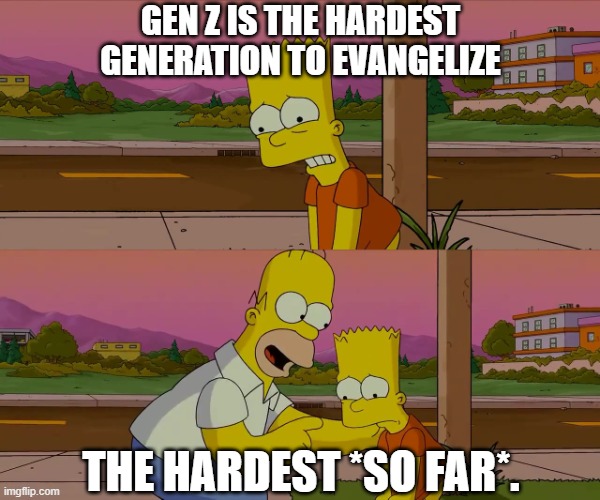
I fully expect evangelicals to learn nothing from this window’s closing either.
They can’t.
When a high-control group’s ideals clash with those of a group prizing low control, the results are the offense of the gospel
By now, evangelicals are completely invested in being confrontational, arrogant, and authoritarian toward their prospects. That approach will only draw in similar people. That’s why they’re so thrilled with their supposed “quiet revival” of Gen Z men: For whatever reason, some of these guys do legitimately want high-control, right-wing authoritarian figures to obey. Not enough Gen Z men are joining to reverse the decline, but yes, some of them do indeed join evangelical groups (and tradcath, and hardline Orthodox, etc).
For most Gen Z prospects, though, this approach will only drive them further and further away from hardline religion in general. They value authenticity, which that end of Christianity suppresses and demonizes. They do value relationships, which can only exist in their most shallow and transactional forms in evangelicalism. There’s not a single Gen Z value that evangelicalism doesn’t trample.
But whatever becomes canon in evangelicalism stays canon. Forever. Evangelical leaders can’t tell their followers to stop being so offensive. They can only try to curb the worst examples of offensiveness. Even the ones cautioning Christians not to be too personally offensive still default to the false idea that ‘the gospel’ itself is offensive. Anyone insisting on love alone as a recruitment tactic gets accused of Jesusing all wrong.
I’m glad evangelicals don’t listen to me. I’d hate to disturb them in the middle of a decades-long mistake. If they actually listened to heathen heretics like me, they’d focus on recruitment tactics that actually work. We can all be glad that they don’t and therefore can’t.
NEXT UP: The amazing meltdown of the Jehovah’s Witnesses continues. This one’s shocking even me—see you soon! <3
Endnotes.
1 Corinthians 1:23-24 talks about how nonsensical Christianity is from both a Gentile and Jewish standpoint. It calls out the way Jesus is a “stumbling block” to Jews. But he’s a “stumbling block” because he literally doesn’t fit any of their predictions about their Messiah. That’s why they overwhelmingly rejected Christianity in the 1st century. Gentiles were more interested in how much sense the new religion made, but it makes none. Christian leaders needed its completely illogical nature to be a positive, not a negative. So they simply insisted that it was.
The problem addressed in 1 Corinthians centers on cultural expectations, not the behavior of missionaries or the inherent offensiveness of the “gospel” or evangelism at all.
Please support my work!
Thanks for reading, and thanks for being part of our community! Here are some ways you can support my work:




0 Comments