Recently, a professor describing herself as “spiritual-but-not-religious” wrote about how the cultural decline of Christianity has affected religious infrastructure. It got me thinking about what’ll happen as Christianity continues to erode in America. There definitely exist both good and less-good sides to that erosion—and what this professor calls a bill coming due. Today, let me show you that infrastructure—and let’s explore what’s happening as Christianity continues to decline.
(This post and its audio ‘cast first went live on Patreon on 5/29/2026. They’re both available there now. Please support my work—see the end of this writeup for options, and thank you for whatever you decide to do! From introduction: Dr. Hector Avalos’ amazing talk about the death of ‘biblical history‘.)
SITUATION REPORT: A tired old Christian claim gets me thinking
I don’t hang out on social media much at all, but I did enjoy this exchange with a Christian:
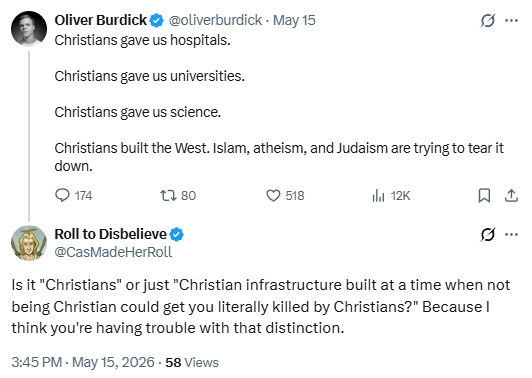
It’s been a hot minute since I saw Christians arguing that their infrastructure PROVES YES PROVES that their religion is best. But I guess nothing ever really leaves Christianity. (Some elderly evangelicals out there likely still think the Satanic Panic is real.)
In truth, that infrastructure did arise out of Christianity, but it also could have arisen in any other major religion with vast temporal power. Christianity is not special for having built schools, allowing scientists to work, or even running hospitals. That’s stuff every world religion has done.
In fact, it’s stuff every world religion did—well before Christianity was even a glimmer in some inventive first-century wordsmith’s eye. However, no religion lasts forever. And once it’s gone, what next?
In a May 14 article for Religion News, Liz Bucar (a professor and author) covers what rising secularization means for Christianity’s infrastructure. Here, “infrastructure” doesn’t mean just buildings. It also means political apparatus and community aspects, even religion’s ability to draw many people together for big projects.
Today, let’s go on a journey through the ancient world and see what religious infrastructure looked like before Christianity. Then, let’s explore the post-Christian world together.
The emergence of religion in humanity
First, let’s start with the earliest history of religion.
Humans didn’t specifically evolve to be religious, contrary to what some Christians insist. We have no real “god-shaped hole,” though many people today do have a god-shaped wound. But religion plays upon a number of the mental quirks of our evolution. It rides, so to speak, on rails that developed long before for different purposes.
In a very real sense, gods evolved alongside humans. As Barbara King wrote in Evolving God:
[T]o fully probe the origins of religion, we must look beyond even the first glimmers of human evolution to examine the emotional lives of the apes. And so I start the evolutionary clock earlier than do others who chart the origins of the religious imagination.
Indeed, our ability to imagine something that doesn’t exist—which scientists call decoupled cognition—may have influenced toolmaking. After all, as Lewis Wolpert has written, a toolmaker needs an idea in mind, a goal to reach using humble starting materials. From there, our ability to imagine may have led us to the notions of spirits, an afterlife, and gods. Our linguistic abilities allowed us to transmit those ideas to others.
That progression took a great deal of time, of course. But those early humans had all the time in the world.
Organized religion as a cohesive force
I’m hardly the only person who’s ever seen religion as a force for cohesion in large groups. It’s not even a provocative idea. As Ken Baskin wrote in 2018:
First, the challenge of every evolving species to ‘know’ exactly what they must know to survive; and, second, the challenge of every social species to encourage cooperation, even to the point of individuals giving up their lives, even though their primary instinct is survival. The human response to these two challenges includes myth, which helps us understand what we must know, and ritual, which encourages strong group ties and cooperation. When myth and ritual became integrated in human behavior – I speculate it might have been between 1.5 and 2 million years ago – they would provide the critical process by which the human social complexity skyrocketed, as communities grew from bands of about 20 to cities of 20 million.
Other scholars, like those involved with the Seshat project, suggest that when a civilization grows past about a million residents, “moralizing gods” begin to dominate the religious landscape there. These gods also grow in scope and power as the population grows.
In that way, small-scale collective rituals become huge ones. Small gods become big gods. Yahweh, as just one example, was a small god long before he became a big one. Over time, those small gods largely vanished in the West; nobody buries Sumannus’ lightning anymore.
These “big gods,” as they’re called, governed equally big civilizations. And in their long shadows, infrastructure proliferated.
The infrastructure of religion
Before Christianity existed, other civilizations practiced charity of all kinds. Even Hammurabi’s Code, written in the 1700s BCE, provides for charity and debt relief, focusing particularly on the protection of widows and orphans. Hammurabi ruled the Old Babylonian Empire between about 1792 BCE-1750 BCE. The empire itself flourished between about 2000 BCE-1600 BCE. It was a cultural part of the overall Mesopotamian Civilization, which ran from about 3400 BCE-500 BCE. But before his legal code, the Code of Ur-Nammu (inscribed around 2100 BCE) talks about similar protections:
The orphan was not delivered up to the rich man; the widow was not delivered up to the mighty man; the man of one shekel was not delivered up to the man of one mina.
Like most ancient civilizations, Mesopotamians practiced hospitality toward strangers and charity for the poor. They had a strong sense of duty toward those who lacked familial protection and victims of misfortune. Accordingly, the Babylonian Empire’s temples weren’t just religious centers. They also educated highborn or donated children and performed administrative tasks for the empire, as well as distributing grain in times of famine.
Even earlier than that, around 2100 BCE, Ancient Egyptian rulers proudly inscribed their charity efforts on their tomb walls (and deciding that the gods were most pleased with him):
I gave bread to the hungry and clothing to the naked;
I anointed those who had no cosmetic oil;
I gave sandals to the barefooted;
I gave a wife to him who had no wife.
In Ancient Athens, the eponymous archon—the chief religious and civic leader—bore responsibility for widows and orphans. In fact, Athenian law provided a number of protections for women and children who lacked familial protection. And this was going on well before Christianity existed. (Alas, many Christians today don’t know anything about it.)
In Sri Lanka, some of the earliest hospitals in the world got built around the 4th century BCE. It took a while for people to build general hospitals rather than specialized ones, but once we got going we didn’t stop. The Romans built military hospitals around the 1st century CE. In modern-day Iran, the first teaching hospital was founded around 300 CE.
Christianity emerged at a critical time for world civilizations. Its vast infrastructure can’t be overestimated in importance to local communities. Schools, orphanages, even senior care centers proliferated across Europe and beyond as it advanced.
However, it’d be inaccurate in the extreme to claim that the ancient world was just in awe of Christian charity. In point of fact, citizens of the Roman Empire thought it was weird to give anything to the destitute. In the 2nd century CE, the poet Lucian of Samosata even wrote a poem about a con artist who tricked Christians into giving him tons of money and revering him as a great teacher and spiritual leader.
Despite those hurdles, Christians continued to focus on mutual aid, organized giving, and—of course—careful records of who got what from whom.
Secularization advances, while Christianity falls back
About 1800 years later, the artifacts of Christian infrastructure surround us in America—for good or ill. Way too many hospitals are run by religious groups that don’t recognize America’s protections of human rights. Christian-run orphanages and unwed mothers’ homes abound, many caught up in huge scandals. Churches and religious schools, of course, dot our landscape. And numerous “ministries” exist solely to clamor for temporal power in legislative halls.
However, fewer and fewer Christians are paying money into the vast Christian machine that pays for all of that stuff.
Some 25 years ago, my favorite coffeeshop in Idaho was a lovely converted church building. The church had closed years earlier, but some Christians eventually bought the building and turned it into a thriving business. If buildings can be lucky, then this one was lucky. Another, smaller church one street over from it wasn’t nearly as picturesque. After years of standing empty, its new owner demolished it to refashion the site into a convenience store and parking lot. Indeed, most churches that close will eventually experience much the same fate. Nothing else can be done for them. Usually, their congregations have let their upkeep and maintenance lapse so far that the safest thing to do is raze the building and just start over with something else.
It’s much harder to say what can be done with the other massive infrastructure projects of Christianity. Some of them, like the hospitals, can fund themselves. But many others depend on Christian giving. Catholic parochial schools already face a financial crisis caused by fewer enrollments every year. A 2025 report from James Mattison reveals that as Christian affiliation wanes, so does charitable giving to religious groups—while giving to secular groups increases all the time.
Secularization may be starting to reveal holes in the social fabric left by religion
Christian infrastructure goes far past abandoned church buildings, of course. That’s the point Liz Bucar makes in her Religion News article (relink). As a “spiritual-but-not-religious” person herself, she’s studied religious infrastructure and its effects on American society. As she writes:
Organized religion, for all its failures, knows how to show up. It has institutions, congregations and email lists. It has spent decades building the kind of infrastructure that translates conviction into political action. That is why when conservative Christians want the government to promote Christian values, they have organizations, lobbying arms and school board slates ready to go.
What do spiritual-but-not-religious people have? Podcasters and social media influencers.
She’s right. The entire Civil Rights Movement of the 1950s-1960s owes a lot of its success to Black church communities (though white congregations largely stayed well out of it, as the groundbreaking book The Gathering Storm in the Church explores). That’s also why the Religious Right has held onto a great deal of temporal power despite plummeting membership numbers. Thanks to endless politicization since the 1970s, evangelicals vote—and the men at least vote reliably Republican.
There’s not an easy solution to secularization’s erosion of religious infrastructure
That nuts-and-bolts understanding of the political process has stymied other movements seeking solutions in government. Without a way to organize large numbers of people and persuade others, secular movements face an uphill battle against well-entrenched religious groups.
Some secular people do join churches for decidedly secular reasons. I’ve run into more than a few people who join for social reasons, and I’ve even written about alt-right Gen Z men joining very conservative churches basically for their aesthetics. But for most people, joining a church is out of the question when we can’t accept Christian claims.
To her credit, Bucar isn’t suggesting any such thing. Rather, she wonders if maybe secular people can figure out a way to create a new infrastructure that “scales” larger than just the individual experience:
We have borrowed the most individually appealing parts of religious practice — the meditation, the ritual, the transcendence — and left behind everything that felt like a duty. Or commitment. Or accountability. Or even community that makes demands on you. The obligation to show up even when you don’t feel like it. The sense that your spiritual life is bound up with other people’s. [. . .]
The spiritual-but-not-religious Americans I’ve interviewed for my research are often the most thoughtful people I’ve met when it comes to meaning, mortality, ethics and human flourishing. They’ve thought hard about how to live. What they haven’t figured out is how to translate that wisdom into anything that scales.
We could certainly quibble about just how fantastic that stuff really is or even how present it truly is in modern Christianity—duty, commitment, accountability, or even community making demands. I don’t think much of it really is on either count. But I think she’s got a point here.
Religion might have served humanity well once, allowing us to build huge cities and sprawling infrastructure all over the world. But we’re in a new world now, one crying out for different solutions. I hope whatever we come up with works better than Christianity.
NEXT UP: The modern AAA video games industry offers some lessons to Christian leaders. See you soon! <3
Please support my work!
Thanks for reading, and thanks for being part of our community! Here are some ways you can support my work:




0 Comments