For years now, I’ve said that Christianity wouldn’t exist today if it weren’t for its leaders grabbing and wielding legal powers of coercion 1800 years ago, then protecting it with everything they had. In recent decades, secular governments have been peeling away those powers bit by bit. But amid more bad news of serious decline, evangelicals have dropped whatever remained of their pretense of wanting to win through persuasion and recruitment. Now, they’re out for pure power.
And what’s so funny about the situation is that—like all control-hungry narcissists—they really are their own worst problem. This effort is doomed to fail for one simple reason: They can’t legally force Americans to play along anymore, so not even their own members will entertain their demands.
(This post first went live on Patreon on 5/25/2026. Please support my work—see the end of this writeup for options, and thank you for whatever you decide to do!)
SITUATION REPORT: I’ve always said they can see the necessity of religious dominance just as well as we can
On May 7th, a number of Christians observed America’s National Day of Prayer. It proceeded much like others did: Some local celebrations, White House statements on social media, Donald Trump pretending he’s Christian to humor the Christian Right, etc.
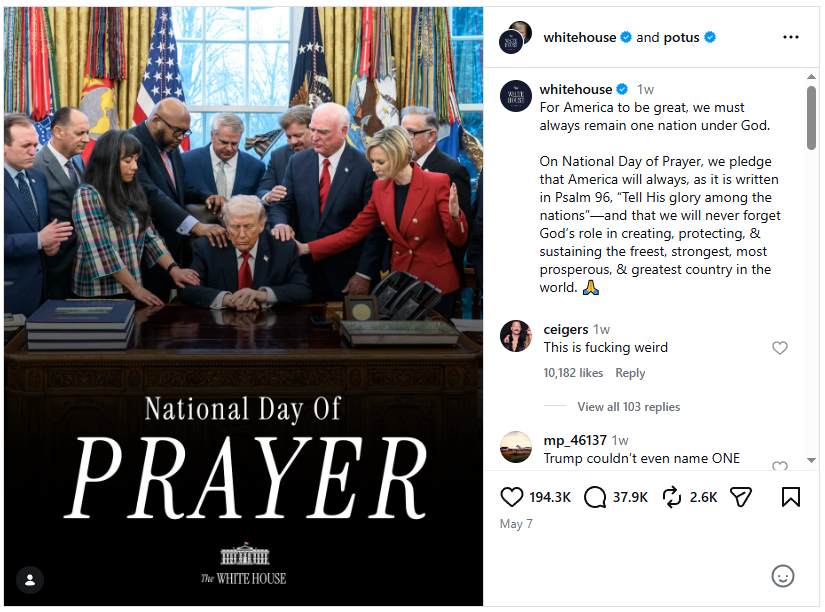
Shortly afterward on the 17th, the Christian Right held a similar but much bigger spectacle called “Rededicate 250.” This event focused on making America sound like it only exists because Yahweh likes Americans best. It claimed miracles galore occurred throughout American history and quoted the current President of the United States saying that if Christians could “bring religion back stronger, you’re going to see everything get better and better and better.”
In addition, prominent Republicans (Mike Johnson, JD Vance, Marco Rubio, Pete Hegseth, and likely others) encouraged the mostly-elderly attendees to vote in ways that enshrine Christian dominance into law.
The name “Rededicate 250” refers to the Christian Right’s desire to turn America into “a Christian nation” in honor of the upcoming 250th birthday of the Declaration of Independence. Obviously, the Declaration was signed in 1776. (The Constitution, signed in 1787, went into effect in 1789. But given that it doesn’t give Christian religious leaders temporal power or imply that America should be “a Christian nation,” we might not see a “Rededicate”-style event in 2037.)
Unsurprisingly, Christians’ attention has focused far more on the “Rededicate 250” event.
Fireworks and Christian nationalism > quiet prayer in private
It’s funny that “Rededicate 250,” with its overt Christian nationalism and blatant grab for power, got so incredibly much more attention from the Christian Right, while the National Day of Prayer—focusing as it does on thinking extremely hard at the ceiling—got so little. But it’s not surprising.
Right-wing Christians know what actually gets things done in the real world. Thinking at the ceiling is all fine and good, but it doesn’t do anything real to improve Christianity’s numbers. For that, Christians need temporal power. And that is what Rededicate 250 was all about: Encouraging Christians to view themselves as the rightful owners of America and their version of Christianity as the dominant political force in Americans’ lives. They weren’t even subtle about it.
If they weren’t such an incredible threat to American democracy, it’d be easy to mock right-wing Christians for such blatant hypocrisy. Of course, more’s going on here than just hypocrites being hypocritical. Right-wing Christians have figured out what has to happen to get them back into a position of dominance over Americans.
Taken together, both the prayer and nationalism events reveal that these Christians fully understand how necessary temporal power is to their dominance over Americans’ lives. Without it, they’re cooked.
And the worst part is, they know it quite well. Today, let me show you the lessons these Christians have absorbed—and why they’re pushing harder than ever to regain their lost power over Americans.
But to fully understand why all of this stuff is happening, we must look back in time.
How Christianity became a world religion and major political power
For all Christians’ mythology about the early growth of Christianity, the historical record doesn’t agree. Neither does the Bible itself. After the Gospels, the rest of the New Testament contains endless tantalizing hints about how hard it was to recruit new members. But as hard as it was to recruit, retaining those hard-won members seemed even more difficult.
However, getting the recruits to actually follow Christian rules proved impossible, leading to one of the funniest comments about the Bible that I’ve ever seen:

What really kickstarted Christian dominance was their leaders gaining temporal power. Once Christianity became an official state religion in the Roman Empire, and from there the only allowable religion, growth could begin in earnest.
Losing religious dominance in America
The Enlightenment certainly stalled theocrats’ dreams. It, along with the Scientific Revolution, changed how people saw everything—from themselves to the world to the universe beyond our planet. These changes led to a significant paring-away of Christian leaders’ power. But quite a few Christians still wanted it back. Indeed, without it they don’t feel safe.
Even the Protestant Reformation didn’t remove that yearning. No, control-hungry Christians just headed for America. There, they hoped for a fresh start as a “holy experiment,” as “plantations of religion” —with the kind of power they had been denied back home. However, the big-name leaders of this new land were not religious extremists. They were Enlightenment thinkers like Thomas Jefferson, who explicitly rejected the idea of allowing religious leaders any kind of power within government.
By the 1940s, that loss of power had hit critical levels for right-wing Christian leaders. One book in my library, As We Were: Family Life in America 1850-1900, is just a nonstop Christian complaint about losing power and deference amid the social changes of the early 20th century!
In response to these losses, right-wing Christian leaders sprang into action. Along with conservative American politicians, they engineered a series of moral panics to create Christian nationalism: a volatile union of authoritarian religion and overreaching government.
Religious dominance as part of the Red Scare
Here’s how they did it.
Back in the 1950s, the National Day of Prayer grew out of the Red Scare. Billy Graham, in particular, deliberately framed evangelical Christianity as the only way to defeat Communism. Thanks to this framing, America—which was supposed to maintain a careful and wary distance between government and religion—adopted a number of overtly-religious platforms and civic customs.
For many years, Americans knew better than to voice disbelief or wrongthink opinions that might lead their neighbors to suspect they weren’t fervent Christians. With Christianity viewed as an essential part of an upright, law-abiding, democracy-loving life, few dared to dissent.
When we look at stories about the secularization of the West, we must remember that America lags behind Europe and other areas because of this coercive atmosphere that the Christian Right created. That lag didn’t occur because American Christians are just so much more Jesusy than those of other nations. They’re definitely not! It’s more like not being Christian came with severe penalties that simply didn’t exist to that extent in countries like the UK.
Religious dominance is still alive and well in America
As legal challenges chipped away at Christian overreach, those penalties began to diminish. Oh, there certainly do still exist areas where people face serious penalties for refusing to participate in Christian activities. One resident of a small town in Kansas revealed those penalties in a 2024 story in the Kansas Reflector:
“It’s hard to fit in unless you go to SSPX,” [Hannah] Stockman said. “And then there’s the townies, who kind of all just stay isolated in their own home.” [. . .] Many non-SSPX residents were afraid to oppose the church, Stockman said, and she described their thought process as: “We stand up, then we will lose our business. Or, if we stand up, my husband will lose his job. Or, if we say something in opposition, there’s a whole array of fear.”
And “SSPX” is a Catholic church, not even evangelical! But they’re conservative Christians in America, which means they’re dysfunctionally authoritarian, which means they’re extremely tribalistic. The differences between Catholic and Protestant conservative Christians eroded 25 years ago. Nowadays, they’re bunkmates.
That said, I heard these exact same stories decades ago from people who refused to join evangelical churches: social ostracism, loss of customers for their businesses, bullying of their kids at school, and even vandalism and theft of their property.
Jesus might have told his followers to love their enemies, but they’ve redefined “love” quite a bit by now.
Unfortunately for them, there are just too many dissenters now for the tribe to fully retaliate fully against them all. Nowadays, they must pick and choose their targets.
The last time Christian nationalists pushed hard for a return to dominance
About a decade ago, Christians talked like this as a response to New Atheism.
Back in 2016, a major Southern Baptist Convention (SBC) leader, Russell Moore, wrote movingly of religious freedom as an essential right and liberty. Of course, he also completely pissed off the other SBC leaders. They far preferred that it mean the freedom to pick which Christian church you’ll attend, to paraphrase Bryan Fischer in 2015. But hey, Moore tried.
In those years, Roy Moore, a creepy Alabama judge, went viral in 2014 for a very similar opinion. And evangelical pastor Joe Morecraft said in 2013 that he wished American evangelicals could literally enslave atheists. You know, for their own good.
But after a while, the calls for enslavement and a theocratic America quieted somewhat. For a while, anyway.
In recent years, I’ve seen an uptick in the number of right-wing Christians openly trampling the idea of religious freedom. When Jenna Ellis recently informed her podcast listeners that religious freedom actually means empowering Christian nationalism, it felt like such a blast from the past.
What is old is new again
But I hadn’t seen anything yet.
Donald Trump’s new Religious Liberty Commission openly seeks to force religious symbols and mandated prayer time into public schools, gain even more religious exemptions for themselves, and set up an automated, federally-funded hotline that tells callers, “There is no separation between church and state.”
Predictably, the “Religious Liberty Commission” itself is made up entirely of controversial figures and post-truth faux-experts who don’t like knowing that Americans are fully allowed to reject their control-grabs. I didn’t see a single non-Christian on the list of members, much less anyone from a different religion.
This past December, Vice President JD Vance told a crowd that religious liberty is a Christian concept. He’s certainly not alone in this mistake; I’ve seen the hard-right evangelical site The Gospel Coalition (TGC) asserting the same thing. It’s absolutely not, of course. I hope I’ve shown you that religious liberty, as a concept, is actually a reaction to Christians’ inevitable abuse of temporal power. If Christians still held that kind of power over others, they wouldn’t care about religious liberty at all.
Maybe Trump’s aiming for a third golden statue from his biggest fans.

But the motivations of these other people are all too easy to discern.
Demographics is destiny: A funny thing happened on the way to the Panopticon
This is unpleasant stuff to contemplate, speaking as an American who somehow still loves her country. However, two cultural developments give me hope.
First and foremost, what we’re seeing is a pair of time bombs exploding at both ends of Christian demographics. Grabbing harder for control, particularly of children, is not a way to win over either those children or their parents. Ask any country with mandated Christian education (or anyone who went to a fancy parochial school in Kansas): They’ll tell you that kids, who lack the compartmentalized framework adult Christians develop, easily spot the problems in Christianity and reject it.
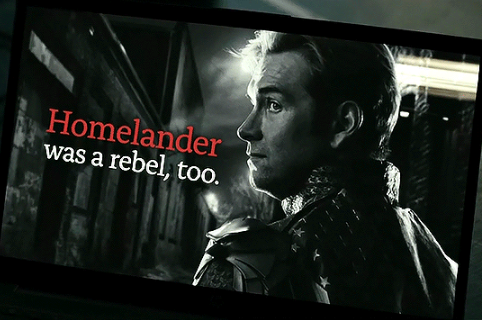
Modern kids in particular seem completely inoculated against the Christian Right’s usual recruitment strategies. Mega-expensive ad campaigns like “He Gets Us” have gone nowhere—but clearly inspired a hilarious spoof in The Boys starring Homelander as American Jesus 2.0.
Constant hyping of the fake “Quiet Revival” of Gen Z men has imploded on impact with reality as well. There isn’t any sign whatsoever that Christianity has seen any turnaround in its cultural decline.
Meanwhile, another demographic time bomb is starting to go off at the other end of Christianity’s numbers. When I look at pictures of Rededicate 250, I see an audience that is 3/4 elderly white people. Sure, some youth groups attended, and I saw a smattering of younger Black people there. But this event was primarily a cri de coeur of aging right-wing Christians who are outraged, upset, and fearful about their loss of cultural power. Over and over again, we’ve seen that younger right-wing Christians are not only far less numerous but have different priorities than their older counterparts.
The other big problem the Christian Right faces
Second, remember that comment about the Apostle Paul? That’s still true. Even firm, hardline Christian Right stalwarts don’t obey their leaders. Consider church attendance as one example. In their Annual Reports, SBC pastors consistently tell us that only a third of their churches’ members attend services on any given Sunday.
I suspect the real attendance rate is far, far lower than that. Back when I was Pentecostal in the 80s-90s, a “regular churchgoer” attended every Sunday morning. They likely attended on Sunday night and midweek too. Now, it means someone who bothers showing up once a month. (Or less: one study I remember defined regular attendance as 3 out of 8 Sunday mornings!)
There’s never been a positive difference between the behavior of even zealous right-wing Christians and the outsiders they hold in such contempt. That was the entire point of the 2005 book The Scandal of the Evangelical Conscience. Nothing has changed since then, either, except for the worse.
So if the Christian Right fully expects people to feel compelled to attend and support churches, they won’t even get that from their own people. Even if they get everything they wish for and actually create the Republic of Gilead out of the ashes of the great experiment that was once America, it’ll only hasten their decline. Without the power to force people to join up, stick around, and pay tithes, they’re sunk.
Nothing could reinforce the sheer awe-inspiring glory that is full religious freedom better than seeing what happens when religious zealots trample it. The lessons Jefferson took from that exact situation centuries ago may need to be learned anew by modern Americans. But I think we can do it. We’re Americans. We do tough things all the time. As we approach the 250th birthday of the signing of the Declaration of Independence, let us remember and cherish what our predecessors fought and bled to achieve.
NEXT UP: Evangelicals renew their focus on rebaptism as their decline continues. See you soon! <3
Please support my work!
Thanks for reading, and thanks for being part of our community! Here are some ways you can support my work:



0 Comments