We’ve finally arrived at the very end of Alpha Course, the UK-based evangelism series that stands unrivaled as the most popular one of its kind. To cap off their series, our hosts are going to try to make church membership and attendance completely essential to one’s experience of Christianity. But in doing so, they describe a world that just doesn’t exist in reality—one where church communities are far closer and more functional than they are in our world.
(This post first went live on Patreon on 7/24/2026. Please support my work—see the end of this writeup for options, and thank you for whatever you decide to do!)
SITUATION REPORT: We did it! We finished Alpha Course! And it’s a banger: ‘What about the church?’
Alpha Course 16 asks an intriguing question in Christianese. I’m not sure most people would catch it, but I sure did. The question comes at the start in all caps: “WHAT ABOUT THE CHURCH?”
Not “WHAT ABOUT CHURCH?”
But “WHAT ABOUT THE CHURCH?“
The title is in all caps, so we can’t see capitalization, but I strongly suspect that this would look a lot like the uploader’s evaluation: “What About The Church?”
These guys aren’t talking about a church in the usual specific sense of one particular place where Christians congregate. Rather, they’re talking about “the Church,” the universal body of believers who worship together. As we talk about this video, notice when they say “the Church” as opposed to just “church.” They really are making a distinction here, one that I don’t think most people would notice.
And make no mistake here: Alpha Course wants its viewers to know that “the Church” is absolutely essential to their future in Christianity. They can’t really practice Christianity without “the Church.” They need “the Church.” This video will show them why.
As always, timestamps are from the video linked above unless otherwise noted. I won’t be going through a blow-by-blow of the video, because it’s the least consequential one of the entire series. Instead, we’ll cover its main themes.
Theme One: Jesus designed his religion to center on church membership, but didn’t specifically demand church buildings
Throughout the video, various speakers try to make the point that Jesus designed his new religion to center around church membership. First, at 2 minutes in, Nicky points out that “the Church” isn’t just about going to a particular building, so obviously that can’t possibly be what “the Church” is all about. He’s trying to say that “the Church” is people, not buildings, and that’s how Jesus totally designed it to work.
And these guys are already wrong.
I don’t think Jesus was designing a whole new religion in the first place. From everything I’ve seen in the Gospels, he was changing Judaism itself, and he expected Jews to be thrilled to align with his vision. (Here’s a great paper about that.) Jesus expected his religion to be made up of Jews doing Jewish things—just shifted for his new ideas. Accordingly, the earliest Christians were just Jews. Though the process of separation began fairly early, the two faiths didn’t peel apart completely till the the 300s. Even then, some sects—like the Ebionites—were still pretty Jewish even into the 5th century and possibly even beyond.
Thus, these first Christian Jews met in two places: Private homes and Jewish temples. Most people already know about the home meetings, so here are some NT verses about the temple meetings:
Every day they continued to meet together in the temple courts. [Acts 2:46]
One day Peter and John were going up to the temple at the time of prayer—at three in the afternoon. [Acts 3:1]
The apostles performed many signs and wonders among the people. And all the believers used to meet together in Solomon’s Colonnade. [Acts 5:12]
At daybreak they entered the temple courts, as they had been told, and began to teach the people. [Acts 5:21]
Day after day, in the temple courts and from house to house, they never stopped teaching and proclaiming the good news that Jesus is the Messiah. [Acts 5:42]
In archaeology, the earliest church buildings start cropping up in the historical record toward the end of the 200s. The very earliest one dates to the 230s and appears to be a Syrian church that started life as a home. Its entire city, Dura-Europos, was conquered and abandoned in the 250s.
Alpha Course Theme One: Everyone just loves the Church and the Church just loves everyone!
This video hammers hard at the idea of church membership being fun, rewarding, and useful. Christians talk up a storm about how much they just love their church communities. Nicky even tells us that the very first reason he loves the Church is because “church is friends” (3:40ish minutes into the video).
At 6:30 minutes, we get a priest, Luis Antonio Tagle, who tells us that a church community operates like a real and very loving family:
[T]he church is a family where the belongingness to one another happens because we have been made one. For me, also, a family is not just where you belong, where you feel you are not alone, but it is also a community where you could be yourself. Before people whom you do not consider family, you need to present a certain image of yourself. But when you are with family, you could appear tired, lonely, cranky, whatever, and feel secure that you would be accepted.
I have never once encountered a church like that in my entire life. In fact, the more hardline the church, the less like that it was. (Also: And possibly also a cult too!) Of course, I’ve known some genuinely nice church communities, don’t get me wrong. But I’d never make the mistake of thinking they were really friends or family. Tagle describes a church concept that just doesn’t and can’t exist in the real world.
The truth about church communities
Evangelism-minded Christians keep trying to paint church communities as a paradise of love, companionship, and cooperation. The truth is usually quite different.
I’d reckon that almost everyone knows that you present only your public face to church people. You wear nicer clothes than usual, behave better than usual, and try your best to be on good terms with everyone. You absolutely never discuss off-limits topics like excessive doubts or dealbreaker opinions. Even Thom Rainer, who’s normally a pretty chill evangelical, slammed down hard on the latter.
At best, a church community is like a workplace office. The people there feel obligated to get along, but they’re not friends and they are certainly not family no matter how many times they say those magic words.
Once a Christian switches churches and sees how many of their previous churchmates still maintain connections, that’ll drive any lingering nails into the coffin of “church family.”
I don’t even need to bring up the huge problem of dysfunctional, power-obsessed congregations that jockey for plum volunteer roles and the pastor’s favor. Some years back, a site called Church Marketing Sucks ran a funny series called “Church Visitor Horror Stories.” These stories aren’t even that weird, though. They’re just what happens when visitors make the mistake of showing up at one of these churches.
This whole mischaracterization reminds me of an unusually-frank Christian blogger who wrote about the situation in the early 2010s. He said that he’d love to invite people to his church, but he knows his church isn’t friendly or welcoming. So inviting them would be a bad-faith move. It would potentially put them in the path of mistreatment. He knew he should invite people to church, but his actual church made him hesitate to do that.
Alpha Course Theme Two: The Church is in Christians’ hearts, but they also need to be part of a church community
This video was a weird tug-of-war between two competing and contradictory concepts:
- The Church is in Christians’ hearts. It exists outside of buildings and distinct groups. It is everywhere that Christians are.
- All Christians should consider church membership and attendance essential and mandatory.
At 11 minutes in, we hear this:
Nicky: In the Old Testament, the physical Temple was God’s home, the place of his presence, and that’s why the people loved it so much. In the New Testament, it’s not a physical building. It’s a building made up of people.
Toby: Paul, in his letter to the Ephesians, speaks about a holy temple: “You too are being built together to become a dwelling in which God lives by his Spirit.” [He’s quoting Ephesians 2:22.]
Hilariously, they then show us some man-on-the-street interviews with people who seem very ambivalent about church membership. All of these people understand that some churches aren’t very nice to people at all, even if they might currently attend ones that are better. Many express distrust of churches as an institution. But they don’t talk at all about what Nicky and Toby actually said. They’re still stuck on the first theme.
Here’s the inescapable fact, though: If Christians themselves were the literal holy temple of Yahweh, then there would be no need to go to a literal holy temple to worship Yahweh.
The video doesn’t do much to answer that question beyond trying to make church membership and regular attendance sound so wonderful that anybody would love to do it just for its own sake.
But if it were, Alpha Course wouldn’t need to make a video like this in the first place.
The reality of church membership and attendance
Last year, Pew Research wrote that about 63% of adults in America identified as Christian. Around the same time, PRRI (Public Religion Research Institute) published a study saying that about 66% do. Gallup went a bit higher, with 69% reporting that affiliation.
However, half of US adults never attend church, according to Pew Research. Only a third say they attend church services at least once a month. And the younger the respondent, the less likely they are to do even that. But it gets far worse: Only 54% of professing Christians told Pew they were affiliated with a church.
A few years ago, I noticed a growing number of what I called churchless believers. These were people who fully identified as Christian and may even have felt passionately about their faith, but didn’t belong to any churches. Often, they felt alienated by the local churches—or had been mistreated or victimized by people there. These days, their stories aren’t hard to find. If a nice church started up near them, then sure, they were open to checking it out. But until then, they’d worship and study the Bible on their own.
If churches were so incredibly and consistently wonderful, then I wouldn’t expect to see so many churchless believers. And yet their numbers only seem to be growing.
And the even more brutal reality about church culture in general
Last time we met up, I mentioned how apologetics as an industry flourishing in late-stage Christianity? That’s how churchless believers are. They exist in late-stage Christianity in the same way. And Christians have mobilized to either support them or condemn them, accordingly. As you might expect, clergy in particular get very tetchy about the idea of Christians not joining churches.
While researching this part of the topic, I ran across some funny memes that target churchless believers. One from Facebook compared not belonging to a church to a zebra not wanting to be part of a herd:

I guess he’s never heard of predatory ministers. Here’s another, this one trying to make the association between Christianity and church seem far closer than it actually is:

But this one might be the very best of the ones I saw, because its creator, Janet Thompson, almost, almost, almost gets it:
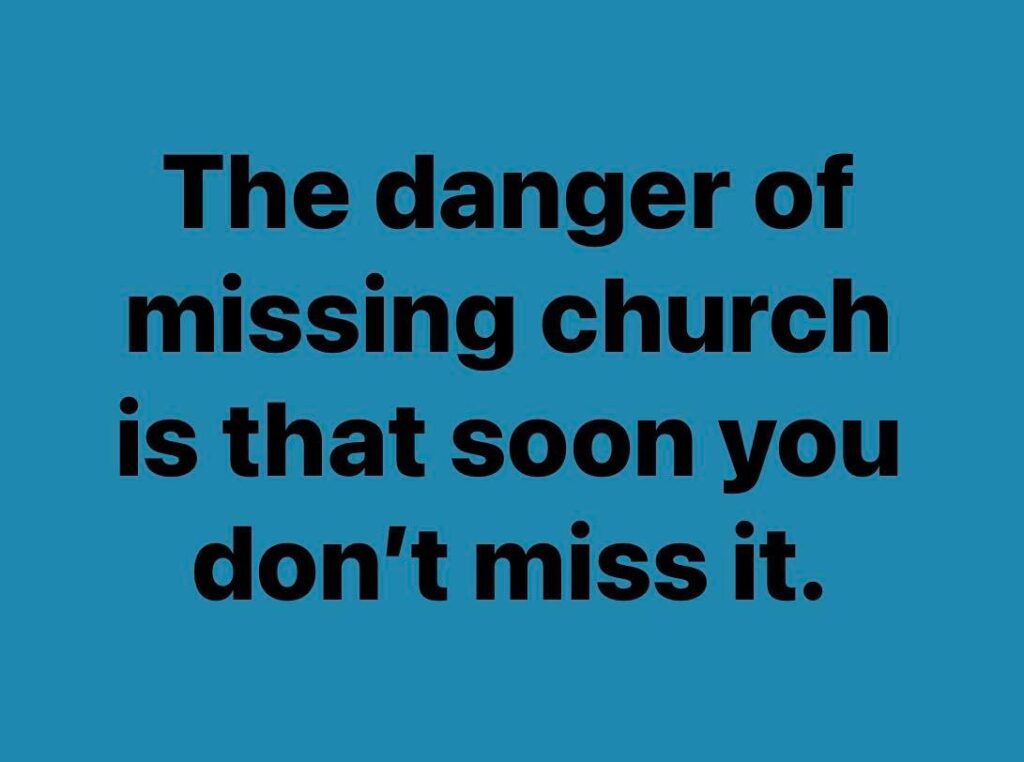
This is absolutely true. And it is what Alpha Course’s very last video is trying to avoid. It wants new converts—who are, after all, the people who should be watching this video—to feel that church membership is essential, but also that it’s also great in and of itself.
It’s hard for me to avoid thinking that Alpha Course is trying to manufacture a need that wouldn’t exist organically. They do not want new converts to skip church attendance.
If converts skip too many church events/services, they might realize that really, church doesn’t add anything to their lives that they can’t get elsewhere for way less hassle.
The superfluity of church culture (is something Alpha Course cannot allow to stand)
As one study last year found, Christianity has three parts to it. In descending order of resources and burden, these are:
- Participation in formal religious observances in groups
- A feeling of religion being important to one’s life
- The sense of belonging to the religion
The study calls this “the Participation-Importance-Belonging (P-I-B) sequence.” When someone participates less often in religious groups, it starts eroding the importance they place on their faith. Eventually, that lowered importance begins eroding their entire sense of belonging to their religion.
This is why every study we find reports that way more people identify as Christians than actually attend church. Mere identification costs almost nothing, while attending church costs way more in terms of time and money. Weekly church attendees tend to be much more fervent than infrequent attendees, and they tend to be in lockstep with their leaders about politics, doctrinal stances, and other topics.
So it behooves church leaders to stress the importance of participation—even when it doesn’t add much to congregants’ lives. Without the ability to straight-up force the flocks to attend, they rely heavily on emotional manipulation to sell the idea.
As for why Alpha Course recommends church attendance so intensely, devoting an entire video to it, that’s simple:
Churches are the ones putting on these Alpha Course series! These events aren’t cheap for churches to put on. They require many hours of volunteer work, at the very least, if not money for snacks, meals, and possibly meeting spaces. Even if the church hosts the event at a neutral retreat/resort site and participants pay some pittance to attend, the church usually subsidizes most of the cost. I can’t imagine these churches not wanting some return on their investment.
Christianity is, at its heart, a business. And Alpha Course’s last video makes that point crystal-clear.
NEXT UP: Why biblical literalists can’t ever concede common-sense ground in the Bible. And we’ll see if we can’t fit in a Alpha Course retrospective along the way. See you soon! <3
Please support my work!
Thanks for reading, and thanks for being part of our community! Here are some ways you can support my work:




0 Comments