In the past, we’ve talked about evangelicals’ modern fixation on inerrancy—the doctrinal belief in the Bible as a divinely-ghostwritten, error-free, literally-true document. We’ve even talked about how inerrancy functions as the ultimate high-control authority source for dysfunctional hardline groups. But today, I want to show you why believers in inerrancy panic over the mere idea of any verse in the Bible being anything but literally true and error-free.
What’s more, every Christian flavor responds to the loss of a fully-divine Bible in different ways. They employ a shifting bright line that acts as a dam to protect their religion from internal collapse. Today, I’ll show you what that bright line looks like and how it shifts with the individual Christian’s specific supernatural beliefs—and then, we’ll see why inerrancy believers tend to defend their beliefs so ferociously.
(This post first went live on Patreon on 7/31/2026. Please support my work—see the end of this writeup for options, and thank you for whatever you decide to do! Note: I’m back to not sleeping ever and it’s making me so frustrated to feel this useless. I apologize for there not being a voicecast today. My priority is and has always been getting those back.)
SITUATION REPORT: An apologetics post grabs my attention in the weirdest way
In 2019, Bart Ehrman participated in an evangelical apologetics conference. Yes, really! And he was very interested in the proceedings for one particular reason:
What I was most interested in was how Christian apologetics – the intelligent “defense” of the claims of the faith – has changed in the many years since I was involved in the movement, shifted in ways I never would have imagined, very much away from our old fundamentalist assumptions and assertions into a far more reasonable and intellectually sustainable form of discourse that requires actual research and knowledge rather than hard-core theological assertion based on completely dubious premises.
The conference topic/theme was addressing the Bible’s numerous contradictory stories and verses. As Ehrman puts it:
How does one deal with apparent or real contradictions and still remain committed to an evangelical view of Scripture as inspired by God and in some sense “inerrant”? I stress “in some sense” because, as it turns out, it is not at all clear what “inerrant” means, and the three of them actually have different nuanced understandings of it.
The answer, as he discovered, involves each Christian setting a bright line in their mind at the dangerous crossing between a fully-divine and a completely non-supernatural Bible. They will not cross that bright line. What’s most interesting here is that all of the speakers at this conference said they were inerrancy believers, but each one interpreted the word differently.
In Christianese, inerrancy means that every single word and teaching in the Bible is objectively factual and without error. Everything it says that happened, really actually happened: the Great Flood, Creation, the Exodus, Jesus’ miraculous birth to a virgin, the Great Jewish Zombie Uprising that occurred at his death, everything. Of course, this definition stretches quite a bit to hand-wave away the Jewish dietary and dress/grooming laws and other such difficult or awkward rules that modern Christians don’t want to follow. (In my work, I often call this belief system literalism; for our purposes, the two terms are interchangeable.)
Inerrancy believers make the bright line a lot easier to notice, since they are the most panicky about approaching it. But every single Christian has one somewhere along the crossing between a fully-divine and a completely non-supernatural Bible.
The varying placement of the bright line of inerrancy
I made a graph of the conceptual framework of how different flavors of Christian (and non-Christians) interpret the line of inerrancy in the Bible. It’s based on studies (also: here1 and here2), my experience with the types, and how each group expresses its core non-negotiable beliefs. It’s not meant to be the actual on-the-ground numbers, but the framework of how each group sees itself and expresses its ideals.
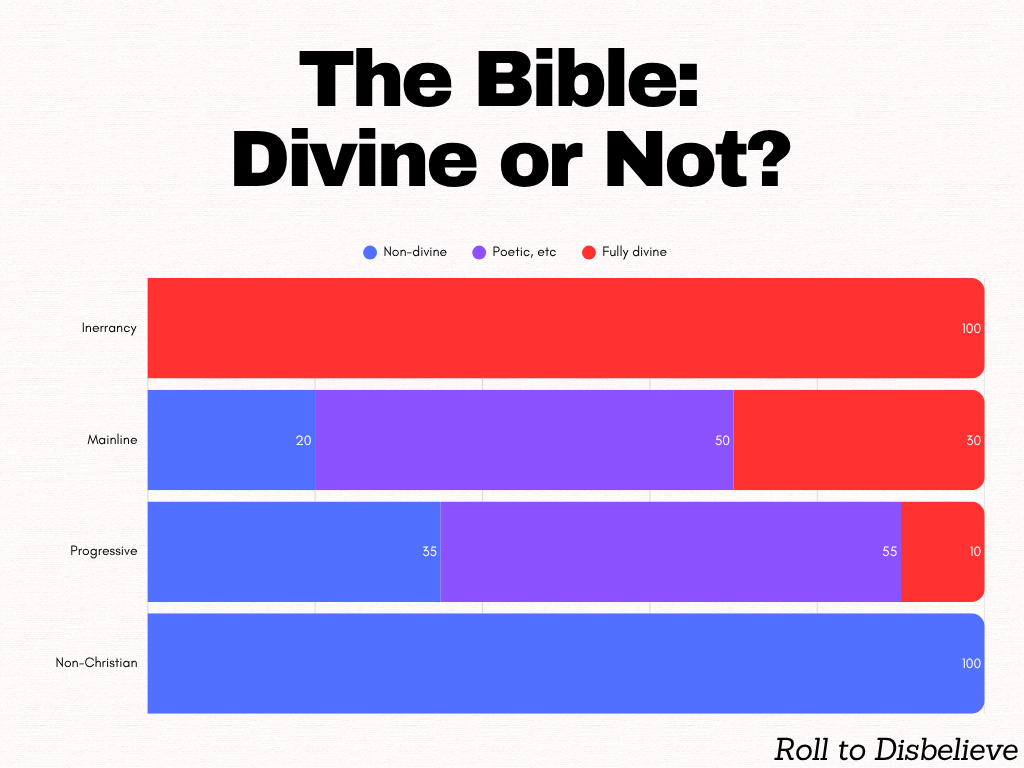
Inerrancy believers like to think they have a 100% fully-divine Bible. As we’ve already seen from Ehrman’s post, the reality tends to involve more poetry and allegory—and a lot of temporary cultural teachings that modern people don’t need to follow. In my opinion (shared by other Christians), it’s an incoherent worldview. But this is the ideal expression of it.
(Here’s where I also mention that when I was Pentecostal (1986-1993/4ish), I managed to consider myself a literalist while also accepting the idea of evolution and the ancient age and natural development of the universe. Compartmentalization is a helluva drug.)
Non-Christians don’t generally think any gods were involved in the creation of the Bible. Sometimes, though, they think parts of it are true on a poetic or metaphorical level. And there are always some unaffiliated people in these studies who somehow respond exactly like fundamentalists.
Between the two extremes, mainline Christians tend to believe in a raft of fully-divine parts mixed with non-divine writings and a middle ground of universal truth expressed in poetry, metaphor, and other literary devices. Progressives tend to stick to only a few specifically divine teachings, with larger shares of non-divine material and poetry/metaphor.
The red bar in each row is the no-go zone. It represents the non-negotiable elements of Christianity that each group feels are absolutely essential to their religion’s survival. If Christians in each group discovered that one of their red beliefs isn’t actually tethered to reality, it might become a serious problem for their faith.
THIS FAR AND NO FURTHER: The accommodation cascade in Christianity
There’s this iconic scene in Star Trek: First Contact where Captain Picard flat refuses to make one more compromise in the Federation’s ongoing war against the Borg:
I will not sacrifice the Enterprise. We’ve made too many compromises already; too many retreats. They invade our space and we fall back. They assimilate entire worlds and we fall back. Not again. The line must be drawn here! This far, no further!
And now you can see why inerrancy people seem so panicky about any challenges to the Bible’s myths and verses. They’re in full THIS FAR AND NO FURTHER mode. After all, if they retreat from full inerrancy in one place, what’s to say they won’t find other places like it? Once they decide one story is truth expressed in poetry, what stops a non-negotiable belief from turning out to be the same thing?
I’m not being hyperbolic here. They fret about “the slippery slope” constantly.
In the Wild: Inerrancy Christians panicking about crossing the bright line
In 2012, Ken Ham summarized the problem that inerrancy believers face:
Who are we to pick and choose which parts of God’s Word are true? Those who attempt to do this are basically placing themselves above the Lord as if they get to decide what is truth.
Around the same time, Jeremy Myers of Redeeming God tried to formulate a new understanding of inerrancy. Of it, he wrote:
I understand that it introduces a very slippery slope of not being able to know for sure if what we are reading in Scripture is an accurate representation of God, or just an accurate account of what some misguided humans thought. Once you begin down this road, our own desire for how we want God to act becomes the arbiter for determining which parts truly represent God, and which parts do not.
To my surprise, a 2015 post from Bob Wilkin of Grace Evangelical Society talks about my three belief frameworks almost to the letter. And he frames my “bright line” as “totally outside the bounds of inerrancy.” I love that phrasing so much:
Reading Genesis 1-3 as poetic fiction means there was no literal Adam and Eve and the whole creation account is a fictional story meant to teach us theological lessons. I consider this view heresy and totally outside the bounds of inerrancy. Most Evangelical scholars, including Bock, Blomberg, Carson, and Keener, would agree with me on this evaluation that taking Genesis 1-3 as poetic fiction is outside the edge of inerrancy.
A 2013 paper from a theology professor, Mark Snoeberger, ends with a stern warning about being too dogmatic about those bounds of inerrancy:
6000-year onlyism has become for the YEC movement to- day what the textual debate was to the fundamentalist movement of the 1990s—an unsustainably exclusive and sometimes shrill stance that threatens the already-fragile credibility of its movement.
A BioLogos member posted in 2019 about wanting help to escape the “slippery slope” they had discovered:
I feel like doubting the validity (specific word choices and meanings) of any part of God’s Word is a slippery slope and would potentially cause one to question the word choices and meanings of all of it.
And this entire 2014 statement from Norman Geisler does a great job of discussing the tensions between inerrancy and real science. He criticizes the mindset here:
[I]f they [meaning Christians] believe that Young Earth and inerrancy are logically connected and then comes to believe for whatever reason that the Earth is old, then logically they would have to give up their faith.
Geisler captures a core fact of that red bar of inerrancy: The larger it is with respect to the other bars, the more claims believers can discover aren’t true.
But mainline and progressive Christians also have beliefs that absolutely must be true
So far, we’ve heard a lot about inerrancy believers who get nervous whenever anything in the Bible turns out not to be literally true and without error. Now, let’s hear from the other types.
On a progressive Christian subreddit in 2025, we find someone who gets a little tired of being asked how Christians can still believe if they don’t hold literally-true beliefs:
[T]here are a significant [number; sic] of people who identify as Christians who have gone (in my opinion) too far over to treating the entire religion as allegorical. In other words, we get people on here, fundamentalists as well as atheists, who ask how you can be Christian at all if there are certain parts of Scripture that you don’t accept as literal historical fact. In some senses it’s a fair question. But while I think reasonable people can disagree about the facts and particulars of the creation of the world and whether, for example, Adam was really made from a clay sculpture that God breathed on, and whether Eve was fashioned from one of Adam’s ribs, or whether that’s a bronze age allegory that points to spiritual truths but is not a science textbook [. . .]
In 2021, another person on that same subreddit complained of “misconceptions about progressive Christians” that annoyed them:
[Misconception:] Progressive Christians tend to not take stories like the Virgin Birth, Jesus’ miracles, the Resurrection as things that actually happened.
Oh boy this one really rubs me the wrong way. If it wasn’t for believing in these things I wouldn’t be a Christian at all.
In 2025, Ryan Burge wrote about a study involving mainline pastors. The study found that only a quarter of them believed in a literal Adam and Eve. But 45% of them said they believed Hell was literally a real place. And about 75% thought Jesus had literally been resurrected.
An evangelical who rejects inerrancy wrote movingly in 2020 about Jesus’ birth. She perceived it as a real thing that actually happened as the Gospels describe. Her post hints at a red-bar non-negotiable belief there.
They’ve all got these red-bar beliefs. The number varies, sure. But for them all, there’s always an arbitrary line they refuse to cross.
Past that line, it’s all literally true and real.
Somehow colliding with the only tree within miles of that field
And past that line, every claim functions as an obstacle that cannot survive impact with reality.
In Kansas, I heard about a guy who was a terrible driver. His family even forbade him to touch their cars! Finally, a friend offered to teach him how to drive. But see, he already knew the guy was very uncoordinated and easily distracted. Knowing that, he took him out to a wild, open field. It was in the middle of nowhere. Kansas is full of these big level spaces with next to no obstacles.
But “next to no obstacles” is not at all the same thing as “no obstacles.”
Indeed, in mere minutes this guy managed to hit a tree. It was the literal only tree within miles. The friend said it had looked like he was gunning for it specifically, though the guy insisted it was an accident.
That’s how this inerrancy bright line seems to me.
When Christian’s beliefs contain a huge number of false claims, every one of them is a tree in the field that they can hit with their belief-car. It can be difficult to avoid hitting them! But if there aren’t many false claims in the mix, the trees are sparser and further apart. Collision becomes less likely.
Of course, even if there’s only one false claim there, the driver might still somehow manage to hit it. But most won’t.
Pruning away the false claims would make driving there much safer—however, once you start pruning, where do you stop? There’s no consistent, reality-based way to separate out which false claims can go and which must stay. A consistent approach would throw out all the claims.
Only one’s sense of what claims must be part of Christianity matter, and each Christian’s must-have framework is going to look slightly different. (What to one Christian are easily-navigated differences become dealbreaker gospel issues to another. Mark Snoeberger sure found that out with Creationists!)
As evangelicals continue to distort the meaning of inerrancy further and further, expect some fireworks out of them as the bounds of heresy get tested more and more often.
NEXT UP: Evangelicals love captive audiences for their preaching and evangelism, and they always have. See you soon! <3
Please support my work!
Thanks for reading, and thanks for being part of our community! Here are some ways you can support my work:




0 Comments