Recently, we watched A Thief in the Night. This 1972 movie is one of the original grandmasters of the evangelical Rapture genre. Millions of people have seen it, and many of them were just children. Today, let’s check out its overview and see how hard it pushes fear-based marketing to get conversions.
(This post and its audio ‘cast first went live on Patreon on 10/9/2026. They’re both available there now. Please support my work—see the end of this writeup for options, and thank you for whatever you decide to do!)
SITUATION REPORT: An overview of A Thief in the Night
The 1972 movie A Thief in the Night covers the leadup to the Rapture and the beginning of what evangelicals call the Endtimes. It follows three young women—Patty, Jenny, and Diane—as they encounter and respond to various recruiting pitches for TRUE CHRISTIANITY™. (A TRUE CHRISTIAN™ believes all the correct doctrines, practices proper devotions at proper levels of fervor, and hasn’t deconverted yet.)
Jenny converts to this flavor. Patty was already a Christian, just not the right kind, so she rejects the pitches. Diane flat-out rejects them and scorns the very idea.
At a State Fair, while Jenny’s off being converted, Patty and Diane meet Jim and Jerry. Jim’s a sweet, earnest guy who likes Patty and eventually marries her. Jerry (whose facial hair had me calling him “Sideburns” the entire movie) gloms onto Diane, and they’re implied to be extremely sexually active behind the scenes. Of course, Jim converts to TRUE CHRISTIANITY™. But Patty still rejects the idea that any loving god could possibly let his children suffer after the Rapture.
One day, Jim vanishes mid-shave—along with every other TRUE CHRISTIAN™ on the planet. Patty is left alone to navigate a terrifying world dominated by the Antichrist, his one-world government (OWG), and his many minions. At the end, she’s captured by Jerry and Diane, who turn out to be the Antichrist’s minions. Curse their sudden but inevitable betrayal!
This movie is meant to recruit people to the creators’ flavor of Christianity. It’s a 70-minute-long sales pitch about how awful it’d be to miss the Rapture. And in its heyday, it was spectacularly influential. Many millions of Christians, most of them very young, saw this movie through their churches. Church leaders showed this movie to little kids. And it had a huge impact on them. Many of them bear the scars from that experience to this very day.
So I want to show you why this movie hurt so many people, and also why its marketing can be safely ignored.
The terminology of the movie
In Christianese, the Rapture involves Jesus whisking all TRUE CHRISTIANS™ up to Heaven. Adherents of TRUE CHRISTIANITY™ are the only Christians who have a chance of getting Raptured.
The Endtimes are Earth’s last, terrible, dystopian seven years. This period includes the Tribulation (a time of great persecution of TRUE CHRISTIANS™) and Armageddon (the last worldwide war). In some flavors of Christianity, the Endtimes include the Rapture midway through (“mid-Trib”), or even at the very end (“post-Trib”). But in today’s movie, it’s “pre-Trib,” so it happens before the Endtimes really begin in earnest.
The “Antichrist” is an elderly nerd who runs UNITE, a riff on the United Nations. In the Bible, the Antichrist is a fearsome figure to TRUE CHRISTIANS™, but he’s dearly loved by everyone else. He’s a peacemaker, a generous and kindly figure. So obviously, he’s pure evil.
The “Mark of the Beast” is a microchip or tattoo that people in the OWG must have in order to buy anything or conduct any official business. In A Thief in the Night, it’s just a symbol tattoo. It’s not entered into a database. There’s no personalization involved in it. Instead, the Antichrist’s minions keep track of who’s gotten one with what look like the roll-call printout lists you see at polling places at election time. Here, the symbol means “666.” People can get this tattoo on their hand or their forehead, but only people who are really fans of the Antichrist get it on the forehead.
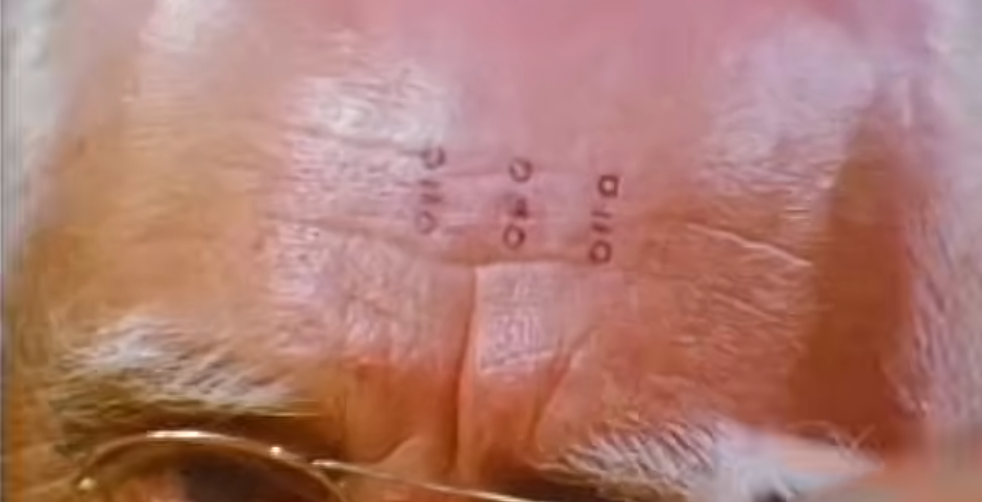
The threats start immediately in A Thief in the Night
Now let me show you how pervasive fear-based marketing is in this movie. All timestamps come from this video:
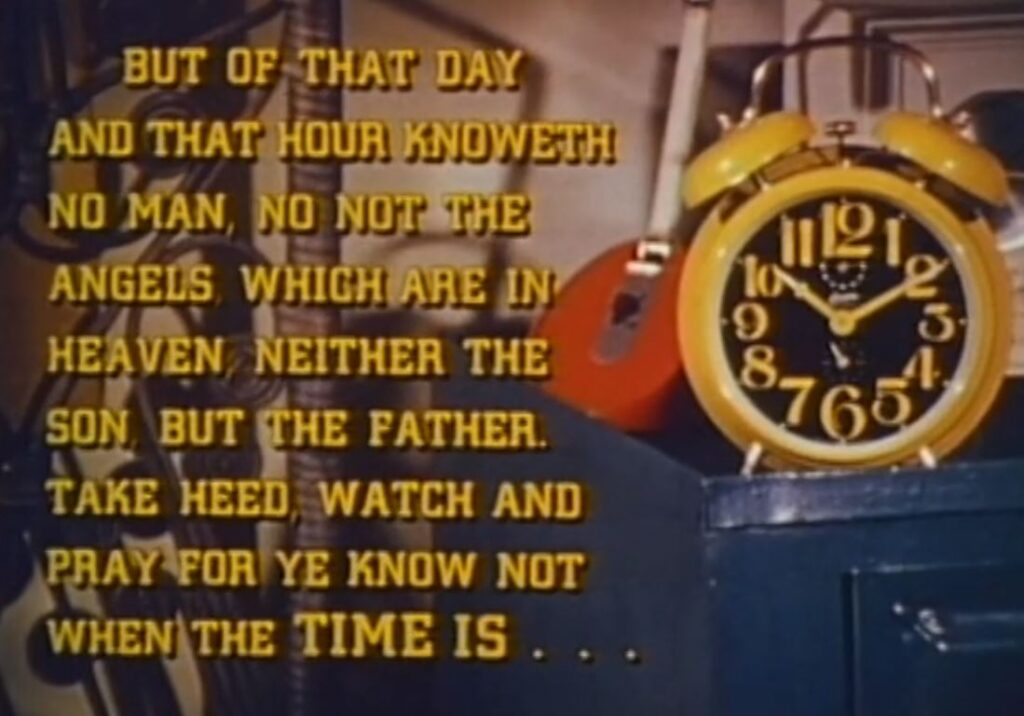
From the very beginning, we get a title card that acts as a threat:
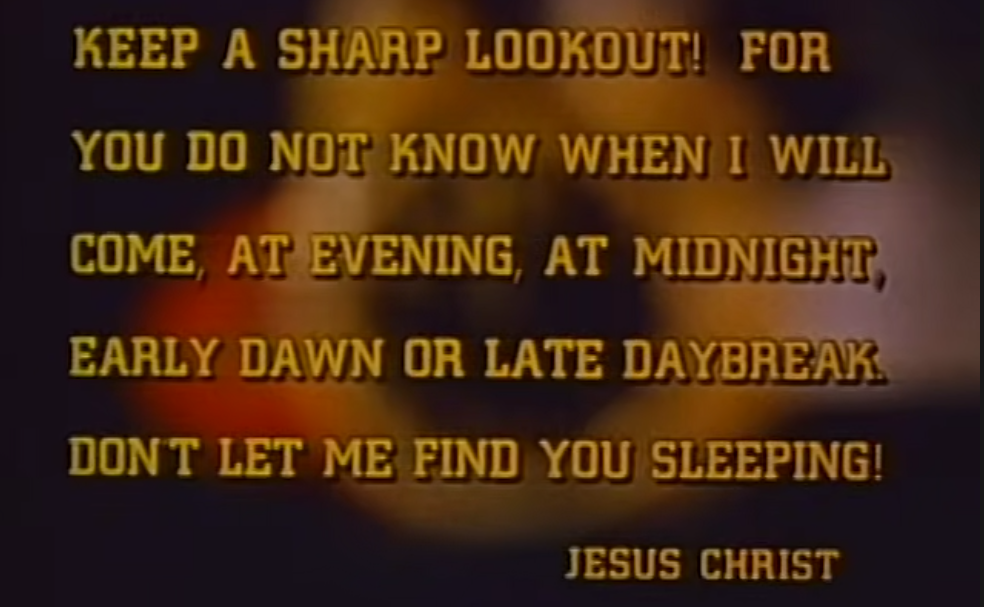
Jesus never says this exactly in the Bible, but he does give a metaphor along similar lines in Mark 13:35-36:
Therefore keep watch, because you do not know when the master of the house will return—whether in the evening, at midnight, when the rooster crows, or in the morning. Otherwise, he may arrive without notice and find you sleeping.
Then, we begin in medias res as Patty discovers her husband Jim has been Raptured. She screams while a radio announcer talks about the world being plunged into chaos.
Now we go back in time a ways to listen to a ginger teenager warn a youth group about how bad it’d be to miss the Rapture. He solemnly informs the listeners that this might be their very last chance to convert. But at no point does he offer any other reasons to convert. All he uses are threats. Shortly after his sermon, he sings “I Wish We’d All Been Ready,” which just consists of even more threats.
Mixing vague promises with threats in A Thief in the Night
Between 8-11 minutes in, Jenny converts to what a female evangelist specifically calls TRUE CHRISTIANITY™. I’m serious—she uses the phrase and everything! The evangelist tells Jenny that if she gives Jesus her entire life, he’ll take charge and run things better than she ever could. It’s a nice switch from threats, but unverifiable vague promises aren’t much better.
At 13:30, the ginger teenager tells Jenny that she’ll face demonic attacks and judgment from other people now that she’s become a TRUE CHRISTIAN™. (That’s a threat.) But it’s okay because Jesus will help her overcome all of that. He’ll keep her from falling victim to demons trying to make her feel depressed and discouraged! These are more vague promises, of course. They’re also about the last ones we’ll get in this movie.
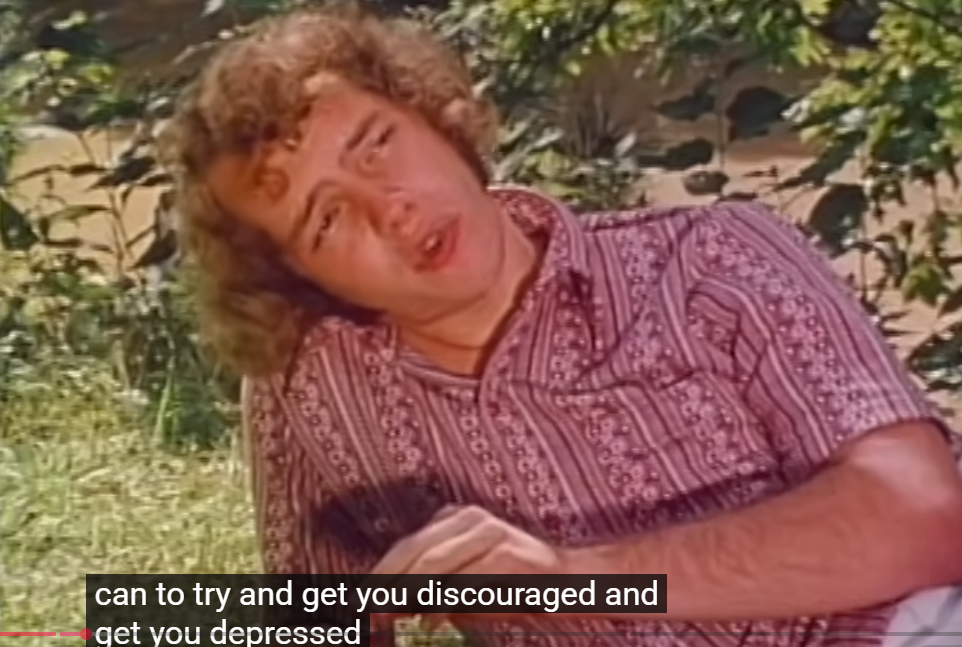
Later on, the same ginger teenager shows up at a fun waterskiing outing to warn all the other attendees about missing the Rapture. I honestly don’t know why they’re friends with him. When I was that obnoxious as a teen, my more-secular friends tended to start avoiding me. I’m bringing him up again for a reason, though, so hang onto this thread.
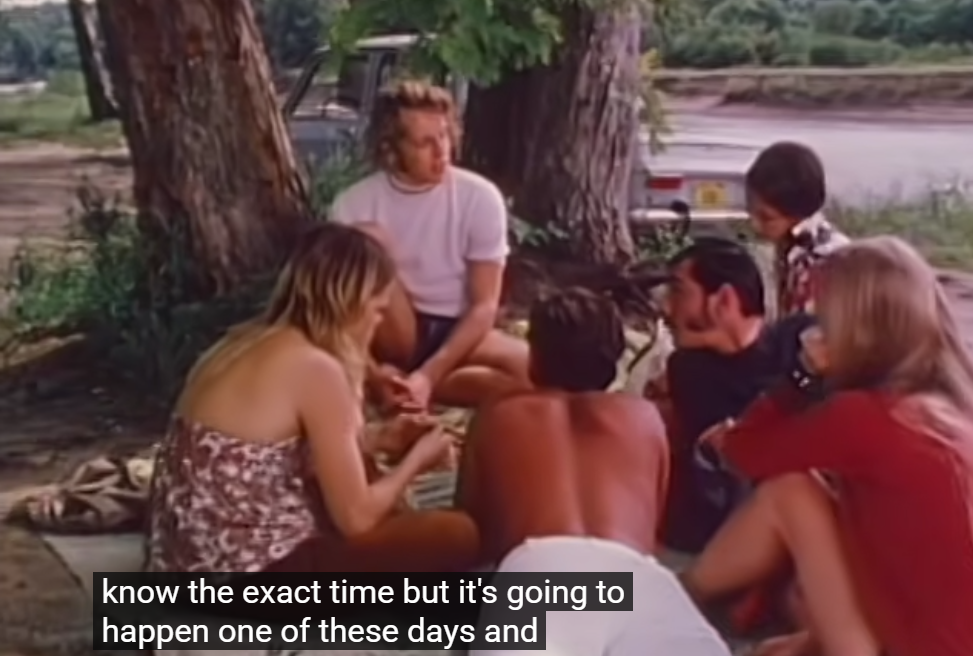
But if you thought this was as bad as the threats could get in this movie, you ain’t seen nothing yet.
The threats ramp up in the leadup to the Rapture
At 29:00, we meet the TRUE CHRISTIAN™ preacher (TCP). He operates the church that Jenny converted to (and to which Jim will soon convert). The TCP thunders out a sermon about 1 Thessalonians 5, which Rapture enthusiasts think talks about the event. In truth, it talks about “the Day of the Lord,” but they’ve decided it means the Rapture. Also, some translations of this chapter specifically use the phrase “a thief in the night,” so I guess it had to be in the movie somewhere.
The TCP goes on at great length about how awful it’ll be to miss the Rapture. While he threatens everyone on behalf of his loving god, the camera pans across the audience and we see a little girl there with her family. She listens intently.
At 32 minutes, after the services conclude, the girl comes home from somewhere, sees the empty kitchen in mid-task cooking, thinks she’s missed the Rapture, and begins screaming uncontrollably. In fact, the movie wants viewers to feel her terror so much that we get multiple takes of the scream from different angles and at close-up distances.

Luckily, she hasn’t missed the Rapture. Her family rushes in to comfort her. They just all happened to leave the kitchen, that’s all. She keeps repeating that she thought they’d all gone. They tell her that if she converts, she won’t ever have to worry about being left behind again. She converts.
This scene infuriates and disgusts me. This child doesn’t have a real choice in terms of what she can accept or reject. The idea of being abandoned, for a child, must be one of the biggest fears they have. Her entire family buys into this nonsense, and she’s far too young to live by herself without them. So of course she’ll buy into their religious weirdness.
At no point has this child been given a real reason to convert. Nobody has. It’s all just been threats.
Segue: The stupidhead meaniepie reasons for rejecting TRUE CHRISTIANITY™
At various times, the movie presents strawman objections to their sales pitch. The movie always treats these objections as ignorant and stupid. Here are the three main objections presented in the movie:
During the first scenes at the State Fair, Diane makes her objections to conversion very obvious. She thinks the threats are laughable. She’s very scornful toward Jenny as well. So Diane is a stand-in for what Rapture people would call worldly people. She’s locked in sin and loving it, so obviously she won’t respond well to anyone Jesusing at her.
When the little girl in the kitchen scene reunites with her family, she whimpers that she thought she’d have plenty of time to convert. For some reason, this movie repeatedly points to “I thought I’d have plenty of time” as a major objection. Maybe for some people that’s accurate, but I’ve never encountered someone saying that myself—not even as a Pentecostal. I especially don’t think a little kid would say it. But she’s clearly a stand-in for the Christians who’d use that as an excuse for not going all-in.
Right after the wedding scene (34 minutes), Patty and Jim talk to the TCP from the earlier sermon. He tries his best to scare Patty into converting, but he fails. She simply refuses to accept that a loving god would allow his children to suffer in the Tribulation. Nothing the pastor does to wriggle out of the Problem of Evil/Suffering/Hell works on her, either, though it does convince her new husband. Patty is our stand-in for the wrong kind of Christian—the Christians who think their god is loving and not actually a genocidal psychopath who plays headgames with his human ant farm.
It all reminds me of the meme “I have already drawn you as a soyjak”:

In this case, A Thief in the Night wins the fight they picked because they have the power to portray objections as ineffective and easily overcome. It doesn’t work that way in reality, but the children forced to see this movie won’t know that for a few years still.
Post-Rapture terror in A Thief in the Night
At 40 minutes in, we finally get the Rapture. From here, the dystopia becomes increasingly worse for those who have refused the Mark of the Beast. It’s an extended threat in cinematic form. Patty wanders around town. She’s lonely for Jim, her friends have deserted her for some reason, and she can’t even buy food.
At 50 minutes, Patty visits her own pastor. He’s not the TCP. He’s an evil ecumenical pastor who rejected literalism and Creationism and Hell and all that blahblah, and now he’s left mired in regret and tears as he realizes he doomed his flock to the Tribulation.
The pair get caught by the Antichrist’s minions. He gets executed, Patty sees his dead body, and she escapes—only to eventually get rounded up in turn.
But wait! DREAM SEQUENCE! Patty wakes up in her bed on Rapture Morning! She dreamed all of that!
And then she finds Jim’s electric razor buzzing away unattended in the bathroom. She realizes the Rapture just happened anyway, and she screams over and over again. The movie fades to this card:
The implication is clear: Everything she dreamed will now happen in reality.
Three responses to Rapture fearmongering
The kind of people susceptible to Rapture marketing tend to be deeply authoritarian and in need of certainty in their lives. Jenny, for example, converts because she thinks Jesus will run her life better than she can. For the little girl, she converts because she’s terrified of being lost without her family. Jim converts after a close brush with death. These three don’t ever engage with evidence supporting any of these scary threats, but just the threats alone are enough for them to want safety.
As for that ginger kid, every time we see him in this movie, he’s threatening people with missing the Rapture! So in this movie, he stands right where he wants most to be: cloaked in borrowed divine authority.
But two characters are immune to the fear-based marketing. Patty trusts her god not to hurt her. Diane rejects all of the fearmongering. These two don’t feel frightened by the Rapture for different reasons, but their lack of fear leads them both to reject repeated sales pitches.
Diane’s probably the most realistic character in this entire movie. She responds to events around her as I’d expect a secular woman to do—though I wouldn’t imagine she’d be the happy minion of UNITE and the Antichrist, because they’re just the other side of the Rapture coin. As the Maximal Maxim goes, “The enemy of my enemy is my enemy’s enemy. No more. No less.”
Compare and contrast with sales pitches for things that are real
As I was re-watching this movie, I kept thinking about how different these sales tactics are from ones that actually work to sell real things.
Decades ago, Volvo had a pristine reputation for safety. Families bought Volvos so they’d be safe even in accidents. Their modern ads, like their vintage ones, focused on that exact safety. So did Goodyear ads. Here are a few I want you to look at, and please be thinking as you do about their use of fear in marketing:
And here’s a Volvo ad from the 2010s:
And the Goodyear ad:
The sales pitches here do use fear, but it’s a grounded fear: What if your loved one faces danger while driving? People do get into accidents, after all. Accidents are real. But Volvo offers innovative safety features, plus decades of crash tests. Goodyear offered “Polyglas” tires that gripped the road better even in poor conditions.
These manufacturers aren’t just saying “buy our products or you’ll be SO SORRY when your family member is killed in an accident!” Nor are their promises vague, as we saw in the movie. The Goodyear ad doesn’t just say their tires will totally help wives on the road at night. The Volvo ads don’t tell us their cars might cure depression if we Jesus—er, I mean, Volvo hard enough.
In all cases, fear flows from facts. No matter what car one drives or what tires one uses, one might get into an accident on the road. When it comes to which configuration of car + tires will keep people safest, Goodyear and Volvo clearly have opinions about that configuration, but other manufacturers would disagree and offer other configurations. Consumers absorb the claims, then decide for themselves how to proceed.
If Volvo’s or Goodyear’s advertising consisted of nothing but horrific scenes of car crashes and admonitions to buy these products or else, I don’t think they’d move a lot of product.
Going for broke on threats
But a large number of Christians expect that exact strategy to work in the religious marketplace. Unfortunately, some people are susceptible to those unverified, unsupported threats—especially when it comes from a religious source. Just as many people get primed to expect the world to be fair, many of us get primed to respond to purely fear-based marketing.
When someone tries that, we need to examine where the fear comes from. Is it from something real? Or something imaginary? What real-world reason exists to make us fear that thing? Is the solution to the fear only obtainable from the person stoking that fear?
In the case of the Rapture, it starts looking really silly when you look too long at where it comes from and why so many Christians still believe it’s coming Any Day Now.
But when they completely lack facts, fearmongering Christians must go for absolute broke on threats. They won’t get nearly the same sales otherwise!
NEXT UP: Yet another evangelical college has yet another sex abuse cover-up. We’ll talk about why this keeps on happening.
Please support my work!
Thanks for reading, and thanks for being part of our community! Here are some ways you can support my work: