Modern Christians may know that their ideal is having faith without any need for proof, but in their hearts they want good reasons to believe. For evangelicals, that tension is particularly intense: Their version of Christianity involves a very active, involved deity—but our world doesn’t show any signs of that kind of god. All too often, the results of that tension manifest as the evangelical essay we’ll be checking out today: The entire concept of ‘proof’ debased and redefined into nonexistence, all to soothe the gnawing insistence of reality at their throats.
(This post and its audio ‘cast first went live on Patreon on 5/1/2026. They’re both available there now. Please support my work—see the end of this writeup for options, and thank you for whatever you decide to do! NOTE: In this post, we use terms like “proof” because the OP uses them. It’s not my preferred term for the compelling evidence most people need to accept an extraordinary claim.)
SITUATION REPORT: An evangelical finally gives us PROOF YES PROOF
On April 22, Baptist Press published a post by John Kyle. Its title is enticingly simple: “FIRST-PERSON: Proof.”
(“FIRST-PERSON” is just how they indicate that a post is an opinion editorial of sorts. Since this site functions as the official mouthpiece of Southern Baptist Convention (SBC) leaders, it’s still something they completely agree with.)
In his post, Kyle tells us that asking for proof of Christians’ claims is very mean and meant to shut Christians up, not legitimately ask for evidence.
“Prove it” is a statement of unbelief. You’re not buying what the other person is selling so you stop the conversation by saying “prove it.” This may come across as a prideful statement because you are convinced that the other person doesn’t know what they’re talking about, so you confidently throw down the gauntlet and say, “prove it.”
But then, he proceeds along to tell us that it’s okay to ask for proof, because Jesus’ followers did that. And what do you know? As Kyle puts it, “God specializes in proof.”
He then offers up proof of his claims about Jesus:
Proof appeared on the road to Emmaus on that first Easter Sunday. [. . .] In the days following His resurrection Jesus appeared to many people [. . .] Luke tells us that Jesus provided proof of His resurrection for the next 40 days [. . .] Jesus gladly provided the proof Thomas needed [. . .]
Then, Kyle promises that Jesus will totally provide proof to anyone needing it, “but maybe not in the way you expect.” This is where he redefines proof so completely that it becomes a meaningless word, because now proof does not mean “getting Jesus to do what you want.” Instead, it means “not asking Jesus to jump through hoops,” but rather “taking Him at His word.” Proof is now “a realization that Jesus is who He claimed to be.”
Finally, he tells readers that “the proof you need is all around you.” This means that the world itself functions as proof of Christian claims, as does the Bible itself and “God’s Holy Spirit” that’s “inside you.”
This line was the first indication I had that this guy’s writing for other evangelicals, not for non-believers. But he still finishes with a very curious promise:
Ask God to provide the proof you need, and just as He provided it for Thomas, He’ll provide it for you. “Don’t be faithless, but believe,” John 20:27
Today, we’re going to tackle his idea of ‘proof’ and see what would work far better than these suggestions—and then, we’ll see why he couldn’t offer any of those instead.
Everyone, meet John Kyle: A very well-indoctrinated Christian with very well-indoctrinated redefinitions of proof
In his biography blurb, we learn that John Kyle was until very recently the director of communications for the Louisiana Baptist Convention, which is a state-level group connected to the SBC. Think of these state-level conventions as individual states in the United States, or (if you’re of a certain age) as the big circular alien ships connected to the huge mother ship in Independence Day. He appears to have recently retired from that position, though he’s been keeping busy writing encouragement/apologetics posts like “Proof.”
It sounds like Kyle landed the communications director job through the evangelical crony network—the state convention’s Executive Director, David Hankins, was once a pastor who had hired him to be an associate pastor. However, Kyle doesn’t appear to have had any other job at the time of his retirement. His Twitter also indicates that he’s part of an evangelism initiative called “Here For You,” which sounds like it’ll be extremely disappointing for any new recruits who take its implied promises too seriously.
Aside from “Here For You,” Kyle’s main claim to fame is having signed the 2012 “Southern Baptist Traditionalist Statement on Soteriology.” Soteriology is the study of how people gain salvation from Hell. If you’re wondering, David Hankins’ son, Mississippi pastor Eric Hankins, wrote the statement’s preamble—and both, naturally, signed it. This statement has all but vanished from the internet (You can see it here, though it lacks the list of signers), and I can see why: It outright and explicitly attacked Calvinists’ beliefs about how their god forces predestined people to believe. However, by 2012, Calvinists had become a significant part of the tribe. As such, this statement caused quite a ruckus in evangelicalism.
In his bio blurb at the Louisiana Baptists’ website, Kyle never mentions any formal seminary education or lead pastor experience. As a result, I doubt he has any. (In evangelicalism, the rule is “if they don’t say it, it never happened.” They don’t like outright lying, but they’re happy to omit inconvenient facts.)
Either way, this guy seems very well-indoctrinated. His redefinitions of ‘proof’ could have told us that, but it’s nice to know for sure.
Now, let’s tackle his response to those asking him for proof.
First defense: Demands for proof are very mean and meant to shut Christians up
First and foremost, Kyle tells us that demands for proof are “statements of unbelief.” They’re a “prideful statement.” Demands for proof get issued in his world when someone wants to demonstrate that the other person “doesn’t know what they’re talking about.” Consequently, they’re not good-faith engagements. They’re used to “stop the conversation” dead in its tracks. More than that, they’re a challenge—to use his own term, a thrown gauntlet.
What a very sad world this guy inhabits. In reality, we all ask for proof every day about all kinds of things. They’re not challenges. Most of us don’t do it to humiliate the other person into acknowledging their inferiority to us. That’s because most of us are not dysfunctional authoritarians, so our world doesn’t shatter when someone doesn’t take our word for something. Nor do we expect anyone else’s world to shatter when we ask them to support their own claims. It’s just how claims operate.
If a grocery store ad claims to have lower prices than other stores, we need more than just their word for it before switching to that store. When one air conditioning company claims their products cool better than others, we don’t spend money till we see evidence of it.
Nobody’s trying to shut Christians up. We just want them to furnish compelling evidence for their claims. Otherwise, we can’t take them seriously. It’s no different from someone telling John Kyle he needs to wear Hawaiian shirts every day, or else he won’t go to the Elysian Fields. He’d be incapable of believing that until we came up with proof for the claim, and I can’t blame him.
All that said, maybe he’d be demanding Hawaiian-shirt-afterlife proof for the reasons he attributes to doubters—not because he’s really interested in seeing evidence, but because he wants to silence those making the claim.
And now, the circular reasoning in lieu of proof
Most of John Kyle’s post largely uses Bible verses and stories to furnish proof of his religious claims:
- The trial and execution of Jesus
- Appearing to many of his followers post-execution
- Creating a magically-rich fishing harvest for Peter, James, and John
- Showing up personally to show Thomas he’d really resurrected
This is pure circular reasoning: The Bible is the source of the claims, so it can’t also form the support for them.
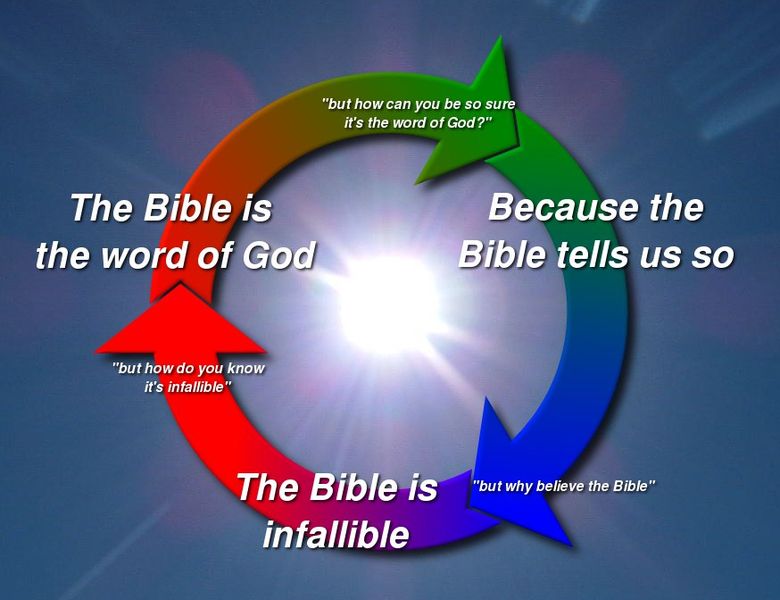
No contemporary extrabiblical sources have ever been found to support whatsoever for the Bible’s claims. Everything Kyle references occurs only in the Bible itself. So we can and indeed must dismiss it.
(See our 1st-Century Fridays series: We did the math!)
The argument from subjective experience as proof of Christian claims
Next, John Kyle tells us that Psalm 19:1 functions as proof of his claims:
Today, the proof you need is all around you. The Psalmist says the heavens declare the glory of God and the skies proclaim the work of His hands (Psalm 19:1). The proof is in front of you as you open God’s word. The proof is inside of you through God’s Holy Spirit.
This one’s a Gish Gallop too: A number of false claims and logical errors strung very close together. Mostly, these are logical fallacies. A logical fallacy is an argument trick. It lacks validity because of an internal error in how it’s constructed.
First, we have an argument from authority, namely Psalm 19:1. Because this verse declares that the entire world is proof of Christian claims, then it must be so! But every religious text and every story set in a fictional setting (but I repeat myself) does the same. I doubt he’s willing to concede the existence of Narnia, Hogwarts, and Gotham City.
Next, the Bible itself is claimed as proof of Christian claims. We’ve already dismissed this one (twice now), but he sure seems to like it.
Finally, we have an argument from subjective internal experience. The feeling of being possessed by Yahweh becomes proof of Christian claims. But feelings aren’t evidence either. Nobody’s ever found a way to measure this indwelling or absence of Yahweh’s “Holy Spirit,” so it can’t be used as evidence. (That’s part of Occam’s Razor: Not the simplest explanation, but the one constructed of the fewest assumptions.)
The tension between faith-without-proof and belief for good reasons
John Kyle actually understands, as do most evangelicals, that the platonic ideal of Christian faith is to have faith for no good reason. As he writes (emphases from original, as always):
Jesus was willing to “prove it,” but then He raised the stakes. He told Thomas, “Because you have seen me, you have believed. Blessed are those who have not seen and yet believe.” John 20:27 (CSB). The Amplified translation puts it this way: ‘“Because you have seen Me, do you now believe? Blessed [happy, spiritually secure, and favored by God] are they who did not see [Me] and yet believed [in Me].”
In other words, they should be able to maintain fervent faith without having any good reason whatsoever to have it. They should be able to just take the Bible’s words for everything and not worry, ever, about what reality tells them.
But they can’t.
Evangelicals really have it hardest out of all the flavors of Christianity: They have constructed for themselves a very active, involved, reality-breaking god who constantly meddles in the laws of cause and effect on their behalf.
But that’s not the kind of world humans actually inhabit. Our world doesn’t speak to any extraplanar or supernatural interference. This god, who should be leaving constant footprints everywhere of his presence, leaves none whatsoever—the same as every god in every religion ever has. The further along our modern world gets, the more technology it puts into the hands of even very young people. And the more of that technology that gets developed, the smaller the gaps the evangelical god must scurry into.
Modern humans want to believe in things for good reasons. Especially when it comes to extraordinary claims, we demand extraordinary evidence. And yes, that includes evangelicals. When their reasons for belief can’t do the trick, they must invent reasons. They must demonize the very act of requesting evidence, and degrade the concept of evidence completely. That way, their lackluster apologetics tricks can actually provide it.
John Kyle’s essay in Baptist Press functions as a great example of exactly how evangelicals shirk their burden of proof. But it’s also a lesson in how they themselves deal with having zero support for their claims.
What kind of proof would work better than anything John Kyle offers for his religious claims
Even in his own post, Kyle shares what real proof would look like:
In a current travel website commercial, one of the men boasts that he secured his reservation for $250 per night and he was quite satisfied with his rate. His friends laughed at him and said they got theirs at the same hotel for $100 less through this website. The skeptical first gentleman responded by saying, “prove it” – which they did, by showing him the website.
The commercial referenced appears to be for a company called Trivago. Here’s one of their ads:
It’s almost comical that this commercial does something that John Kyle, for all his sleight of hand, could never do for his religious claims. Through the hotel desk clerk, the guy in the blue sweater makes a concrete, testable claim: His hotel room cost $155, while the other guy will need to pay $225 for his own room. When the other guy reacts in surprise and asks the blue sweater guy how he got such a less-expensive room, the guy tells him how he did it and shows him the Trivago website so he can get the same deal himself (presumably at some future date).
John Kyle only wishes that any of that could happen in his religion. But in answer to his question, “what kind of proof do you need,” anything he could use as similar support for his claims simply doesn’t exist in Christianity:
- Christians aren’t better people, overall, than non-Christians
- Nor do they escape hardship and bad luck way more often than non-Christians do
- Nothing in the Bible that’s key to Christian beliefs actually happened (as just one example, the Great Jewish Zombie Uprising, when a large group of dead Jews rose from their graves around the time of Jesus’ resurrection to contact their living loved ones)
- Not one first-century writer operating in Rome or Judea bothered to write a single word about Jesus, his followers and family, his teachings, or his death—and that includes all those “eyewitnesses” John Kyle thinks are proof of his claims
- Prayer doesn’t produce the effects in reality that the Bible promises (and realizing this is how I finally deconverted!)
- Nobody’s ever found any support for any notion of the supernatural, much less for any gods or angelic/demonic entities, nor any afterlife for humans
- Not one miracle has ever been verified as really unnatural in nature
- The roadmap evangelicals use for relationships and community does not produce more harmonious, rule-abiding people and groups (and I found that out to my detriment)
Simply put, the proof John Kyle offers doesn’t actually support his claims. His claims not only lack proof, but the world offers only contradictions to them at every single turn.
He’s not just doing the equivalent of claiming that Hogwarts is real. He’s also claiming it’s the capital city of France. So he’s sold his soul, metaphorically speaking, for a paltry bowl of porridge. He prefers that to investing fully in the very real world full of very real people and situations in his only shot at awareness and sapience on this good dark earth.
To me, that’s a tragedy. But it’s one he chose himself. He maintains it through indoctrinated evasion and motivated reasoning. So I will leave him to it.
NEXT UP: Alpha Course #13 tells us how to totally resist evil! See you soon! <3
Please support my work!
Thanks for reading, and thanks for being part of our community! Here are some ways you can support my work: