Every single time something big happens to make evangelicals look terrible, a bunch of them start fretting about Bad Christians. So it’s not surprising that with the 2024 elections upon us, they’re starting to write opinion posts trying to sway the flocks away from what they view as distinctly un-Jesusy attitudes and behavior.
Alas, the Bad Christians they criticize are extremely unlikely to change their ways. Today, let’s explore why.
(I’m still recovering my voice from a terrible cold this past week, so there won’t be an audiocast of this post on Patreon. However, it did first go live there on 8/30/2024.)
Bad Christians: The problem and the solution all in one
In Christianese, believers categorize themselves as TRUE CHRISTIANs™. They allow other Christians to use the label as long as they:
- Don’t embrace any doctrines that the judge thinks are completely unacceptable
- Haven’t done anything the judge thinks is way out of bounds
- Die with the preceding two conditions intact
Thus, a Bad Christian is someone whose practice of Christianity embarrasses the judging Christian somehow. Either their doctrinal stances or behavior clash significantly with the judge’s opinions of how Christians ought to Jesus the Jesus-Jesus.
Unfortunately, both of these definitions are subjective. They depend utterly on the opinion and mindset of the judging Christian. For all evangelicals’ caterwauling about the Bible being all any Christian needs, it very clearly hasn’t laid out a definition of Christian that all Christians can agree is the objective standard. It never has, and I don’t think it ever will.
Nor is there any central authority that all Christians respect who can lay down the law there. There kinda used to be with the Pope, but the Reformation ended that time for good. And even when the Pope was the one supreme ruler of Christendom, lots of competing doctrinal stances and devotions sprung up all the time in Catholicism. From the very invention of Christianity, Christians have never had one set of doctrines and teachings that they all universally accepted.

So as the religion stands now, one Christian’s undisputed central authority figure is simply another’s heretic running from true accountability.
It’s chaotic, yes. But it’s also a surprising windfall for today’s evangelicals. The system they’ve built for centuries works exactly as it is supposed to work. It does exactly what its masters want it to do. Those who benefit from this chaos would never want a central authority over them.
At first, a trickle; then, the flood
In 2022, I noticed some news stories exploring “a potentially historic political shift” in American white evangelicals. One story from Paul Engler in July 2022 tells us this:
In the wake of Donald Trump’s presidency, strains within the evangelical community, especially among people of color, have resulted in significant numbers of people defecting from the right and opening themselves to social justice stances on issues of race, immigration, climate and economic fairness. Should
I’d noticed much the same thing in evangelicals’ own writings and social media posts. White evangelicals were still joined to Donald Trump by the hip, but enough were defecting to make a difference. As an August Pinnacle story tells us:
Historically, when Barack Obama won the presidency in 2008, he captured 26% of the Evangelical vote. By 2020, Joe Biden garnered approximately 24%, whereas Hillary Clinton managed only 6% during Trump’s successful campaign [in 2016].
The reason for this growing trend appears to boil down to Bad Christians. Bad Christians are driving a sizable crowd of evangelicals to do the unthinkable by voting for a Democrat this fall.
Bad Christians are wrecking everything! Gyahh!
White evangelicals in particular seem to be of two minds about America’s future. One camp wants Donald Trump to rule them with an iron fist, while the other seeks to get his opponent elected to forestall the worldwide worsening of evangelicals’ image and credibility. As the evangelicals in that second group see it, they’re working overtime to stop the damage the first one is doing to their religion’s reputation. From Pinnacle:
David French, who became prominent as one of the most recognizable Anti-Trump conservatives, recently reflected this sentiment. French emphasized supporting Harris as part of salvaging conservatism itself, asserting the need for change following Trump’s influence.
He articulated deep concerns over Trump’s negative impact on the church’s reputation, stating, “The viciousness and intolerance from MAGA Christians against political foes is alarming.” French’s op-ed reignited discussions on traditional values versus the evolving political climate.
I’m not sure exactly where this op-ed was, but at least twice this year French has written about the scary violence and aggression he’s sensed from Trump’s most idolatrous supporters. On Threads a week or so ago, he accused Trumpist evangelicals of engaging in “the politics of intimidation, not persuasion.” His commenters generally seem to agree.
So instead of voting for Trump, French plans to vote for Trump’s opponent, Democratic nominee Kamala Harris. He’s not alone, either. A whole group of similarly-minded evangelicals has risen up to do the same.
Evangelicals are tearing each other apart these days
Other anti-Trump evangelicals have been keeping busy asking rhetorical questions like “why aren’t evangelicals offended by Donald Trump?” (We’re coming back to that one in a second here.) Another evangelical, Kirsten Christensen Roberts, wrote in May about how her children have apparently deconverted over Trumpism. In her post, she laments,
It’s tough to convince young people now that there is a way, a truth and a life, when truth has no meaning.
Ryan Burge, a Baptist pastor who does a lot of religion research, has found the same basic problems. In April, he discussed his recent book The Great Dechurching with Baptist News Global (which is not affiliated formally with the Southern Baptist Convention/SBC). As Burge describes it, many evangelicals leave their churches after moving away. Once in their new location, they simply don’t get around to finding a new church to join. However, past that simple reason he’s found that scandals and the culture wars account for a large number of people leaving evangelicalism. A smaller number leave over political differences, but he says “that’s not the norm” even if it gets a lot of attention when it happens.
Not much has changed there, it seems. Burge gave us some good numbers and metrics a couple of years ago. This new book seems to confirm those findings.
(PS: Ryan, if you see this: It’s not your fault. You did your best. I know you did. It’s just that churches close. It’s what they do, eventually, all of them. Gods make no difference there at all. Of course, it’s okay to mourn. Just try to remember: It’s not your fault. Please be kind to yourself as you grieve.)
Bad Christians are a threat almost a decade in the making
Many years ago, Russell Moore led the SBC’s Ethics and Religious Liberty Commission (ERLC). However, he worked under the watchful eye of the extremely-politicized hardliner faction in his denomination. They got furious with him after he vocally opposed Donald Trump in the lead-up to the 2016 election. Not only did Moore oppose Trump, in fact, but he also predicted that the culture wars themselves would spell the beginning of the end of evangelicals’ credibility.
In 2013 and before he even formally became the ERLC’s president, Moore declared that the Bible Belt was “collapsing.” Evangelicals, he said, had solidly lost the culture war they’d started. He was still hopeful that they’d act as a “prophetic minority” to influence American culture, but they would no longer directly steer the nation’s laws and people wherever they pleased.
In 2016, Moore openly compared Trumpist evangelical leaders to “the endless stream of hucksters called ‘television evangelists’ on the airwaves.” He wrote:
These figures cried on cue, sold their protein shakes and end-times emergency food packets, and peddled “anointed” prayer cloths in exchange for donations, all while explaining to us what political point God was making with natural disasters. When one after another fell into open scandal, it wasn’t just their prosperity gospel voodoo that was disgraced before the world, but the reputation of the entire church. And yet the damage done to gospel witness this year will take longer to recover from than those 1980s televangelist scandals.
He isn’t wrong. But he enraged the hardliners all over again with talk like this. As David French pointed out in 2017, Moore had obeyed the SBC’s very own 1998 “Resolution on Moral Character of Public Officials.” By contrast, the SBC’s Old Guard had forgotten all about that silly thing in their rush to slobber all over Donald Trump’s knob. French lamented:
Perhaps the most dispiriting aspect of the Christian role in the 2016 election was the sad absence of faith. It was as if millions of Americans believe that the government is the prime defender of the faith, not Christ, and thus compromising long-held moral positions wasn’t just a painful possibility but an urgent necessity.
He wasn’t wrong there, either, though.
Bad Christians have a clear handle on where power comes from and what it does
When the SBC’s leaders sensed that their dominance was fading in the mid-2010s, they looked not to imaginary friends in the sky but to the sources of real power in America to get them back the dominance they’d lost.
Almost a decade later, white evangelicals still work tirelessly to get their dominance and privilege enshrined into law before it’s too late. No gods are going to keep them powerful. They obviously know this truth all too well. Even so, when the obituary of evangelicalism itself gets written, evangelicals’ own self-serving pivot away from lofty Jesusy blahblah teachings to the tawdry trappings of realpolitik will figure prominently in those future postmortems. I can’t wait to see those writeups.
It comes to this: The Faerie Queene makes for frothy, shimmering, delicious-if-baffling reading. By contrast, Il Principe (The Prince) describes the ruthless nuts and bolts of rulership.
No dysfunctional-authoritarian rulers have ever enjoyed seeing the truth about their power get out to the unwashed masses. White evangelical leaders use their power as the easiest means they can find to achieve the goals they desire. Russell Moore saw that truth. He knew that in abandoning all their official teachings to raise up Donald Trump as their chosen hero, white evangelicals would lose whatever claim they still had to moral authority over others. And that’s largely exactly what happened.
When he named what he saw, though, the rest of his tribe attacked him for his heresy.
So why aren’t evangelicals offended by Donald Trump?…
Over at Baptist News Global, Martin Thielen wrote an opinion post last month titled: “Why aren’t evangelicals offended by Donald Trump?” It’s a good post that calls out evangelicals’ misplaced priorities: namely, that they clutch their pearls with a deathgrip over perceived slights to their religion and god, yet huge numbers of them still idolize Donald Trump and plan to vote for him in the next election:
It’s long past time for evangelicals to be less offended by sex and more offended by Donald Trump, the second most dangerous threat to American Christianity in decades. The most dangerous threat? Hypocritical Religious-Right religion. The kind that gets offended by drag queens but not by Donald Trump.
Thielen laments that he doesn’t think “this damage can be undone.” Over the past decade, Trump’s fanbase has not only destroyed evangelicalism’s entire brand, but has also “trashed the entire Christian brand.” Though he once belonged to an evangelical church, he’s apparently left it due to Trumpist evangelicals’ behavior. To him, Trumpist evangelicals have little care for “Christian ethics and values.”
I agree. Were I Christian, I wouldn’t want to share a label with these clownshoes asshats either. For years now, I’ve felt that evangelicals’ priorities are completely out of whack. They chase temporal power with single-minded devotion, and they don’t care how they get it or what deals they must strike. They especially don’t care if, in pursuing temporal power, they disobey Jesus’ direct commands to them.
Donald Trump did not forge these evangelicals out of nothing. All he did was reveal the nasty, slimy, cracked foundation that had always been there. Until they fell into decline, evangelicals had the luxury of pretense and façade. But now? Now they’re so desperate and grasping that they no longer have the energy or the desire to pretend their false front is real.
Alas, those Trumpist evangelicals will never agree with any of their heretics.
…And here’s why: the Doctrinal Yardstick
The problem our heretics face is simple. Well, it’s multi-part. But once we lay out those parts, it truly is simple.
Part 1: David French, Russell Moore, Martin Thielen, Kirsten Christensen Roberts, and all those other heretics I’ve mentioned today hold very little real power within evangelicalism. Their voices compete with those of hundreds of other evangelicals with wildly contradictory opinions. The flocks listen to and follow whoever best tickles their ears. They ignore—or even vilify and attack—the rest.
Part 2: There’s absolutely nothing in the Bible that unilaterally and completely supports one viewpoint and demolishes all others. In fact, Christians can and do use the Bible to support anything and everything they please. There’s always some way to fold, spindle, and mutilate Bible verses to support something. It’s how anti-abortion forced-birthers make their position sound 100% totally divinely-blessed, even though the verses they cite have nothing to do with abortion or “life beginning at conception” or women’s bodies being public property or whatever else they think justifies fighting against human rights.
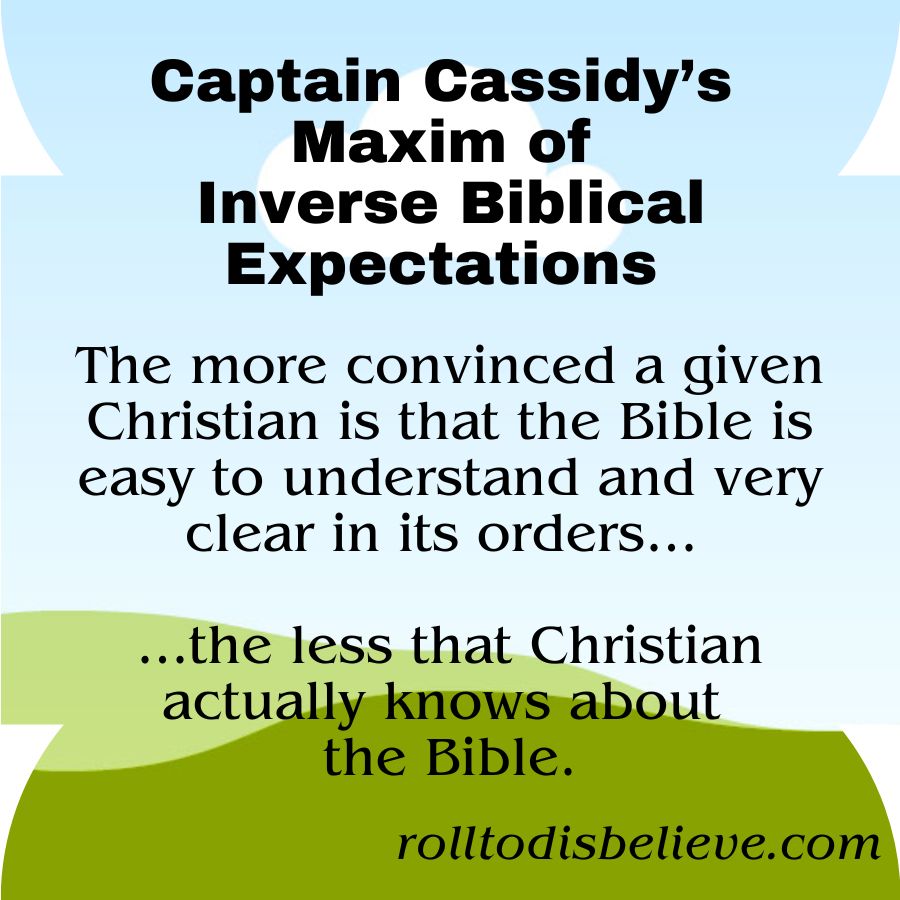
(Captain Cassidy’s Maxim of Inverse Biblical Expectations: The more convinced a given Christian is that the Bible is super-easy to understand and very clear in its orders, the less that Christian actually knows about the Bible.)
Part 3: Christianity has no one central single authority figure that all Christians respect. It has no one single document that all Christians must interpret the same way. The religion’s leaders depend mightily upon their own personal charisma and built-up networks of cronies and hangers-on to force their flocks to obey. Even then, if a sheep gets upset enough at their shepherd, they can simply leave to find one they like better. In most Christian groups, nothing forces people to stick around.
Part 4: The way of a man always seems right to him, as my old Pentecostal crowd would have said. That’s from Proverbs 14:12. My church leaders said this old proverb means that it’s almost impossible for someone to accurately gauge the correctness of their plans and opinions. Without praying and studying the Bible—both agreeing, of course, with those church leaders’ interpretations—it’d be very easy for someone to be very critically wrong.
THE RESULTS: Our heretic guest-stars developed their own conceptualization of TRUE CHRISTIANITY™. They glom onto like-minded leaders and join/form like-minded groups. But their enemies do the same exact things. They have their own different conceptualization. And according to their version of TRUE CHRISTIANITY™, it is the heretics who are wrong and fake and gross. There’s never going to be a way to objectively end their arguing because each and every one of them thinks Jesus personally approves of their particular opinion.
Both of them have tons of Bible verses to support their hot take on Christianity. They’ve both prayed. They both say they desperately want to embrace only the most perfect and accurate doctrines. And yet they both come out with such very different opinions!
Without fail, every Christian’s divine revelation is some other Christian’s heresy. Every TRUE CHRISTIAN™ is another Christian’s “Bad Christian.” And it works that way in reverse, too.
Grabbing for power let the curtain’s edge slip free at last
Once, long ago, evangelicals fretted a lot about their witness. In Christianese, that word represents the sum total of their reputation, credibility, and community standing.
But that fretting vanished around the mid-2010s, once evangelicals realized they were in solid decline. Who has time to worry about one’s witness during the fight of one’s life?
That’s why Trumpist evangelicals keep insisting that they’re the only TRUE CHRISTIANS™ around. No gods are gonna stop them, and no real people can.
By now, they don’t care what outsiders and other Christians think of them—as long as they gain the temporal power they crave. With real power in their hands, it won’t matter if they’re culturally irrelevant and the laughingstock of all who behold them. To get real power, they’re perfectly willing to embrace the hypocrisy they’ve been practicing in secret for decades.
Just don’t imagine there are any good guys in this story. There really aren’t. For the most part, the evangelicals calling Trumpists “Bad Christians” aren’t much better. They still want to dominate American culture and enact laws that damage human rights. They’ve just realized that they will catch more temporal power-flies with honey than with vinegar.
In that sense, maybe it’s better to have snarling, sneering “Bad Christians” openly and nakedly grabbing for power and craving theocracy. Our enemies’ enemy is not necessarily our friend.
All told, the next few months are gonna be an absolute circus. Watch for Christian-on-Christian fighting to increase as we get closer and closer to election time.
NEXT UP: Don’t worry, everybody! Some evangelicals know exactly how to end their religion’s decline. We’ll check out their stunning new ideas next time. See you soon!
Please support my work!
Thanks for reading, and thanks for being part of our community! Here are some ways you can support my work:
- Patreon, of course, for as little as $2 a month! I now write Patreon posts twice a week. They drop on Tuesday and Friday mornings for patrons, then a few days later on the main site, Roll to Disbelieve.
- Paypal, for direct one-time gifts. To do this, go to paypal.com, then go to the personal tab and say you want to send money, then enter captain_cassidy@yahoo.com (that’s an underscore between the words) as the recipient. It won’t show me your personal information, only whatever email you input.
- My Amazon affiliate link, for folks who shop at Amazon. Just follow the link, then do your shopping as normal within that same browser window. This link adds nothing to your Amazon bill, but it does send me a little commission for whatever you spend there.
- And as always, sharing the links to my work and talking about it!




0 Comments