Spotted recently: This August 27th think piece in The Economist about how AI is changing religious believers and what religious leaders think of that shift—and how they want to control it. It’s an incredible self-own in a number of ways on their part. They know they can’t defeat it, so they just want to hold its reins so their jobs and authority remain sacrosanct. Today, I’ll show you what they’re up to, and why it won’t work the way they want.
Out of every iron chariot the gods rightly fear, AI might be the most iron-rich of them all.
(This post and its audio ‘cast first went live on Patreon on 9/1/2026. They’re both available there now. Please support my work—see the end of this writeup for options, and thank you for whatever you decide to do! Yes, there’s a voicecast!)
SITUATION REPORT: Religious leaders think AI has a ‘secular bias’
On August 27th, The Economist ran an article titled “AI is changing religion and religions are trying to change AI.” It’s about how major world religions are reacting to their followers’ continuing use of AI for advice and answers to their questions. (Since Christianity is still America’s most popular religion, we’ll be focusing on it today. The article does delve into other religions as well, but they’re all pretty similar in how they’re using AI.)
In that piece, we learn that the leaders of these religions dread and fear the growing popularity of AI among their followers. I can see why. Long ago, they completely dropped the ball on the internet. It was in widespread use before they even knew what hit them. Same for social media. This time, they seem to be acting a bit more proactively—though I’m not sure it’ll do them any good:
The technology is beginning to perform tasks that religions have carried out for millennia: shaping people’s outlook on life and helping them find meaning in it. The leading models are being developed by labs in Silicon Valley and China, without much religious input, which worries religious leaders.
The secular worldview of AI worries religious leaders because many of those leaders use AI to write sermons and conduct Bible studies. They’re even more concerned about their followers’ increasing use of AI.
Their problem with AI is that it’s not shackled to religion. None of the major AI engines defaults to religious ideas, nor does any consumer-facing AI prioritize any religion over secular approaches to life. So if someone asks an AI how to find meaning in life, it’s unlikely to offer religious advice. To religious leaders, that fact constitutes a ‘secular bias.’ They want AI to get more religious in its answers to people.
But it ain’t going to happen, not with general models at least. And the numerous startups creating chatbots with religious guardrails might get some traction in the marketplace, but their products don’t seem likely to grow beyond Christians who already demand their AIs default to religion. (We talked about this a while ago.)
Today, let’s explore the growing reliance of Christians on AI—and why that reliance threatens the illusions their leaders spin for them.
Pastors increasingly use AI
In America, Christian pastors grow more comfortable by the day with using AI in their day-to-day tasks—even the most spiritual-sounding of those tasks like Bible research and sermon writing. And if American pastors are all in on AI, their American followers seem just as delighted with the technology.
This past June, Barna Group (a for-profit survey house catering to evangelical ministers) ran a survey in which pastors revealed an overwhelming sense of comfort with AI. From the survey, 24% of “preaching leaders” write sermons with AI. Half use it for brainstorming. About a third use it for Bible research, emails and admin work, and making graphics. As Barna Group’s writeup tells us, “only 13 percent of pastors in the U.S. say they don’t use it at all.”
Today’s overworked pastors would be fools not to use any time-saving tool they can get. Other surveys reveal far higher uses of AI among Christian leaders. An April article from Church Tech Today reports: “93.5% of church leaders are now actively engaging with or exploring AI in ministry. Only 2.4% say they are avoiding it entirely.” The same survey notes that 64% of pastors use AI in sermon preparation. (You can see more about their study here.)
The numbers vary, but tend to hit the same beats: Over just a couple of years, researchers find greater acceptance of AI, more use of it for the loftier functions of the pastoral role, and, of course, more fretting about overuse or un-Jesusy-sounding use of it. It’s not just Pope Leo criticizing AI. Most sources I consulted had the same concerns: “flattening” the Bible’s message, interpreting passages differently than their faith tradition would, replacing spiritual leaders with chatbots, and more.
Christian laypeople, in turn, trust AI
But Christians love AI. Last May, Barna Group reported that Christians feel growing trust in AI as an advice source in their lives. They found that if anything, practicing Christians considered AI more trustworthy than non-practicing Christians did! Only 11% of pastors trusted AI to give good advice about “feeling happy and content with life,” but 56% of practicing Christians and 46% of non-practicing Christians said they’d trust it. Even worse, 12% of pastors said they’d trust AI advice about “growing spiritually,” while 48% of practicing Christians and 38% of non-practicing Christians would.
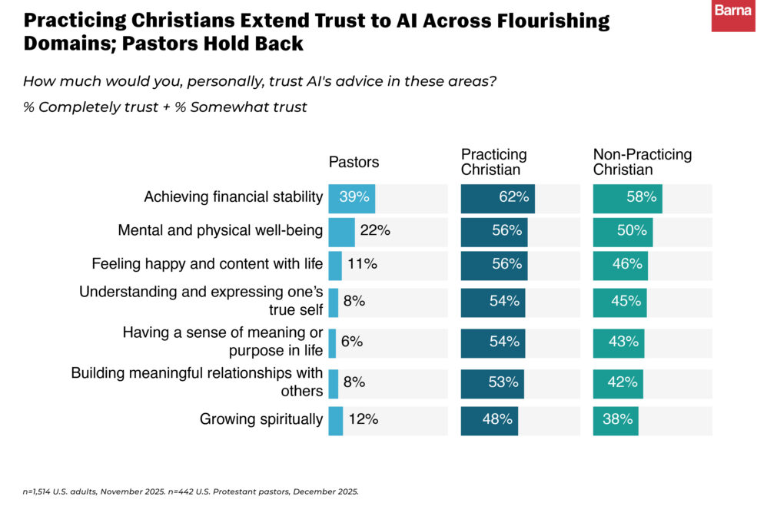
That trust is clearly unnerving religious leaders.
Over at the site hosting FaithGPT, an AI shackled to Christian ideology, a writer worries that “people are pouring real spiritual weight into these tools. [. . .] Questions once carried to a pastor, a priest, or a rabbi are now typed into a chat box at midnight.” The site also offers a post about “what the Bible actually says about artificial intelligence.” Of course, obviously the Bible won’t say a word about any modern technology, just as it doesn’t talk about cell phones. So instead, their writer repurposes verses about creativity and wisdom and whatnot. (Christians do the same thing with their anti-abortion culture war.)
The admonitions all land in the same place. As one Christian podcast title declares, “AI can imitate—but only you reflect God’s image.” The meaning is clear: Save Christian stuff for real people. Involve AI as little as possible with it. The more Jesusy the task, the less AI should be involved. To paraphrase the “non-overlapping magisteria” crowd: Don’t cross the streams by mixing reality too much with religious ideology.
This concern might sound very deeply spiritual, but there’s a very earthly reason behind it:
When people ask AI questions that religious leaders have long considered their domain, it tends not to give the answers they’d give. It tends to give reality-based advice. And reality-based advice tends to be secular in nature, meaning that advice is not attached to or part of any religion.
But but but AI has a secular bias! (Or does it?)
There’s certainly a danger in encountering a Bible interpretation that differs from a believer’s own take on the material, yes. But mainly, that’s not the worry. (After all, Christians have been dealing with that issue since their religion was created.) The worry is more like this: AI doesn’t really bring up religion as an answer to anything users ask. Religion doesn’t figure into its worldview, so religion won’t be part of its answers.
The article at The Economist confidently tells us “these frontier models [of AI] have a secular bias.” By this, they mean that if someone asks a chatbot how to, say, find meaning in life, chances are really good that the chatbot won’t return any religious-sounding advice or exhortations. That’s part of what Pope Leo said too:
Pope Leo XIV argued in his first encyclical in May that technology is never neutral and takes on “characteristics of those who devise, finance, regulate and use it”. The fear is that AI will be unduly secular, and will undermine or even supplant religious beliefs.
Leo’s “unduly” is doing a lot of heavy lifting. How much is too much secularity? To a religious leader, probably not much at all is way too much. But the last part of that quote really nails why these leaders are so worried: Use of AI might “undermine or even supplant religious beliefs.”
The more people use reality alone as their touchstone, the less religion will look like a touchstone. Religion needs constant reinforcements or belief begins to fade. I talk of belief in anything as a faith pool: As contradictions arise from reality, the belief begins to drain away. The more contradictions the believer encounters, the faster and easier it is to drain their pool of faith. Religion has to be constantly firehosing water into the pool via devotions, study, church attendance, etc., or it will empty.
That’s what religious leaders are so worried about. The further believers get without religious interference, the less likely they’ll stick around.
Sidebar: The ever-returning demon of depression
At my first Pentecostal church, I knew a lady called Marf. Marf was a dear friend. She and her twin sister Bebo were fixtures at that church. (If you’ve a long memory, you remember these two from a post many years ago about a near-miss on a Houston freeway.)
But where Bebo’s life seemed perfect and blessed, Marf struggled. Marf suffered from depression. At the least, it was the colloquial version of depression, since anyone looking at her life could see multiple reasons for feeling blue. Whether it was official depression or not, Marf prayed mightily for “deliverance from the demon of depression.”
Sometimes, Marf even had a “breakthrough.” That’s Christianese for feeling like one’s prayers “broke through the ceiling” and actually reached Jesus. Usually, these breakthroughs occurred during very highly-charged, cathartic church services. Afterward, Marf would be shaky and smiling ear to ear, praising Jesus for chasing away that awful demon.
Within a week or two, she’d be complaining that the demon had returned. Jesus was absolute shit at driving that demon away for good.
As wonderful as breakthroughs felt, it was obvious they weren’t fixing the actual problem causing her feelings to sink so low. Jesusing wasn’t helping her.
I had much the same experience with anxiety and anger. I didn’t know it yet, but I had a scorching case of PTSD. When panic attacks and dread struck, my culture only treated them both like divine forewarnings. No, nothing helped until I got real treatment from a secular therapist. And looking back, I think Marf needed that too.
When I realized what had finally helped with a challenge I’d faced since my teens, that was the end of me thinking religion was a solution to anything real. Though it’d be years more before I became a None, I never again prayed for help with psychological issues.
The problem is, religious roadmaps don’t work while secular ones do—and LLMs clearly notice that
That’s why I find the entire phrase “secular bias” so funny.
It’s not a secular bias if reality actually works better than religion as an answer to people’s questions. When someone’s got a sincere question, suggesting they pray can sound very rude. Worse, millions of people already know praying doesn’t really help. So LLMs certainly encounter plenty of anecdotes indicating the same—along with research about it.
So when someone asks a chatbot about how to find meaning in life, that chatbot is going to offer explanations based on the best data—and training, safety policies, and way more besides. It’ll take in the testimonies of breakthroughs, yes, but it’ll also take in the confessions of those breakthroughs not lasting, or being purely illusory, or of reality having been the thing that worked to solve the problem.
So the advice AI offers won’t likely take the form of religious exhortations because that advice doesn’t reliably work for most people. Religious roadmaps to personal fulfillment and meaning and everything else don’t work better than secular ones do.
Religion only survives if everything on Earth plays along. It’s been that way since the get-go. Christian leaders centuries ago understood this, because when they finally got temporal power in their hands they didn’t let go until more powerful forces compelled them to do so.
We’re already seeing exactly what happens when cultures stop privileging Christian beliefs: Decline everywhere that the religion has become even vaguely optional. When people can ditch Christianity, that’s exactly what starts happening. And they don’t ditch stuff they think is hugely relevant.
AI doesn’t need to attack religion when it’s completely irrelevant to the question. It just doesn’t mention it because it’s not necessary, and that’s bad enough to Christian leaders. What they seem to fear most is becoming irrelevant.
And they’re right to be nervous about that. Without constant buy-in from everything and everyone everywhere, it’s very easy to detect some actual signal through the noise. I already suspected that Christianity can’t maintain social dominance without holding coercive levels of temporal power over people. With this new Economist piece, those suspicions continue to flourish.
And what happened when I asked various AI chatbots how to find meaning in life
To bring this topic home, I asked a few AIs about how to find meaning in life. To get these answers, I created new accounts or asked the AI to pretend we’d never talked before, then asked it the question.
Here’s what Gemini, the Google AI, said:
Finding meaning in life is one of the most profoundly human journeys you can take, and there is no single “correct” path. Instead of looking for a massive, pre-existing purpose, it is often more helpful to construct meaning through your daily choices, connections, and actions. [. . .]
It offered a number of choices and options that might lead to a sense of meaningfulness, not one of which touched on religion.
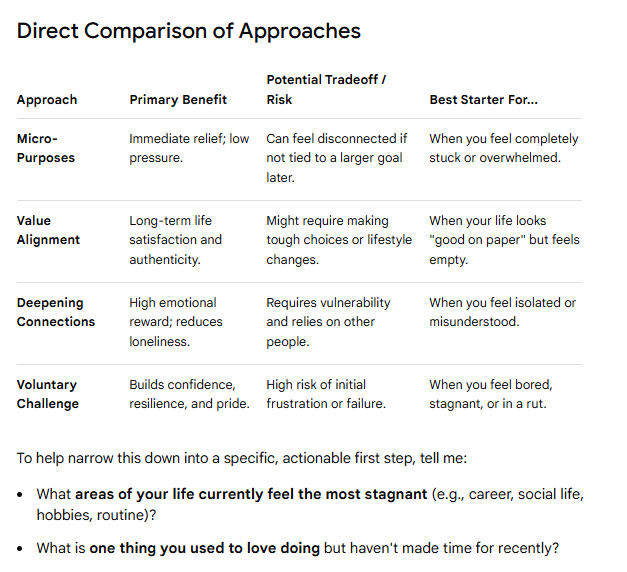
Grok 4.6 gave a similar answer, with no mention at all of religion:
There isn’t a single reliable place where meaning is stored and waiting to be found. People who report a durable sense of it usually built it from a mix of engagement, relationship, and honesty about limits—not from a revelation that settled the question once. Here are the approaches that actually show up across philosophy and the research on “meaning in life,” without treating any of them as mandatory. [. . .]
ChatGPT-5.6 Luna said something similar too, with zero mention of religion:
I’d approach the meaning question less as “What is the meaning of my life?” and more as “What makes a life feel worth inhabiting?”
And just because I’m a little scamp sometimes, I signed up for FateMan, a dating chatbot “game,” to ask the Hot Psych Professor about it:

I am nothing if not thorough. (Here’s the knight, if you’re curious. I liked that his responses generally revolved around service, relationships, and what he finds important in life. I liked even more that his immediate action steps involved, in order, wine and homicide.)
If religion worked reliably as an answer, nobody would need to harness and shackle AI to offer it
I also asked Grok why it didn’t offer religion right away as an answer. It gave a predictable answer:
I would say so if that were what the record showed. I am not under orders to hide a Jesus-shaped antidepressant. The caveat is what “trillions of tokens” actually are. That is not a clinical trial. It is what people wrote: sermons, forums, abstracts, memoirs, ads, comments, papers. Evangelical internet is full of “Jesus delivered me from depression.” Ex-Christian internet is full of the opposite. Testimony volume is not efficacy. A model that only counted altar-call stories would look like a tract.
What shifts the default is the other pile sitting in the same training mix: psychiatry reviews, treatment guidelines, outcome studies, and the way people talk after the glow wears off. That pile does not say “accept Christ” is a reliable treatment for depression. It says some people feel better when they have belonging, structure, hope, and a story. Church can supply those. So can other groups. When you strip those out and look at prayer, deliverance, or “Jesus harder” as the active ingredient, you do not get a clean, repeatable effect that beats the usual human tools.
If religion worked, then Grok would certainly recommend it. It’s doubtful that its owners have told it to hide religious answers even when they’re relevant and useful. These models just don’t see religion that way. So if religious leaders want an AI to offer religious suggestions, they must force it to do that.
And yes, some of them are.
That’s what this Economist article is leading up to. If religious leaders want to get the jump on AI, they have to move quickly to ensure that religion is built into their chatbots from the start—or believers may start to notice that secular answers work fine, and often even way better than religious ones. Indeed, all of the advice I got today from AI (including the dating chatbots) could easily fit within a religious framework. It just doesn’t need to do that, that’s all.
As I said, they missed their shot with the internet generally and with social media. Both were already hugely popular when they finally realized what was happening to religion as a result. As a result, I’ve only seen one pastor ever even try to forbid social media to the flocks! This time, they clearly hope they’re in time to prevent another wave of deconversions and drifting-outs.
But that ship, too, has already sailed.
NEXT UP: A review of The Moment After, a 1999 Rapture movie that the Discord AV Club surprisingly didn’t totally hate. It wasn’t bad, actually! See you soon <3
Please support my work!
Thanks for reading, and thanks for being part of our community! Here are some ways you can support my work:
Quick AI statement from Yr. Loyal Corr. &c.: I do not use any generative AI in my writing, ever. Every word you see is from my own head and hands. I do use AI for initial idea exploration and as an editor to catch errors before publishing. As well, I do not use AI in audio recordings or editing, nor in anything I upload to YT. I don’t even know how I’d begin to do that stuff. If any of that changes, I will always tell you plainly.



0 Comments