You know it’s summer when we finally see our first SBC metrics drop! Last time we met up, I showed you some details of those metrics from the Southern Baptist Convention (SBC)—and how those figures paint the picture of a struggling, rapidly-polarizing behemoth entering its managed-decline phase.
But as we’ll see, Southern Baptist leaders can’t just outright say any of that. Instead, they have to find a way to spin bad news straw into winning team gold. Today, I’m going to show you some of the hands-down most spectacular cope I’ve seen out of this denomination in about fifty years.
(This post first went live on Patreon on 5/25/2026. Please support my work—see the end of this writeup for options, and thank you for whatever you decide to do!)
SITUATION REPORT: Cope cope cope about the 2025 SBC metrics drop
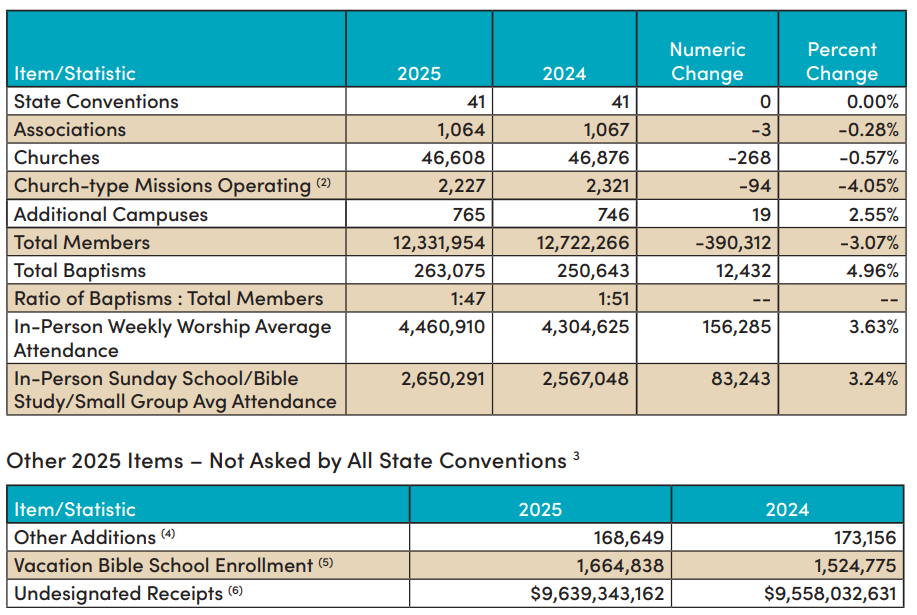
Every year before the SBC’s big Annual Meeting in the summer, they drop a sneak peek of the previous year’s performance metrics. Here’s the release itself from Lifeway (the SBC’s research and publishing arm), and here’s the table from their report:
In addition to the numbers themselves, Lifeway offered us an interview with the current Executive Director of Lifeway for another couple weeks, Scott McConnell. (On June 1st, Ryan Blackwell steps into the role. McConnell had a pretty short run! And so did his predecessor, Ben Mandrell.) During his interview, McConnell said something that really caught my attention:
“It’s hard to directly compare today’s average worship attendance to pre-COVID attendance in 2019. The reported number is still almost 800,000 less than in 2019, but 10% fewer churches are reporting non-financial numbers on the ACP [Annual Church Profile] today than in 2019. As cooperation improves, not only will metrics improve but Southern Baptists will be better positioned to impact communities for Christ.”
Really.
There’s a lot going on in that little paragraph. McConnell is really, truly pushing the notion that more complete reporting will totally improve the SBC’s metrics. That is an incredibly, breathtakingly dishonest claim to make. It’s like he doesn’t even know what kind of denomination this is.
Today, I’ll show you how the SBC’s worst cultural traits make it impossible for the mother ship to get complete “cooperation” from member churches.
The scandal of the evangelical authoritarian psyche
First, let’s start with the biggest problems within evangelicalism. The biggest problem of all involves their entire notion of how communities should be structured.
If evangelicalism as a whole can be characterized as authoritarian in nature, then the SBC is doubly so. Power and authority always flow from above, while members have next to no power at all. Powerful leaders can and do expect obedience and no backtalk from their subordinates.
However, that’s not what makes the SBC such a hotbed of abuse. Authoritarianism, properly corralled, fully accountable, and with enough third parties watching, can be a very effective way to run an organization with clear-cut goals—and whose followers get paid enough to put up with not having an override switch.
Rather, the SBC is dysfunctionally authoritarian. It lacks all of the guardrails I mentioned just now. Instead, powerful leaders appoint subordinates on the basis of loyalty, not competence. Power itself becomes the group’s leaders’ goal, not anything the group ostensibly wishes to accomplish. Followers can only be assured of safety through loyalty, and even then they might run afoul of a leader without meaning to—or even become a focus of leaders’ abuse.
As for those leaders, they slip entirely free of accountability. Their subordinates protect them from any possible consequences of their behavior. Even the worst monstrous predators in ministry can find a post-conviction pulpit job in an SBC church. There just isn’t a low that’s too low for church hiring committees.
What I describe here is exactly why the SBC is in the middle of a sex abuse crisis that’s dragged on for seven years now (“Abuse of Faith”). Their entire culture made sex abuse not only possible but inevitable. And without major reforms to that culture, their churches will never be safe.
But SBC leaders are thoroughly enmeshed with the system their culture built. They don’t want major reform. Not even the Pretend Progressives, my term for the SBC faction making the most noise about sex abuse reforms, really want that. If anything, SBC leaders and pastors tend to think the answer to any problems they’re facing obviously involves assuming even more power over their followers.
The scandal of the evangelical prosperity gospel
Second, evangelicals tend to buy heavily into prosperity gospel these days. Oh, it doesn’t always take the form of specific name-it-and-claim-it, blab-it-and-grab-it demands of Jesus. But its claws have still dug into the evangelical heart so deeply they cannot be removed, to the point where an evangelical can ostensibly reject prosperity gospel itself while still completely buying into its main premise:
If you are Jesusing correctly, then Jesus will totally reward you in some material way during this lifetime. Conversely, if you’re Jesusing incorrectly, he will punish you somehow.
So a church grows because its pastor and congregation are Jesusing correctly. But if someone is Jesusing wrong, or their heart isn’t quite sufficiently into it, then Jesus will hold back his blessings. That church will fail to thrive and probably even close forever soon.
This is why so many megapastors tend to become powerful leaders within the SBC. It’s also why plum denominational roles tend to go to pastors who’ve “grown” churches to megachurch status. Pastors will find it difficult even to find speaking gigs at the Annual Meetings if their churches fell apart and closed! But for one whose church grew, doors open as if by magic. Everyone wants to touch the hem of his slacks as he passes.
Every single SBC pastor on Earth knows what bad numbers will mean for their own future careers in the denomination. Some report anyway. But most will sensibly keep back any info that might damage the SBC’s reputation—or their own. Others will find ways to make bad news look considerably more palatable, just like megapastor and former SBC president J.D. Greear did with his “Who’s Your One” evangelism campaign.
The scandal of the evangelical need to win at all costs
Third, evangelicals desperately want to be on the winning team. They can’t tolerate supporting any endeavor that is obviously failing. I get that idea because of how dishonest and squirrelly SBC leaders get around any hint of not-winning. If SBC leaders decided to reveal the real truth of the denomination’s crushing decline, they’d likely see half of their donations disappearing overnight—and neighboring hard-right evangelical denominations getting a huge influx of former Southern Baptists!
In the SBC, this tendency manifests as inconsistent reporting of metrics. On years when Beach Reach is bombing, their metrics don’t get into the Annual Report. When Total Receipts began seriously tanking, they vanished and we only get Undesignated Receipts from now on. When Sunday School attendance plummeted, Sunday School reporting vanished, returning a few years later combined with small group and Bible study attendance.
In recent years, SBC leaders have even tried to fiddle with their idolized baptism ratio (the number of baptisms compared to total membership, which is 1:47 this year)! Even more hilariously, as the denomination’s leaders struggle to deal with their status as a tainted brand, they’ve even tried to change the denomination’s very name to Great Commission Baptists!
For the 2025 metrics drop, SBC leaders had to work hard to deal with a lot of extremely bad news. Some of them focus on the good news, as Kevin Ezell did with baptisms in the Lifeway writeup.
As we’ll see, though, Scott McConnell has a whole other way of hand-waving it away.
Now let’s look at the cope over the 2025 SBC metrics drop
Now that you know the most relevant parts of evangelical dysfunction, let’s look again at what Scott McConnell said about this latest metrics drop.
First and foremost, it’s extremely easy to compare worship attendance in 2019 to the 2025 numbers. We’ll do it right now!
After all, the same SBC pastors are filling out the ACP. And they are getting roughly the exact same attendance percentages year after year. In this case, 35.8% of the total number of members got counted as sitting in church in 2019, versus 36% in 2025. Yes, that’s 800k fewer people in the pews, but that’s because the SBC’s membership fell from 14.5M in 2019 to 12.3M in 2025. Attendance is actually holding steady at about the same level it’s been since about 1998—a fact which makes me strongly suspect that it’s not completely accurate anyway.
However, even without any promise of accuracy, McConnell tells us that “10% fewer churches are reporting non-financial numbers on the ACP today than in 2019.” So only “61% of churches reported at least one non-financial item” on that questionnaire. Every state-level convention seems to have its own questionnaire (and the mother ship doesn’t seem to care that they’re getting apples-to-oranges forms from each of those lower-level conventions). But here’s a sample ACP from Texas.

It only asks a few questions total, with most concerning non-financial stats: Total membership, total baptisms (which it then breaks out by age group), additions (meaning the number of other people who joined without getting baptized, usually by transferring in from another SBC church—and remember this idea because it’s coming up again in just a minute), worship attendance, Sunday School/Bible Study/Small Group attendance, and Vacation Bible School (VBS) enrollment. From what I’ve seen of ACPs, this is all fairly standard. Some conventions leave some questions out, others add more questions, but overall this Texas form is representative.
Even as few as the questions were, barely over half of SBC member churches answered anything about their total membership, baptisms, headcounts, child enrollments, etc. And Scott McConnell is super-sure that if he could only get more churches to “cooperate” more by reporting their numbers, SBC metrics would start looking way, way better—and their evangelism would start getting way more effective too!
The myth of the SBC church doing banger numbers but not reporting in
I find McConnell’s dishonesty just breathtaking.
Here’s the rule:
Evangelicals always report wins. To report a win, they’ll mangle numbers as much as they must.
When evangelicals actually have a win to report, they do not shut up about it, ever. (That’s also how we know they don’t actually have any real evidence for their supernatural claims: If they did, there’s no way we wouldn’t all immediately know about it.)
Here’s the corollary to the rule:
When evangelicals have a loss on the books, they take rigid vows of silence. If there’s just no way to turn bad numbers into success, the bad numbers just get omitted.
So there’s no way whatsoever that some SBC church out there is doing incredibly well but somehow just forgetting to fill out their ACP. It isn’t happening—not in this world, not in this denomination. If an SBC church isn’t reporting in, it’s because they’re doing so poorly that they don’t want to embarrass themselves, their pastors, or their denomination.
So what we’re seeing here is the best-case scenario. The numbers we have are from the churches whose pastors either aren’t too ashamed to report in at all—or just aren’t interested in going further in the SBC as a career path. No other pastors will report numbers to the ACP. They know what happens to the bearers of bad tidings!
Little wonder the number of SBC churches “cooperating” with the ACP have been falling steadily since 2013.
The SBC metrics drop reveals still more ghost members on the rolls
That’s why it’s apparently taking forever for SBC pastors to clean up their membership rolls, too. McConnell tried to shame those pastors as well, saying:
“Church closures and churches cleaning up their membership rolls to reflect those people God has currently entrusted to them have negative impacts on total membership numbers. Churches with more than four times as many members as their average attendance are either unhealthy or need to clean up their membership records.”
McConnell refers here to ghost members: people on the membership rolls who aren’t actually members of those churches anymore. He implies that the presence of these ghost members is having a negative impact on attendance and other metrics.
But once again, he’s reckoning without his hosts. Membership in SBC rolls can be a difficult topic, particularly in the small congregations that are the vast majority of member churches. It’s like removing the profile of your dead pet from a pet-shop site online. There’s a lot more involved than just saying “look, this one’s not a factor anymore.”
And I get it. When Lord Snow passed away, I couldn’t bring myself to remove his profile from Chewy.com. (Recently, they added a way for members to memorialize/retire a pet’s profile!)
For churches, the situation is even more delicate and fraught.
Does the church really want to say goodbye forever to that one person? What about people who’ve moved away, but might move back one day? Or who want to keep receiving the newsletters and whatnot, because they still feel connected to their onetime church home? Would it insult surviving family members to see Great-Aunt Sally removed? Or anger the parents whose kids have long since gone to college and deconverted?
No, my very strong suspicion is that church membership is also much more dire than we’re seeing in these tables. There are enough churches with ghost members to catch McConnell’s specific attention. But if SBC pastors actually did what McConnell is trying to shame them into doing, we’d likely see the SBC’s membership numbers tank even harder.
Most ironically of all, he’s calling attention to SBC number-fudging when attendance isn’t actually looking bad at all.
And a hidden message in the baptism numbers in the SBC metrics drop
Kevin Ezell, the president of the SBC’s North America Mission Board (NAMB), gave us another key piece of information in that Lifeway writeup:
“Every baptism represents a life transformed, someone who has found forgiveness and new life in Jesus Christ.”
Remember the evangelical rule? Wins = instant blabbing forever, while losses = radio silence or number-fudging? And the ACP sample above that asked about additions to the membership? Here’s where we circle around to that stuff.
The SBC does some very fancy footwork around the entire topic of baptisms. As you see in the ACP sample, in theory at least they know exactly what age groups are getting dunked. They also know how many “additions” churches get (which are, again, people joining up without being baptized all over again).
However, we almost never, ever see those stats. The only times I’ve ever seen them talk about baptism stats by ages were a task force report from 2014 and a sky-is-falling alarm bell ringing about teen baptism rates in 2020. As for additions, we never see those anymore. They used to be a line item in the Annual Reports. You can see them all the way up to the 1957 report (p. 720). But in 1958, that “additions” line vanished—never to return.
I don’t know what was happening behind the scenes to make additions vanish. But I do know Southern Baptists. Something unpleasant was going on with those numbers.
And the re-baptism problem that we almost never hear about
There’s a second issue with the way SBC churches report their baptisms, and it involves the conditions under which people get baptized at all.
Anecdotally, I’ve heard many, many reports of evangelicals getting re-baptized. Sometimes, they want to be dunked again because they lapsed for a while or—in the case of children who got baptized very young—didn’t really understand what was happening the last time. Other times, they get re-baptized because their previous baptisms didn’t get done with the right magic spell wording. And still other times, it’s a show of commitment to a new church if they switch. (Personally, I’ve been baptized three different times. I refused to do it a fourth time when I rejoined Pentecostalism at 17.)
Given the steep declines in Christian numbers in recent years, not to mention the SBC’s very own membership declines, it is extremely unlikely that the 2025 baptism numbers represent brand-new, bagged-and-tagged heathens who converted to Christianity for the first time.
But that’s exactly how Ezell characterizes each and every baptism: “forgiveness and new life in Jesus Christ.”
Just as evangelicals have forgotten all about “additions,” they have forgotten that quite a few baptisms are re-dunks of evangelicals who—at least in theory—already got “forgiveness and new life” the last time they went under the water.
SBC leaders can’t do anything about these bad metrics, either
It’s tough to be a dysfunctional authoritarian evangelical these days. But it’s even tougher to be one in the SBC right now. This huge denomination can’t even hold membership steady anymore. Its churches have been shrinking further and further—both by the SBC’s reckoning and my database’s.
In 2007, Tony Kummer noted that 21% of SBC churches had fewer than 100 members. Another 23% had 100-199 members. By 2023, according to Lifeway, that first figure had risen to 70%. (I can’t find figures for specifically 100-199, but the 2023 report says 20% had between 100-249 members.) Additionally, Kummer wrote that 22% of churches in 2007 had more than 500 members, while in 2023 only 4% of churches were that big.
Smaller churches becoming the norm also gets borne out by my database, which tracks congregation size if SBC members were evenly distributed among all SBC churches. That number’s been shrinking for many years. In 2007, it sat at 363 people, but in 2023 it was 276.
And almost every single time that the SBC’s leaders try to goose the flocks into doing more evangelism, the results are hilariously awful. Their “Million More in ’54” campaign aimed to shore up sagging Sunday School enrollment in 1954. Recruiters managed to add about 600k people to the program—nowhere near a million. However, their “Everyone Can” evangelism drive, which sought one million baptisms in 2005-2006, failed to get anywhere near that many. Worse, they bagged fewer baptisms in both 2005 and 2006! (And fewer in 2007 and 2008. In fact, with few exceptions baptism numbers have trended downhill since 1989.)
And let’s not get started on their “Bold Mission Thrust.” It was a complex, 25-year plan with many different objectives running from 1976-2000. As I built my database, I always had a good laugh at both the name and how badly the SBC missed almost all of its objectives every year. Here, for example, is the 1980 Annual Report, with the campaign’s goals and metrics on p. 35. In the 2000 report, it’s on p. 60. Given how NAMB redefined “missionaries” to achieve the campaign’s goals back in 2000, we can likely take any reported success with a person-sized pillar of salt.
The SBC cope shall continue until SBC morale improves
One of the most fascinating things about the SBC’s decline is how the denomination’s leaders and followers alike respond to it.
When the rigidly hardline faction, which I call the “Old Guard,” hijacked the denomination with their “Conservative Resurgence,” it utterly failed to reverse the SBC’s declines. And in answer, Paige Patterson (one of its two main architects) stood ready in 2004 to hand-wave away any concerns with doublespeak, weasel wording, and moved goalposts. At the end of his interview, he said:
“It is too early to tell all of the effects of the conservative renaissance. Wait 20 more years, and we will have a better view.”
Well, it’s been more than 20 years! The SBC is still declining. And all the hardliners can say is still nothing but cope. Fewer and fewer SBC members seem to believe all the excuses they’re hearing out of their leaders.
It’s good for the rest of us that the SBC’s members can’t evangelize as well as their leaders defend their own bad ideas and most poisonous traits. If they could, the denomination would be doing fine today.
NEXT UP: As evangelicals try harder than ever to strip religious freedom from Americans, scholars fret about the ongoing secularization of the country. See you soon! <3
Please support my work!
Thanks for reading, and thanks for being part of our community! Here are some ways you can support my work:




1 Comment
Rebaptism in the grand age of Christian decline - Roll to Disbelieve · 05/25/2026 at 4:01 AM
[…] he can refuse to report on baptisms at all, which increasing numbers of churches are doing, to my eternal amusement! Or he can allow iffy rebaptisms to proceed. (I’m guessing pastors’ opinions on […]