Ever since I began tracking evangelicals’ insistence on a Gen Z revival, I’ve noticed how well they avoid any unpleasant jabs from reality about it. But lately, it feels like they’re going overboard in avoiding facts. Something else seems to be going on here besides just yet another evangelical talking up a revival that never materializes. This is bigger than just a local church’s fervor fizzling out. Indeed, this is turning into a perfect follow-up to how they behaved when their decline first hit headlines.
Today, we explore how this story is shaping up and how it compares to what they were doing ten years ago.
(This post and its audio ‘cast first went live on Patreon on 10/2/2026. They’re both available there now. Please support my work—see the end of this writeup for options, and thank you for whatever you decide to do!)
SITUATION REPORT: Yes, they’re still on about that big huge Gen Z revival
A revival, in Christianese, describes a large-scale conversion of adults. Revivals can be local, national, or even worldwide, but they must involve lots of conversions to qualify for the label.
Ages ago, we talked about the “Quiet Revival.” This phrase originated in the UK in a survey published by the Bible Society in April 2025. In the report, the group found big jumps in church attendance in Gen Z men.
In response, evangelicals insisted that the survey meant that Gen Z young adults were converting in record numbers to evangelicalism. More than that, the conversions were staying under the radar. In other words, this revival was “quiet.” Sure, every reputable survey house reported declines in Christianity all over the Western world. But this group claimed that young adults were still joining up.
This report lit a spark under evangelical leaders’ asses. That spark didn’t extinguish even when the Bible Society withdrew the claim due to faulty survey methodology! (And notably, even in their retraction, the Bible Society still insisted that Christianity was experiencing a resurgence of interest from young adults.)
In recent news, evangelical leaders keep reporting record numbers of conversions and baptisms. In August, megapastor Josh Howerton said in an interview that “every pastor I talk to” makes that claim. He’s one of those Calvinist theo-bros, too—and quite a controversial character in his own right. His church isn’t in the official member database of the Southern Baptist Convention [SBC], but it shows up in official and unofficial SBC news and has deep ties to the denomination. So the pastors he’s talking to are likely SBC as well. That only makes his claim more remarkable.
A September post from Tim Jackson for the Christian Restoration Association offers readers the same claim. To bolster his claim, Jackson cites an April 2025 Barna report (almost certainly this one). He cites some of the worst-of-the-worst hypocrites in evangelicalism as role models for young men, including Doug Wilson and Mark Driscoll—along with Josh Howerton, ironically enough.
And on September 26, Christian Post reported that Gen Z adults were “more likely than older Americans to describe themselves as ‘religious’, even as many also engage in practices at odds with Christian teaching.”
In these claims, we see a lot of smoke. Now let’s see what the fire actually looks like.
Where evangelicals are getting the idea that revival is happening in America
On September 15, Barna Group claimed that “one in three young adults say they’re attending church more often than a year ago.” They balanced that claim by adding that 45% of respondents reported no change at all in their churchgoing habits. A Barna leader, Daniel Copeland, said that “The real story isn’t the average, it’s who’s stirring at the edges and what they are looking for.” But it doesn’t seem like evangelicals caught that nuance.
Shortly after that story, on September 17, Christian Post reported that “male teens now outnumber females in church youth groups.” They base that claim on a Barna Group report titled Reimagining Ministry for Gen Alpha. (Gen Alpha is the current youngest American generation. Their oldest members are at most 16 years old.)
As for that September 26 story from Christian Post, they get this idea from a September 2026 Harris Poll that bases its conclusions on 372 Gen Z respondents.
Gloo, a rising behind-the-scenes force in evangelicalism, reported on September 16 that Gen Z was “a generation looking for spiritual depth.” They’ve “strategically invested” in Barna Group, so it’s not surprising to see frequent collaborations between the two. Nor is it surprising in the least that their main suggestion to church leaders was to maintain “the oldest practices of the Church: prayer, worship and life with other believers” instead of trying to come up with new ways to attract young adults.
Almost all of the revival claims I’ve seen draw upon Barna Group reports—the ones I’ve described here and others still besides. They don’t draw upon reputable surveys and studies because none of those would support any narrative of revival. Even George Barna himself, who parted ways with Barna Group back in 2009, wrote in April that he doesn’t think there’s a revival going on with Gen Z.
Revival in America is still just a pipe dream
On August 25, Christian Post published an opinion piece by Arnie Cole. It’s titled “Is there a revival in the US? The real data says no.” In it, Cole unequivocally denies there being any revival going on in America:
No, the United States is not in a revival. Not as of the summer of 2026, not by the standard the Christian tradition has historically used and not by any standard the data can support.
And he ought to know. He runs various organizations that promote Bible reading and engagement, and ran research for a 2025 report called “State of Christianity in America.” Nobody but nobody would love to see a revival in America more than this guy. But here he is telling evangelicals that it isn’t happening and they need to stop making it happen.

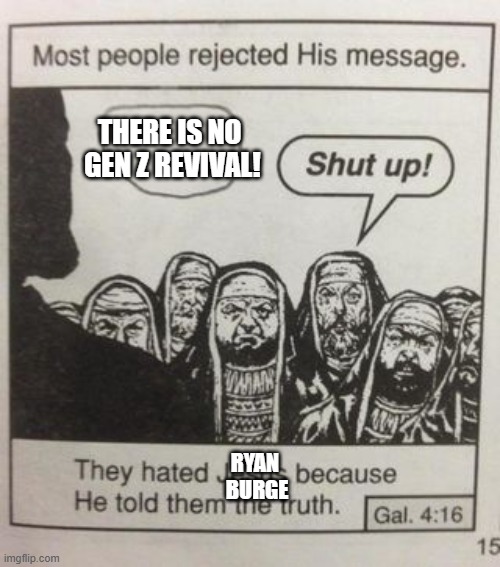
He’s not the only person harshing the evangelical revival buzz, of course. From the get-go, Ryan Burge has been trying to tell them there isn’t a revival. But he’s finding out that Christians never listen to their prophets. Prophets only tell them what they don’t want to hear, after all.
In September, Hannah Hartley wrote an important analysis of both evangelical claims about revival and what the numbers actually say:
What is happening is not a generation turning Christian. It is a narrower group of already-inclined young adults, particularly young men, becoming more visible and vocal at a moment when a media and political environment was primed to find that story compelling.
She also accurately points out that this entire story is built top-down. It’s not based on what’s happening on the ground in churches. Instead, big-name leaders and groups (like Gloo and Barna) push this narrative out into the wild. They can only desperately hope it will actually catch fire and become reality.
In short, no matter how many totally-real pastors tell Josh Howerton they’re baptizing record numbers of young adults, those young adults aren’t moving the needle on Christian decline. They’re not saving churches from closure. They’re not fixing the ongoing membership hemorrhage in the SBC.
Why evangelicals can’t face the truth about their imaginary American revival
On September 25, David D’Amato made quite an interesting point:
The clickbait mirage of religious revival has obscured these very real trends for years, forestalling a more relevant and important conversation about the role Christianity plays in American politics and culture.
Evangelicals distract themselves from unpleasant truths with comforting fantasies. They’ve been using this exact same playbook for decades. Even when I was a Christian back in the 80s and 90s, nobody questioned preposterous testimonies because they always affirmed and validated Christian beliefs. Nobody investigated urban legends, either, because they told Christians that demons, angels, and miracles were all real. It didn’t even occur to us that our peers and leaders might lie.
When evangelicals finally faced the undeniable fact of their decline in 2015, they responded in the same way they are now—with denial. They pointed to everything but their own broken system as the cause of that decline. As long as they could blame decline on “cultural Christians” and demons, they didn’t need to look too closely at themselves. (The message is always perfect in broken systems.) In a very real sense, they “forestalled” equally relevant and important conversations by focusing on non-causes and non-solutions for their decline.
So when Gloo tells evangelical leaders that their old-fashioned church services are perfect as is, they’re just feeding those same delusions of adequacy. When evangelical pastors talk about record numbers of baptisms, they can ignore church closures and overall membership declines. Most of all, when evangelicals insist that Gen Z men are converting like whoa, they can ignore that the 4-14 window has already closed on that entire generation—just as it is beginning to close now on Gen Alpha.
Why this false revival story is important: The real headline
The real headline here isn’t “there is no revival happening in America,” just as it wasn’t particularly “Christianity is in a serious decline” back in 2015 or even “nothing supernatural lives at the heart of Christianity itself.” In all of these cases and more, the real headline is how the most fervent Christians deal with those truths.
Similarly, their response to the truth about revival is becoming a bigger story than the false revival itself. Evangelicals really need to have some big conversations about the growing alt-right politicization of Gen Z men and the theo-bros pandering to them, about how evangelicalism is fast becoming dominated by said Calvinist theo-bros and Christian nationalism, about how far evangelicals are willing to go to enshrine their religious privilege into American law, about how evangelicals are sneaking indoctrination into public schools, their ongoing idolization of strongman leaders like Donald Trump, and even about how incredibly post-truth evangelicalism itself has become since 2015.
More than that, even, they need to have conversations about the nonstop abuse scandals pouring out of their most fervent churches. They need to be focusing on making churches safe for everyone, on ending the careers of all abusers in ministry, on focusing on all that boring stuff Jesus actually explicitly commanded them to do.
But evangelicals don’t want to have any of those conversations. What they want is to be told they’re perfect. Jesus loves them best! They’re better than everyone else! Thus, they deserve to rule America—and the world beyond.
No, reality explodes on impact with that level of antiprocess. Nobody debunking revival claims stands a chance of breaking through it. Evangelicals would rather have a fake revival than no revival at all.
Really, nothing could summarize post-Christian America better than evangelical avoidance and denial. Indeed, their response to revival claims tells us more about them than they should really want us to know.
Alas, they can’t stop being their own worst problem. And so their decline will continue long after they’ve discovered some new way to deny reality.
NEXT UP: Reasons to convert to TRUE CHRISTIANITY™, according to the 1972 Rapture movie A Thief in the Night. See you soon! <3
Please support my work!
Thanks for reading, and thanks for being part of our community! Here are some ways you can support my work: