Alpha Course is a venerable evangelism-focused Bible study about Christianity. As such, its creators brought their A-game to making it as persuasive as humanly possible. But to call it underwhelming would be an understatement. In the series’ second video, “Who is Jesus,” we explore various bad apologetics arguments and emotional manipulations that are evangelicals’ only substitute for real evidence about the founder of their religion.
(This post and its audio ‘cast first went live on Patreon on 6/20/2025. They’re both available now! NOTE: There’ll be another watch party for #3 and #4 on the Discord – on Saturday, 6/28, 7p PT. Here’s your Discord invite (case sensitive; type this into Discord’s server-adding plus sign on the left bottom of your server list: 8pkasaySuD )
(Series tag for ‘Answering Alpha‘)
SITUATION REPORT: Gosh, who is this strange Earthling you call Jesus?
This video presents evangelicals’ arguments regarding Jesus. They intend this video to be an introduction to the topic to those who might feel curious about Christianity.
(For the first video’s review, click here.)
In this second video, we encounter a wealth of evangelism strategies:
- Logical fallacies (appeal to antiquity; appeal to popularity)
- Miracle claims without evidence
- Historical claims that can only stand by mangling concepts like “contemporary”
- Pivoting to emotional testimonies in case none of that worked
- Bad apologetics arguments to seal the deal
- A very strange omission about the earliest New Testament fragments
So in just 25 short minutes, we get a whirlwind tour of everything evangelicals think will convince normies to adopt their religion.
(Interestingly, I recently learned Alpha Course is supposed to be ecumenical. In hindsight, now I understand why the presenters praised C.S. Lewis’ book Mere Christianity like they did in the first video—like at 12:34 in the first video, timestamped here. But I suspect everyone at the watch party, including me, took it as purely evangelical.)
First and foremost, Alpha Course wants to establish the need for Alpha Course
To reinforce the need for Alpha Course, the video first spends quite a lot of time on young adults looking embarrassed and saying “uh”. Eventually, some of them offer muddled guesses about Jesus like “he was a really great person” and “a god.” A few, clearly Christian, say he’s “the son of God” and “everything.”
If I asked random young adults about a major figure from any well-known world religion, I suspect I’d get the exact same kind of answers. For most young adults today, religion isn’t very relevant to their everyday lives. Outside of specific contexts, they don’t think about it much. They have to get into the headspace for such discussions—and while they’re getting there, they use verbal filler words like “uh.” It doesn’t mean these young adults are stupid or ignorant. It just means they’re trying to be socially sensitive while readying themselves to engage with the other person’s requested discussion topic.
This first part of the video clearly establishes the need for Alpha Course. Apologists and evangelists do this all the time. In any evangelical apologetics or evangelism book, the first part of it establishes the need for the book itself.
How to really support a claim
To support my claim, I went to Google and typed in “amazon.com evangelism apologetics book” and selected the very first return, Turning Everyday Conversations into Gospel Conversations (2016, but first published in 2001). It’s a Southern Baptist Convention (SBC)-aligned evangelism guide.

Then, I pulled up the book’s sample reading. This revealed 45 pages out of ~144 total that deal only with the great need for evangelism and apologetics—and how well this book will meet that need.
Similarly, the first part of Alpha Course establishes the need for Alpha Course. Every video will likely start in similar fashion.
Alpha Course starts off with the Cosmological Argument
Next, the main presenter of the video, Nicky Gumbel, offers his conversion testimony. It’s the one we saw in the previous video: He was totally a committed atheist and lawyer from an entire family of lawyers, so he thinks he totally understands how to evaluate claims. In fact, he argued with Christians all the time in college! But one day he read the New Testament and decided its claims were completely true. (He’ll return to his testimony at the end of the video around 23 minutes in, as well, to claim “the evidence” persuaded him.)
He asserts that one cannot “prove” Christianity mathematically or scientifically. However, the scientific method finds either support or a lack of support for a given claim—if it is falsifiable at all, which many religious claims aren’t.
Then he compares a cake to the universe, saying that just as a cake requires a baker, someone also had to create the universe. This is a very old and thoroughly debunked Creationist argument called the Cosmological Argument. It is a logical fallacy (the Appeal to Ignorance) as well as a false comparison:
- Whatever begins to exist had a cause.
- The universe itself began to exist.
- Therefore,
the universe had a causeJesus/Yahweh created the universe.
Some apologists, like William Lane Craig, rely heavily on this apologetics argument. In doing so, though, they’re counting on the flock’s inability to think critically about Christian claims. Starting at 6:32 in the video, Gumbel even claims that the Cosmological Argument must be true because the Bible talks about Jesus’ resurrection. His conclusion here doesn’t even remotely follow his premise, but he delivers it with certainty nonetheless.
Alpha Course mangles history to PROVE YES PROVE Jesus existed
(Here, Yr. loyal &etc. grins, cracks her knuckles, and dives right in.)
Finally, at 6 minutes in, Gumbel starts to talk about the ostensible topic of his video. He claims that Jesus totally existed as a real person who lived, died, and resurrected himself around 33CE. Further, he asserts that the Gospels are historical documents.
He supports these claims with statements from Josephus and Tacitus. Of note, he offers no counter-arguments and doesn’t mention when Josephus and Tacitus were active. But I will.
Titus Flavius Josephus was born in 37CE, four years after most people think Jesus died (33CE). He was a Jewish historian who fought against the Romans in the First Jewish-Roman War (66-73CE). Around 75CE, he wrote about that war. Around 93ish CE, he wrote Antiquities of the Jews. As part of that latter book, many Christians think that he included what they call the Testimonium Flavianum.
The problem with the Testimony is very simple: It is not mentioned in any 1st-3rd century sources at all. Even Origen, who in the 3rd century wrote the famous Contra Celsus, a rebuttal to a critic of Christianity, didn’t mention it—and if it had existed, it would have gone into Origen’s rebuttal. The Testimony isn’t even written in 1st-century language. Historians today generally regard it as mostly a forgery.
As for Tacitus, he wasn’t even born until 56CE. At best, all his writing confirms is that Christians existed and that he’d learned some of their beliefs.
As we discovered in the 1st-Century Fridays series a while back, no contemporary authors in the ancient world mention a word about Jesus, his followers, or his take on Judaism from 0-33CE. No, not a single one. The earliest fragments of Gospel verses are among the earliest real evidence we have of the religion’s very existence, and the earliest of these fragments, Rylands Library Papyrus P52, dates to around 100-150CE at the earliest—and to the early 3rd century at the latest.
Even early Christians themselves were puzzled by the total absence of Jesus, Christians, and Christianity in early writings. In the 9th century, a Catholic patriarch named Photius I even mentioned this strange omission from the works of Justus, a contemporary of Josephus.
Of course, you’ll learn none of this stuff from Alpha Course. After name-dropping Josephus and Tacitus, Gumbel rushes right past the entire topic.
Alpha Course is off on the road to Judea; they certainly do get arooouuuuunnnnnnd…
Now, we explore Jerusalem (at 6:45 in) with Gemma and Toby, our presenters from the first video. As they’re being driven around town, Toby wonders if there’s “any evidence that he [Jesus] even existed.” Well, we already answered that question: No, there is not a single shred of truly contemporary evidence suggesting that Jesus, his followers, or his religion existed in 33CE.
But wait! Gemma has a different answer: “Actually, there’s quite a lot of evidence.”
Oh really. Do tell.
She just asserts that “no serious historian would deny Jesus existed.” She name-drops Tacitus and Suetonius to support her claim. We already looked at Tacitus. As for Suetonius, he wasn’t even born until 69CE. He wrote about the Great Fire of Rome commonly blamed on Nero, but somehow he omitted all mention of religiously-persecuted Christians in that account.
But we’re about to get an even more hilariously clumsy misuse of history.
The Appeal to Proximity of Events
Alister McGrath, billed as a professor of science and religion at Oxford, tells us that generally, the earliest copies of writings were written much later than the events depicted.
This, at least, is true. Homer’s Odyssey deals in events taking place during the Bronze Age around 1200BCE. The earliest bits of it we’ve found are on clay potsherds from about 400-500 BCE, while Homer himself probably lived around the 800s BCE.
But then McGrath claims that we can trust the earliest fragments of the Gospels about the history of the 1st century because they’re much closer to the events depicted.

This is a fallacy. Something false doesn’t become true just through temporal proximity. Weekly World News stories about “Bat Boy” can’t be trusted just because they supposedly happened right before the issue went to press. Hogwarts doesn’t become real just because Harry Potter books take place in modern England.
Further, McGrath somehow forgets to mention that out of the many thousands of scraps of New Testament writings, not a single one completely agrees with any other one. Now, these are usually very minor differences—like spelling errors. But they are, all the same, differences. And of the differences that aren’t minor, oh, they are major indeed. McGrath doesn’t talk about that.
Incidentally, one common way to debunk fallacies like this one is to ask if other religions can say the same things. And they sure can! The oldest bits of the Quran, for example, are from about 650CE, though historians say it was first transmitted orally from the beginning of Islam in 610CE. So we have contemporary bits of the Quran from very nearly the actual time of the events their authors describe.
And yes, I’ve seen Christians convert to Islam over this exact line of thinking.
Alpha Course sees nothing wrong with circular reasoning
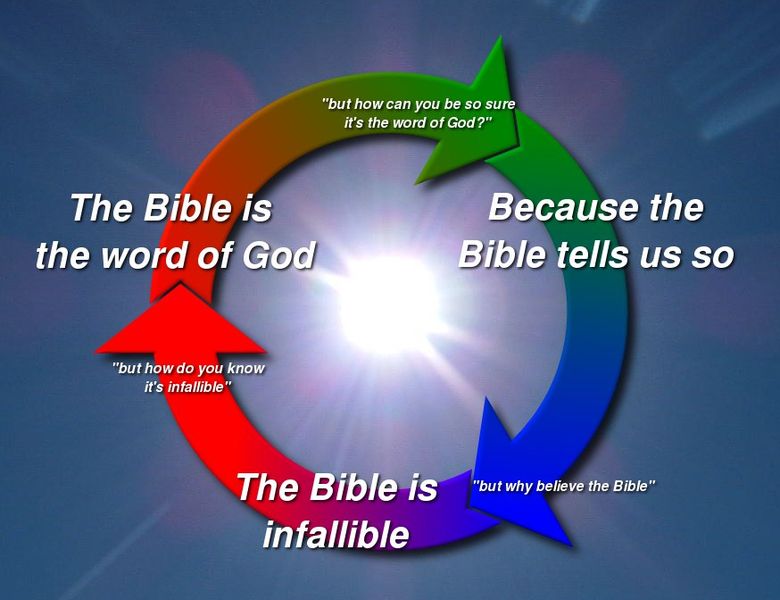
For most of the rest of the video, Nicky Gumbel, Toby, and Gemma try to use the Bible to prove the Bible’s own claims are true. This is so absurd that I’ll only note that someone could do the same thing to PROVE YES PROVE that Spider-Man is real or that Hogwarts is a real boarding school teaching real magic to (poorly-supervised) children.
No, the Bible cannot be both the claim and the support for the claim. But evangelicals know this, and we know they know it—because we just spent about 13 minutes watching them trying to manhandle history into their claims. (They even hilariously describe a circular stone in front of Jesus’ supposed tomb, when Jews were using square stones during his supposed lifetime!)
At 20 minutes in, Gemma and Toby also offer the common (and false) apologetics arguments about the supposed “four facts” of Jesus’ resurrection. I covered a similar argument back in 2014!
Here is the set this video uses:
1: The Gospels say Jesus’ tomb was open, so it totally was. Their picture at 20:13 even shows a round stone rolled away from a circular tomb entrance like it’s in Hobbiton or something. Of note, Jews in the 30s used square stones for rectangular entrances. But Alpha Course liked the image at 20:13 so much they reused it at 20:30!

2: The Gospels say Jesus appeared to his disciples after he resurrected himself, so he totally did. But strangely, not one of those people thought to write anything down about what they’d seen, or even to report it to someone else who could do it.
3: The Gospels talk about the disciples’ transformed lives post-Resurrection; none of those disciples would ever have died for a lie! First, none of those disciples appear anywhere outside of the Bible and its various apocryphal writings. Even if folklore about those disciples is correct, people can be sincerely wrong about their beliefs. Sometimes, people in other religions even die for refusing to recant their beliefs.
4: People still believe in Christianity today. So? Sometimes religions do last for thousands of years. Being long-lived doesn’t make a claim more true. Ancient Mesopotamian beliefs held strong for about 6500 years.
Three of the four “facts” here rely on circular reasoning—using the Gospels to prove the Gospels’ own claims about Jesus’ death, resurrection, and subsequent appearances to various followers. And the historical record doesn’t play nicely with those “facts” at all. As for the fourth, it’s a logical fallacy we could call the Appeal to Longevity.
In the course of all of this circular reasoning, Alpha Course’s presenters deploy a popular apologetics argument to really seal the deal.
Alpha Course sees nothing wrong with false dilemmas, either
At 11 minutes, we get a quote from Bono, the lead singer from U2. He says that Jesus got crucified because “he went around saying he was the Messiah.” So to Bono, Jesus either was what he said he was, in which case everyone needs to convert, or else “he was nuts.” Since Bono can’t imagine Jesus as being “nuts,” he thinks Jesus must be the Messiah.
This is a false dilemma, which is a common apologetics tactic. Here’s how it goes:
- Either this is true or that other thing is true.
- They can’t both be true.
- I don’t personally like that other thing.
- Therefore, this is true.
Often, however, more options exist than just those two. And perhaps neither is true. Worse, perhaps the more painful option is, after all, true.
But Alpha Course goes for broke on this fallacy. They even name-drop its most famous form, C.S. Lewis’ “Liar, Lunatic, or Lord” trilemma.
![A man who was merely a man and said the sort of things Jesus said would not be a great moral teacher. He would either be [insane]... or else he would be the devil of Hell. You must make your choice.](https://rolltodisbelieve.com/wp-content/uploads/2025/06/CS-Lewis-false-trilemma-liar-lunatic-lord.png)
The argument usually goes that if Jesus wasn’t really a godling, then he must be either a lunatic or a liar. But are those really all our choices? No, they aren’t.
In 1997, some Taiwanese cultists went to Vancouver, BC with their “Jesus of the East” to meet up with the prophesied “Jesus of the West.” They hung around the Vancouver airport for a long while before going home in defeat. At the time I saw the newspaper stories about their wait, these Christians seemed to very sincerely believe their claims were true. They didn’t seem to be lying, evil, or insane. They were sincere, but nonetheless they were wrong—just like many Christians are today and as Jesus himself might have been.
Wrapping up Alpha Course Video #2: The faith pool of Nicky Gumbel
At 22 minutes in, Nicky Gumbel reappears to assert that Jesus totally was a man “whose identity was God.” And nope: Jesus never once directly says who and what he really is in the Gospels. The Book of John comes closest there, but it was written really late compared to the other three canonical gospels.
Nonetheless, Gumbel lumbers onwards to describe how his belief went from his head to his heart, and then he asserts that viewers can have the same exact experience.
He’s describing a concept we talk about a lot around here: the faith pool. Once we receive evidence that we think is compelling about a claim, a faucet turns on and starts feeding water to the claim’s faith pool. A drain in the pool represents reality itself, which constantly contradicts religious claims about the supernatural. Once the level of the water is high enough despite that drain’s presence, we start believing.
Conversely, when we find out one of the underpinnings of our beliefs isn’t true, its faucet turns off. If enough faucets turn off quickly enough, the drain will work faster than the faucets, the water will drain away, and we’ll stop believing.
So belief and disbelief aren’t choices people make. Rather, they are responses sparked in us by compelling evidence—or a lack thereof.
Nicky Gumbel’s faith pool is fed by circular reasoning, bad apologetics, a mangled understanding of history, an authoritarian need to follow a leader, and a need for certainty and correctness. That is what adds up to compelling evidence for him. Evangelicals gave him all of that, and so he is evangelical.
I can see why Gumbel bristles so hard in the first video about people saying they’re glad Christianity works for him, but it doesn’t for them. That’s a serious problem for him! One of his faucets is labeled “this works for every human on Earth.” So it failing to work for everyone is a reality that directly contradicts his beliefs.
However, he needs to deal with that on his own time. It’s not anyone’s problem but his own.
Alpha Course so far has been quite a disappointment in terms of offering any new or different reasons to buy into Christianity. Its arguments are literally decades old and its misunderstanding of history is childish to say the least. There’s nothing new here. Nobody at the watch party was impressed.
But it’s still very funny for those exact same reasons. I was laughing my ass off at the tomb thing from Jerusalem—what a ridiculously stupid claim to make when the facts are all right at hand about what shape of stone would have been in front of a Jewish tomb in Jerusalem in 33CE!
I highly encourage everyone to see this video series. It’s the best evangelicals can muster in terms of persuasion. And I mean that very literally.
NEXT UP: 9Marks, a hardline Calvinist resource group for pastors, has officially diagnosed what’s wrong with the Southern Baptist Convention! We’ll check it out next week – stay tuned! <3
Please support my work!
Thanks for reading, and thanks for being part of our community! Here are some ways you can support my work:



1 Comment
Alpha Course #3 and a non-answer about 'Why Jesus Died' - Roll to Disbelieve · 07/11/2025 at 4:00 AM
[…] Last time, we talked about the main problem the Gospels face: […]